Interactive Web Edition

Classic Problems in Magnetohydrodynamics

These notes grew out of graduate lectures on magnetohydrodynamics given without pretending that fusion, space physics, and astrophysics are separate intellectual worlds. One of the pleasures of MHD is that the same equations reappear in liquid-metal experiments, in tokamaks and reversed-field pinches, in the solar wind, in planetary interiors, and in accretion flows.

This web edition keeps that spirit, but adds interactive explorers, movies, and stitched navigation so the classic problems can be approached from several directions at once: derivation, geometry, experiment, and physical intuition.

This edition also comes with a full disclosure. At the beginning of the Spring 2026 semester, I treated the project as an experiment in what was actually possible with ChatGPT: I fed in handwritten lecture notes from roughly fifteen years earlier, and the OCR-plus-editorial pipeline produced a remarkably faithful LaTeX draft of about two hundred pages. From there I filled in missing derivations, repaired notation, expanded the history, and continued developing both the notes and the web edition in active collaboration with ChatGPT.

A theoretical result does not become fully intelligible until it has been reconstructed at least once. These notes are therefore organized around problems rather than formalism alone, and the algebra is carried far enough that the approximations, balances, and experimental consequences stay visible.

Cary Forest
Department of Physics, University of Wisconsin--Madison
Copyright © 2026 Cary Forest. All rights reserved.

How to use these notes

They are modular by design. You can read them linearly, but they also work as a problem-driven reference. Readers interested in equilibrium and stability can move quickly into tokamak geometry and kink/ballooning theory; readers drawn to astrophysical applications may prefer dynamos, shocks, solar wind, and reconnection.

What to expect

  • historical context alongside modern derivations
  • explicit intermediate algebra rather than only final formulas
  • experimental perspective whenever possible
  • interactive companion tools for selected lectures
Overview

The current web edition covers Lectures 0 through 42, from the opening foundations through equilibrium, waves, kinetic MHD, interchange, kinks, TAEs, ballooning modes, tearing, helicity, reconnection, shocks, and the late-book appendices.

If you want a printable version, use the PDF edition linked above. For a long-lived archive record, use the Zenodo project DOI 10.5281/zenodo.20140830.

How to cite these notes

Preferred citation: Cary Forest, Classic Problems in Magnetohydrodynamics: Interactive Web Edition (University of Wisconsin--Madison, 2026), magnetohydrodynamics.physics.wisc.edu, project DOI 10.5281/zenodo.20140830.

Zenodo DOI: 10.5281/zenodo.20140830

Source / release record: github.com/cbforestWI/Classic-Problems-in-MHD

From the preface

These notes grew out of graduate lectures organized around the idea that fusion, space physics, astrophysics, and liquid-metal MHD are not separate intellectual worlds. The same equations reappear in all of them; what changes is the dominant balance, the closure, and the physical intuition needed to use them well.

The current manuscript also has an unusual provenance. It began this semester as an experiment in whether handwritten lecture notes from about fifteen years ago could be recovered through OCR and turned into a serious LaTeX draft with ChatGPT. That first transcription was unexpectedly successful, and the present edition was then expanded, corrected, and reorganized through a continuing human-AI collaboration.

I have also come to believe that a subject becomes memorable when it is organized around problems rather than around formalism alone. That is why these notes are built around flux freezing and its failure, equilibrium and force balance, waves, stability, dynamos, self-organization, reconnection, shocks, and the geometric and topological constraints that make magnetized fluids both elegant and dangerous.

Books, notes, and people I learned from

These lectures lean heavily on the classical literature and on a long line of excellent books and notes, especially Cowling, Chandrasekhar, Roberts, Hide, Moffatt, Kulsrud, Miyamoto, Freidberg, Schnack, Bellan, Wesson, Krall and Trivelpiece, and Zohm.

Russell Kulsrud deserves a special note here. I first learned MHD in my first year at Princeton, in the spring of 1987 at the Graduate Program in Plasma Physics, from Russell himself. His kinetic-MHD notes were very much on his mind at the time, and they helped shape the way I first encountered the subject. Later I learned a great deal more from him as I moved into experimental dynamo work, and then again from his textbook, which remains one of the clearest guides to how plasma physics, kinetic thinking, and MHD fit together.

These notes also reflect material learned from conversations, classes, blackboards, and draft notes, including ideas and derivations I learned from Dalton Schnack, Steve Cowley, Alex Schekochihin, Dmitri Ryutov, and many others.
A note to readers

These notes are still evolving. Some lectures are more polished than others, some topics are treated in more depth than others, and there will certainly be mistakes, omissions, awkward explanations, and places where a clearer path through the physics is still needed.

If you notice an error, a weak derivation, a broken reference, or have a suggestion for improving the notes or the web edition, please contact Cary Forest or open an issue through the GitHub site repository. Corrections and suggestions are genuinely welcome.

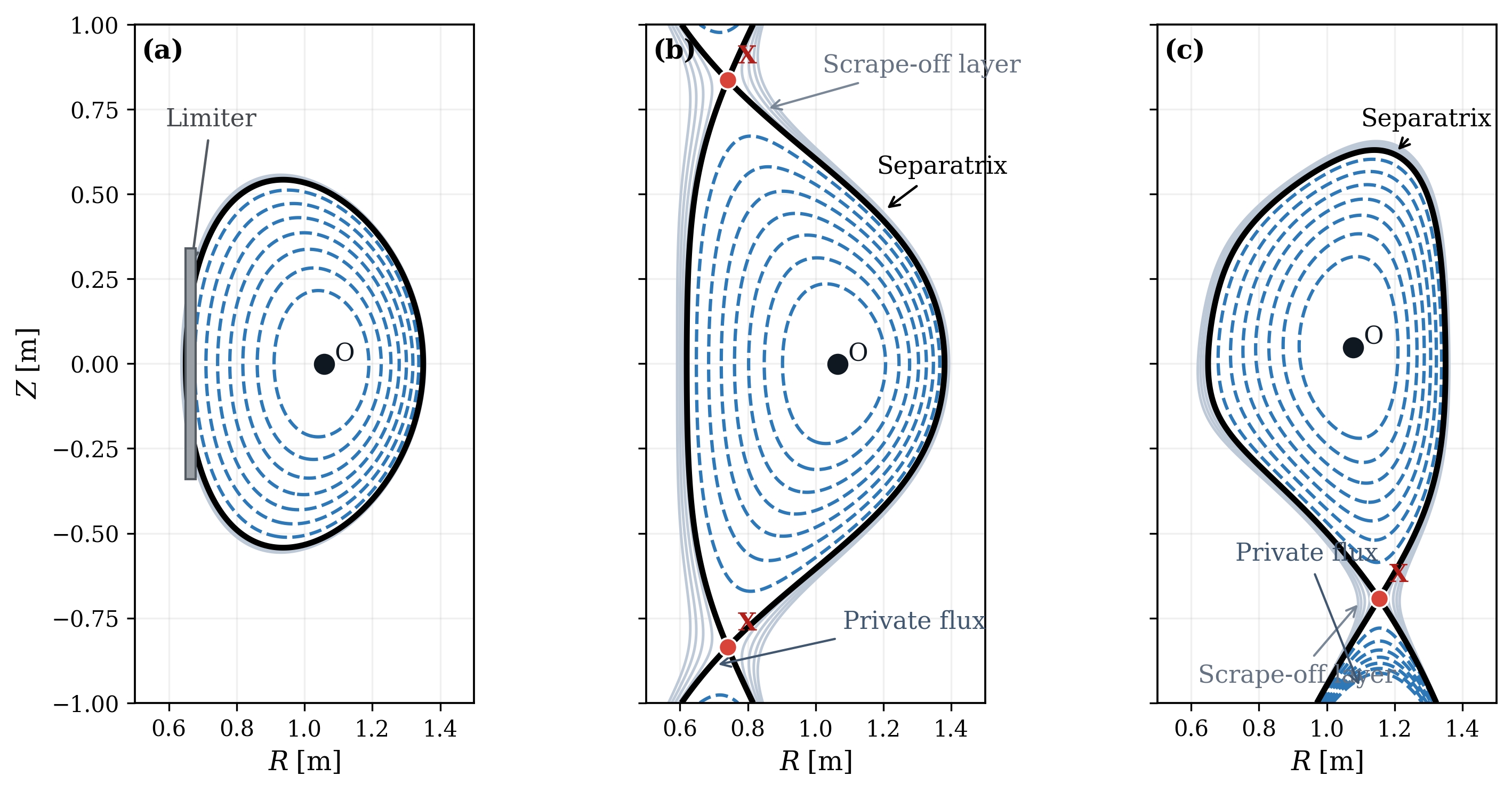
Shaped flux surfaces and analytic equilibrium familiesEquilibrium and shapingAnalytic Grad-Shafranov structure, shaping, reconstruction, and the geometry of confined plasmas.
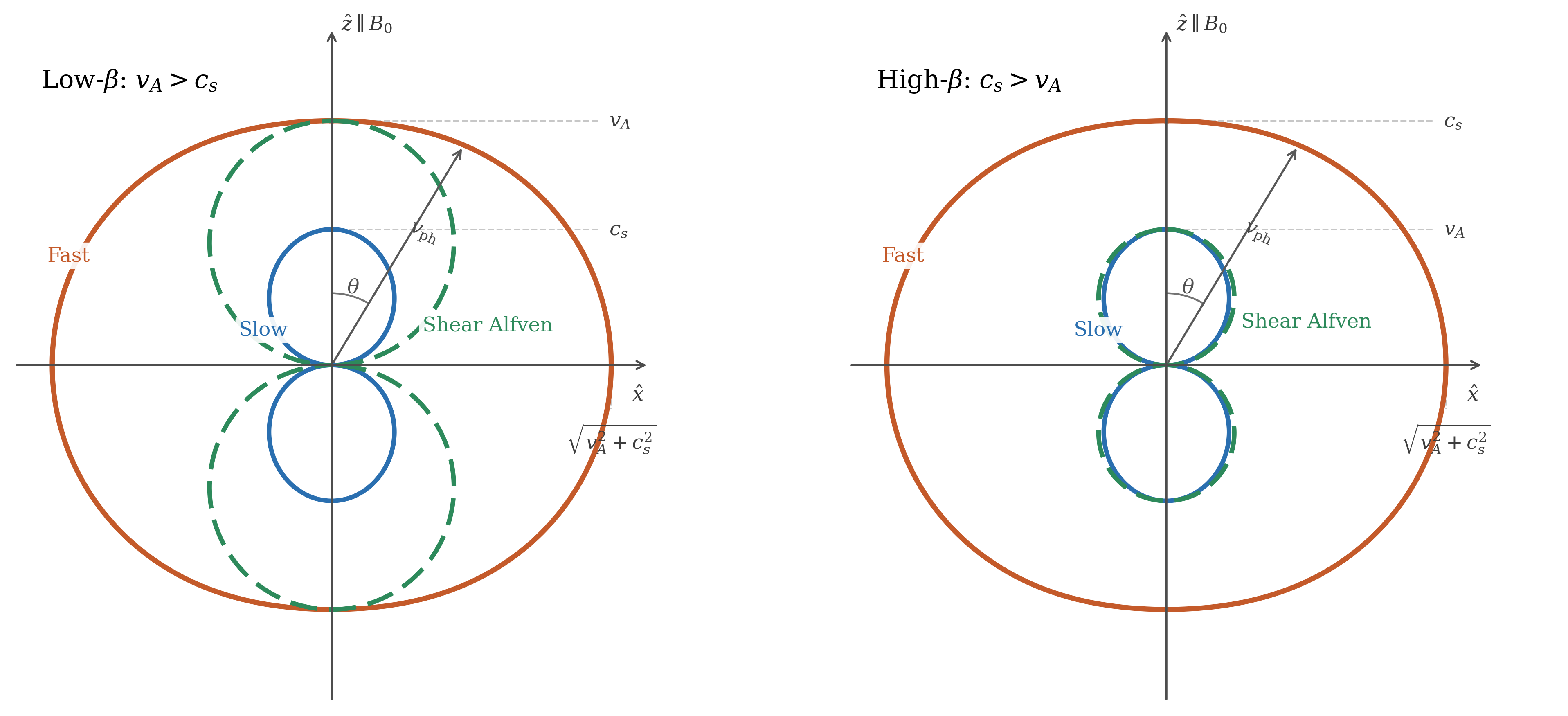
Polar Alfvén-wave branch structureWaves and continuaFrom basic Alfvén-wave geometry to toroidal continua, gaps, and energetic-particle-driven mode structure.
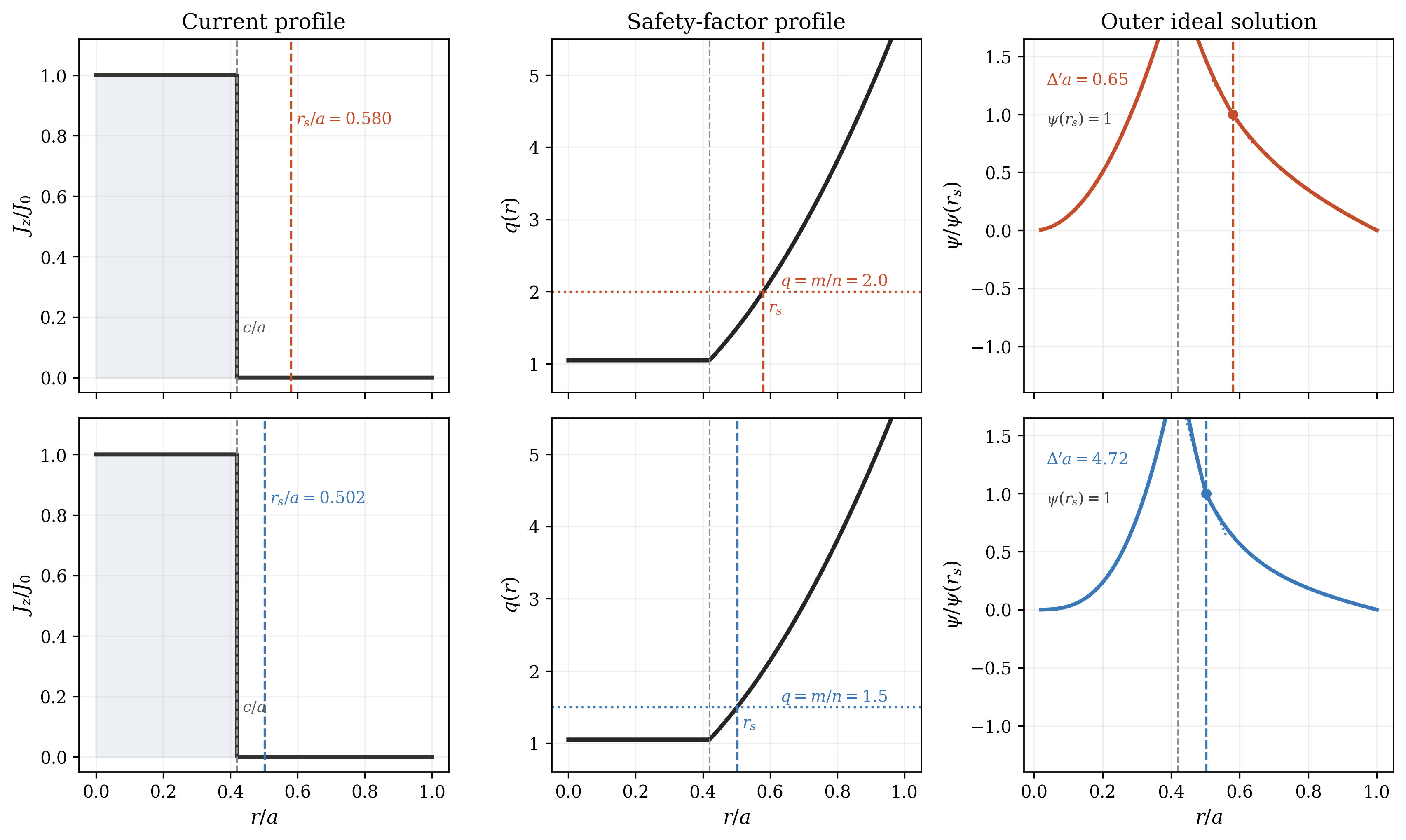
Tearing-mode current and flux profilesRelaxation and reconnectionTearing, helicity, self-organization, and the ways magnetic topology changes when ideal constraints fail.

Foundations

Begin with impedance matching, one-fluid MHD, Braginskii closure, and CGL if you want the assumptions and limits made explicit from the start.

Equilibrium

Jump to the Grad-Shafranov sequence for force balance, tokamak shaping, reconstruction, and the equilibrium logic behind later stability theory.

Stability

Follow the ladder from interchange and kinks through internal kink, TAE, ballooning, and resistive instabilities, with explorers attached to many of the central cases.

Applications

Liquid-metal flows, solar wind, disc winds, dynamos, shocks, and reconnection show how the same equations reorganize themselves in very different physical settings.

Contents

Part I: Foundations
Lecture 0 Impedance Matching: The Background You Already Have
Lecture 1 Foundations of MHD
Lecture 2 Flux Freezing and the Ideal MHD Limit
Lecture 3 Braginskii Closure and the Validity of MHD
Lecture 4 CGL: Collisionless, Anisotropic MHD
Part II: Classical Examples and Applications
Lecture 5 Hartmann Flow
Lecture 6 The Solar Wind and Parker Spiral: Dynamic Equilibrium
Lecture 7 Disc Driven Winds and Magnetic Towers
Lecture 8 Dynamos
Part III: Equilibrium
Lecture 9 Grad's Equilibrium Analysis
Lecture 10 The Grad-Shafranov Equation and the Solov'ev Solution
Lecture 11 The Shafranov Shift
Lecture 12 Equilibrium Reconstruction and Properties
Part IV: Waves and the Energy Principle
Lecture 13 The Energy Principle
Lecture 14 Alfvén Waves
Lecture 15 Kinetic MHD: Collisionless Pressure Response
Lecture 16 Gravitational Interchange
Lecture 17 The Magnetorotational Instability
Part V: Pressure- and Current-Driven Stability
Lecture 18 Magnetic Interchange
Lecture 19 FLR Stabilization: Roberts-Taylor Extended MHD
Lecture 20 The Kruskal-Shafranov Kink Mode
Lecture 21 Newcomb's Formulation for the Diffuse Pinch
Lecture 22 External Kink Modes
Lecture 23 Suydam and Mercier: Local Pressure-Driven Stability Tests
Lecture 24 The current-driven internal kink mode: Rosenbluth, Dagazian, and Rutherford
Lecture 25 Bussac: The Toroidal \(n=1\) Internal Kink
Lecture 26 Toroidal Alfvén Eigenmodes
Lecture 27 Ballooning Modes
Part VI: Resistive Relaxation, Reconnection, and Self-Organization
Lecture 28 Furth, Killeen and Rosenbluth: Tearing Modes
Lecture 29 Coppi, Greene, and Johnson: Resistive Interchange
Lecture 30 Magnetic Helicity, Relaxation, and Self-Organization
Lecture 31 Magnetic Reconnection
Part VII: Shocks and Discontinuities
Lecture 32 Shocks
Appendices: Advanced Topics and Appendices
Lecture 33 Hydrostatic and Thermal Equilibrium of the Sun
Lecture 34 Inertial Confinement Fusion: Adiabatic Compression and Shock Heating
Lecture 35 Kinetic examples for \(p_\perp (\psi ,B)\) and \(p_\parallel (\psi ,B)\)
Lecture 36 Self-Adjointness of the Ideal-MHD Force Operator
Lecture 37 The Reversed-Field Pinch
Lecture 38 Motion, Moving Walls, and Shear in MHD Stability
Lecture 39 Ferritic thin wall and the ferromagnetic wall mode
Lecture 40 Matched Inner Tearing-Mode Solution for \(y''=-x(1-xy)\)
Lecture 41 The 2-D Toroidal Energy Principle and the High-\(n\) Ballooning Limit
Lecture 42 Resistive Modes of a Sheet Pinch