Lecture 22
External Kink Modes
Overview
Only after the fixed-boundary problem has been cleared does it make sense to let the
plasma edge move. In the external problem \(\xi _a\) is free, the vacuum and wall contribute to
\(\delta W\), and instability occurs when the full plasma-plus-vacuum functional becomes negative
for a mode with \(\xi _a\neq 0\).
Historical Perspective
The external kink is where Newcomb’s framework becomes practically important. The
interior solution alone is not enough; one must also solve the vacuum problem and
impose the wall boundary condition. That logic, already clear in cylindrical pinch theory,
carried directly into tokamak design: internal profiles determine whether a regular plasma
solution exists, while the vacuum region and conducting structures decide whether the
boundary can bulge outward. That is one reason this sequence of lectures is so central
historically.
22.1 Vacuum energy and the surface form of \(\delta W\)
Vacuum field.
Let the plasma occupy \(0\le r\le a\), with vacuum in \(a<r<b\) and a perfectly conducting wall at \(r=b\). In vacuum,
\[\B _1 = -\grad \Phi , \qquad \lap \Phi = 0. \tag{22.1}\]
For a single helical harmonic, \[\Phi (r,\theta ,z)=\phi (r)e^{i(m\theta +kz)}, \tag{22.2}\]
so \[\frac {1}{r}\dd {}{r}\left (r\dd {\phi }{r}\right ) - \left (\frac {m^2}{r^2}+k^2\right )\phi =0. \tag{22.3}\]
The exact finite-\(k\) solutions are modified Bessel functions. For the large-aspect-ratio kink problem, however,
\(|ka|\ll 1\), and it is more useful to display the long-wavelength form immediately: \[\phi (r)=A r^{|m|}+B r^{-|m|}. \tag{22.4}\]
Wall condition.
At a perfectly conducting wall,
\[B_{1r}(b)=-\pp {\Phi }{r}\bigg |_{r=b}=0 \qquad \Longrightarrow \qquad \phi '(b)=0. \tag{22.5}\]
Applying (22.5) to (22.4) gives \[B = A\,b^{2|m|},\]
so that \[\phi (r)=A\left (r^{|m|}+b^{2|m|}r^{-|m|}\right ).\]
Matching at the plasma boundary.
At \(r=a\), ideal MHD requires
\[B_{1r}(a)= iF(a)\,\xi _a. \tag{22.8}\]
Since \(B_{1r}(a)=-\phi '(a)e^{i(m\theta +kz)}\), \[-\phi '(a)=iF(a)\,\xi _a. \tag{22.9}\]
This fixes the constant \(A\), and evaluating the vacuum magnetic energy then produces a pure boundary term,
\[\delta W_v = \frac {\pi }{\muo }\,\frac {a^2F^2(a)}{|m|}\,\Lambda _m\,|\xi _a|^2, \tag{22.10}\]
where \[\Lambda _m = \frac {1+\alpha _m}{1-\alpha _m}, \qquad \alpha _m\equiv \left (\frac {a}{b}\right )^{2|m|}. \tag{22.11}\]
The no-wall limit is \(\Lambda _m\rightarrow 1\).
Full reduced functional.
Including the plasma term (21.92), the total energy is
\[\frac {\delta W}{2\pi ^2 R_0/\muo } = \int _0^a\left (f|\xi '|^2+g|\xi |^2\right )dr + \left [ \left (\frac {FF^\dagger }{k_0^2}\right )_{r=a} + \frac {a^2F^2(a)}{|m|}\Lambda _m \right ]|\xi _a|^2. \tag{22.12}\]
This is the master expression for the external ideal problem.
22.2 From the internal solution to the surface energy
What is assumed at this stage.
At this point the local pressure-driven tests of Lecture 23 have been passed and the fixed-boundary
internal problem of Lecture 24 has no unstable mode. One now reopens the variational problem by
allowing the edge displacement \(\xi _a\) to be nonzero and by keeping the vacuum term in (22.12).
Convert the bulk term to a boundary term.
Starting from
\[I\equiv \int _0^a\left (f|\xi '|^2+g|\xi |^2\right )dr,\]
use (21.99) in the form \(g\xi =(f\xi ')'\): \[I = \int _0^a \left (f|\xi '|^2+(f\xi ')'\xi ^*\right )dr = \left [f\,\xi '\,\xi ^*\right ]_0^a .\]
Regularity makes the \(r=0\) term vanish, so \[\int _0^a\left (f|\xi '|^2+g|\xi |^2\right )dr = f(a)\,\xi _a'\,\xi _a^*. \tag{22.15}\]
Substituting (22.15) into (22.12) yields the pure surface form \[\frac {\delta W}{2\pi ^2 R_0/\muo } = \left [ \left (\frac {F^2}{k_0^2}\frac {r\xi '}{\xi }\right )_{r=a} + \left (\frac {FF^\dagger }{k_0^2}\right )_{r=a} + \frac {a^2F^2(a)}{|m|}\Lambda _m \right ]|\xi _a|^2. \tag{22.16}\]
Everything has now been reduced to the boundary behavior of the minimizing interior solution.
Caution
Equation (22.16) is powerful precisely because it hides the labor in the interior problem.
The ratio \(a\xi '/\xi \) at the boundary is not arbitrary. It encodes the entire internal profile through
the solution of (21.99). Also, the sign of \(\xi _a\) is just a normalization choice: the external
question is whether the free-boundary problem admits \(\xi _a\neq 0\) with total \(\delta W<0\).
22.3 External kink and the role of the wall
No-wall \(m=1\) limit.
If the plasma is internally stable and \(m=1\), the minimizing interior eigenfunction is rigid to leading
order, so \(\xi '=0\) while the edge displacement \(\xi _a\) is now free to be nonzero. Using (22.16) with \(\Lambda _1=1\) gives
\[\frac {\delta W}{2\pi ^2 R_0/\muo } = \frac {2B_0^2 a^2}{R_0^2} \left (1-\frac {1}{q_a}\right )|\xi _a|^2. \tag{22.17}\]
Hence \[q_a>1\]
is the no-wall large-aspect-ratio external-kink threshold. This is exactly the same upper root that appeared
in the periodic Kruskal–Shafranov discussion, Eq. (20.39).
A completely explicit analytic profile.
To make the full wall problem transparent, take the simplest analytic current profile: constant \(q(r)=q_a\),
corresponding in the cylindrical model to a uniform axial current density. Then the factor \(\left (n-\frac {m}{q_a}\right )^2\) is constant, and
the Euler–Lagrange equation (21.99) becomes
\[\dd {}{r}\left (r^3\dd {\xi }{r}\right )-(m^2-1)r\,\xi =0. \tag{22.19}\]
Try a power law \(\xi \sim r^s\). Then \[s(s+2)=m^2-1,\]
so \[s=m-1 \qquad \text {or}\qquad s=-m-1.\]
Regularity at the axis selects \[\xi (r)\propto r^{m-1}, \qquad \frac {a\xi '(a)}{\xi (a)}=m-1. \tag{22.22}\]
Boundary energy for the analytic profile.
Insert (22.22) into (22.16). Using (24.6)–(24.7) and \(k_0^2a^2\simeq m^2\) gives
\[\begin{aligned}\frac {\delta W}{2\pi ^2 R_0/\muo } &= \frac {B_0^2a^2}{R_0^2 m^2 q_a^2} \Big [ (m-1)(nq_a-m)^2 + (n^2q_a^2-m^2) \nonumber \\ &\hspace {3.3cm} + m\Lambda _m (nq_a-m)^2 \Big ]|\xi _a|^2 .\end{aligned} \tag{22.23}\]
Now factor the bracket carefully:
\[\begin{aligned}&(m-1)(nq_a-m)^2+(n^2q_a^2-m^2)+m\Lambda _m(nq_a-m)^2 \nonumber \\ &\qquad = m(nq_a-m)\left [(\Lambda _m+1)(nq_a-m)+2\right ].\end{aligned}\]
Therefore
\[\frac {\delta W}{2\pi ^2 R_0/\muo } = \frac {B_0^2a^2}{R_0^2 m q_a^2} (nq_a-m)\left [(\Lambda _m+1)(nq_a-m)+2\right ]|\xi _a|^2. \tag{22.25}\]
Using (22.11), \[\Lambda _m+1 = \frac {2}{1-\alpha _m}, \qquad \alpha _m=\left (\frac {a}{b}\right )^{2m},\]
so (22.25) becomes \[\frac {\delta W}{2\pi ^2 R_0/\muo } = \frac {2B_0^2a^2}{R_0^2 m q_a^2(1-\alpha _m)} \, (nq_a-m) \left [nq_a-\left (m-1+\alpha _m\right )\right ] |\xi _a|^2. \tag{22.27}\]
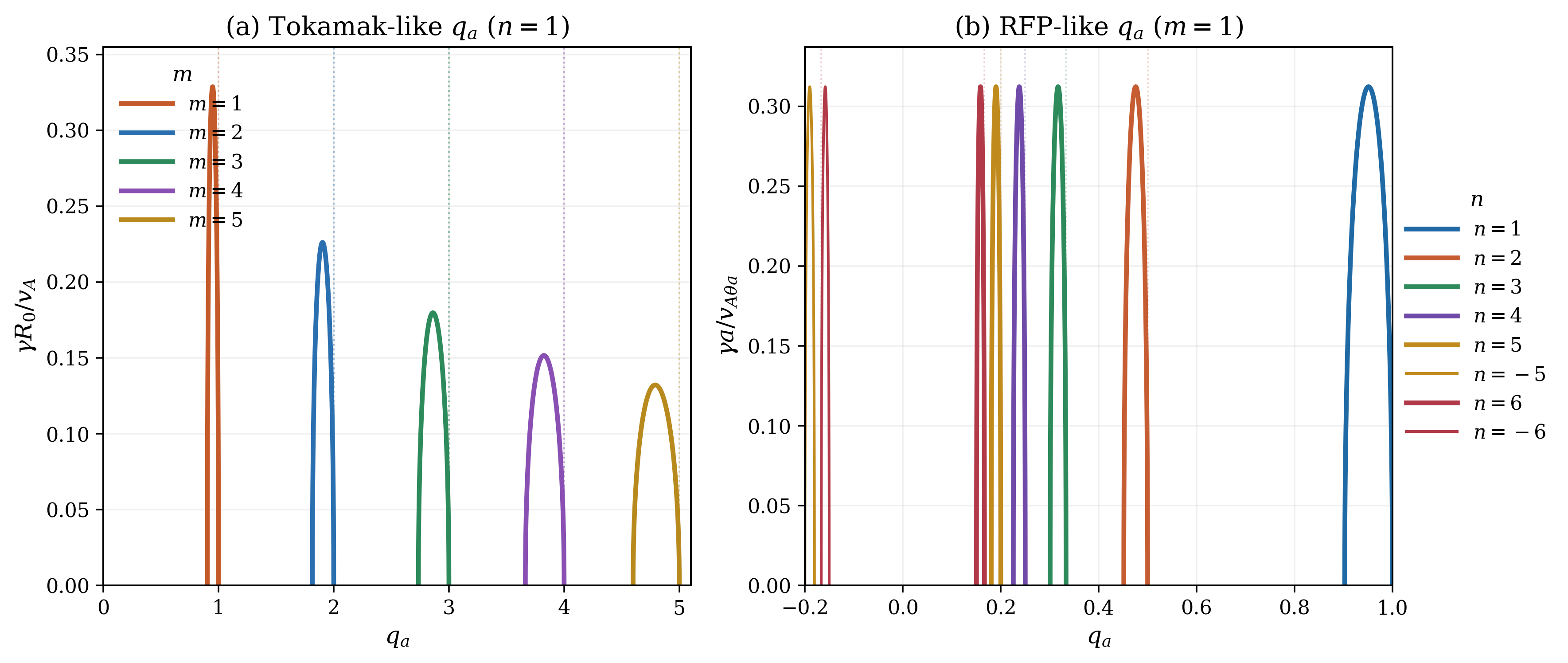
Hence the ideal external mode is unstable only in the interval \[m-1+\alpha _m < nq_a < m, \qquad \alpha _m=\left (\frac {a}{b}\right )^{2m}, \tag{22.28}\]
or, equivalently, \[\boxed { \frac {m-1+\left (a/b\right )^{2m}}{n}<q_a<\frac {m}{n}. } \tag{22.29}\]
Separate the no-wall and wall pieces.
For the resistive-wall analysis, write the ideal-wall result as
\[\delta W_{\rm ideal}(b)=\delta W_\infty ^{\rm tok}+\delta W_b^{\rm tok}. \tag{22.30}\]
Setting \(\alpha _m=0\) in (22.27) gives the no-wall energy \[\frac {\delta W_\infty ^{\rm tok}}{2\pi ^2 R_0/\muo } = \frac {2B_0^2a^2}{R_0^2 m q_a^2} \, (nq_a-m)\left [nq_a-(m-1)\right ] |\xi _a|^2, \tag{22.31}\]
while the wall contribution is the difference \[\frac {\delta W_b^{\rm tok}}{2\pi ^2 R_0/\muo } = \frac {2B_0^2a^2}{R_0^2 m q_a^2} \, \frac {\alpha _m}{1-\alpha _m}(nq_a-m)^2 |\xi _a|^2. \tag{22.32}\]
The resistive-wall regime is the strip \[m-1<nq_a<m-1+\alpha _m, \tag{22.33}\]
where \(\delta W_\infty ^{\rm tok}<0\) but \(\delta W_{\rm ideal}(b)=\delta W_\infty ^{\rm tok}+\delta W_b^{\rm tok}>0\).
Connection back to Kruskal–Shafranov.
For \(m=n=1\), Eq. (22.29) reduces to
\[\left (\frac {a}{b}\right )^2<q_a<1,\]
which is exactly the periodic ideal-wall stability band derived earlier in Eq. (20.62). For general \((m,n)\) the same
algebra produces a band immediately below each rational value \(q_a=m/n\). This is the diffuse-profile version of the
same story: the wall introduces a second root, and that second root is what creates the stability
window.
Interactive External-Kink Explorer
Open a browser companion to the external-kink lecture. The app reproduces the lecture’s ideal-wall constant-\(q\) bands in \(q_a\), then replaces the analytic interior with a smooth tokamak current profile fixed by \(q_0\) and \(q_a\) so the edge logarithmic derivative \(a\xi\prime(a)/\xi(a)\) comes from a numerical Newcomb solve.
Open the external-kink explorer
Kinetic energy and growth rate.
For a normal mode with time dependence \(e^{\gamma t}\), the ideal-MHD energy principle gives
\[\delta W + \gamma ^2 \mathcal {K} = 0, \qquad \mathcal {K} \equiv \frac 12 \int \rho \, |\bm {\xi }|^2\, dV .\]
For the analytic constant-\(q\) profile, the regular internal solution is \[\xi _r(r) = \xi _a \left (\frac {r}{a}\right )^{m-1}.\]
If we approximate the inertia by the dominant radial displacement and take uniform density, then \[\begin{aligned}\mathcal {K} &= \frac 12 \int _0^{2\pi } d\theta \int _0^{2\pi R_0} dz \int _0^a \rho \, |\xi _r|^2\, r\,dr \nonumber \\ &= 2\pi ^2 R_0 \rho \int _0^a |\xi _a|^2 \left (\frac {r}{a}\right )^{2m-2} r\,dr \nonumber \\ &= \frac {\pi ^2 \rho R_0 a^2}{m}\, |\xi _a|^2.\end{aligned}\]
Using Eq. (22.27),
\[\delta W = \frac {4\pi ^2 B_0^2 a^2}{\mu _0 R_0\, m q_a^2(1-\alpha _m)} \, (nq_a-m)\left [nq_a-(m-1+\alpha _m)\right ] |\xi _a|^2, \qquad \alpha _m=\left (\frac {a}{b}\right )^{2m}.\]
Therefore \[\gamma ^2 = -\frac {\delta W}{\mathcal {K}} = -\frac {4 B_0^2}{\mu _0 \rho R_0^2 q_a^2(1-\alpha _m)} \, (nq_a-m)\left [nq_a-(m-1+\alpha _m)\right ].\]
Writing \(v_A^2 = B_0^2/(\mu _0 \rho )\), this becomes \[\boxed { \left (\frac {\gamma R_0}{v_A}\right )^2 = \frac {-4 (nq_a-m)\left [nq_a-(m-1+\alpha _m)\right ]} {q_a^2(1-\alpha _m)} } \qquad \left (\alpha _m=\left (\frac {a}{b}\right )^{2m}\right ).\]
Hence instability requires \(\gamma ^2>0\), i.e. \[\frac {m-1+\alpha _m}{n} < q_a < \frac {m}{n}.\]
The resistive-wall continuation.
Once the shell conductivity is finite, the ideal-wall increment \(\delta W_b^{\rm tok}\) is only partially restored. The thin-wall
interpolation and dispersion relation derived in the Kruskal–Shafranov lecture, Eqs. (20.107) and (20.110),
therefore give
\[\gamma \tau _w = -\frac {2b^2}{b^2-a^2} \frac {\delta W_\infty ^{\rm tok}}{\delta W_{\rm ideal}(b)}. \tag{22.42}\]
That is the slow RWM branch sitting just below the ideal-wall threshold. The same bookkeeping
will reappear in Appendix E, where Eqs. (E.44) and (E.45) give the corresponding \(m=1\) RFP
energies.
Constant-\(\lambda \) RFP analogue.
The force-free Taylor equilibrium \(\curl \B =\lambda \B \) gives the RFP companion to the analytic constant-\(q\) exercise.
Appendix E works the derivation through explicitly, starting from the Bessel core (E.26) and the edge
safety-factor relation (E.32) and ending at Eqs. (E.37)–(E.42). In the same rigid-core \(m=1\) approximation used
here, the result can be written as
\[\frac {\delta W_{m=1}^{\rm RFP}}{2\pi ^2 R_0/\muo } \simeq \frac {2B_{\theta a}^2}{1-\alpha _1} \,(nq_a-1)(nq_a-\alpha _1)\,|\xi _a|^2, \qquad \alpha _1=\left (\frac {a}{b}\right )^2, \tag{22.43}\]
with \(B_{\theta a}\equiv B_\theta (a)\). For a uniform-density rigid core, \[\left (\frac {\gamma a}{v_{A\theta a}}\right )^2 \simeq \frac {-4 (nq_a-1)(nq_a-\alpha _1)}{1-\alpha _1}, \qquad v_{A\theta a}^2\equiv \frac {B_{\theta a}^2}{\mu _0\rho }. \tag{22.44}\]
So the same surface-energy logic predicts a low-\(q\) RFP band \(\alpha _1<nq_a<1\): the qualitative difference is that \(q_a<1\) lets several
toroidal harmonics fit below the same upper root.
What these analytic profiles are good for.
The constant-\(q\) profile is not the only choice. A constant-\(\lambda \) force-free profile leads to the familiar
Bessel-function equilibrium, and its RFP free-boundary reduction is worked through in Appendix E,
Eqs. (E.28)–(E.50). For the variational logic in the tokamak setting, the constant-\(q\) example is hard to beat
because it makes the boundary ratio \(a\xi '/\xi \) analytic and therefore makes the stability bands, the no-wall/wall
split, and the RWM continuation completely explicit.
22.4 From external kink to peeling modes
Why the edge problem is different.
The external-kink calculation above treated the current profile as broad and the mode as a global
boundary distortion. The edge of an H-mode tokamak is different. There the pressure pedestal produces a
narrow region of strong parallel current density, usually a mixture of Ohmic, bootstrap, and
Pfirsch–Schlüter current. A minimal sketch is
\[j_\parallel (r) = j_{\rm core}(r) + j_{\rm edge}\, \exp \!\left [-\frac {(a-r)^2}{\Delta _{\rm ped}^2}\right ], \qquad \Delta _{\rm ped}\ll a. \tag{22.45}\]
If the free energy is concentrated in this narrow outer layer, the minimizing ideal mode no longer looks like
a broad external kink. It becomes radially localized at the edge and tries to peel the outer flux surfaces
away from the core. That is why the tokamak edge literature calls it a peeling mode in the
classic large-aspect-ratio edge literature of Connor et al. (1998); Wilson et al. (1999); Snyder
et al. (2002).
What changes in the energy balance.
In the cylindrical lecture the competition was between line bending, vacuum matching, and current drive
at the moving edge. In the toroidal edge problem the bookkeeping becomes
\[\delta W_{\rm edge} \sim \delta W_{\rm bend} \;+\; \delta W_{\rm vac} \;+\; \delta W_{\rm Mercier} \;-\; \delta W_{j_\parallel (a)} . \tag{22.46}\]
The first two terms are the same stabilizing ingredients already familiar from the external kink.
The last term is the destabilizing work done by the edge-localized parallel current. The new
ingredient is \(\delta W_{\rm Mercier}\): once toroidal curvature and pressure-gradient effects are retained, the same
Mercier/Suydam physics that later appears in the ballooning lecture contributes already here.
In the large-aspect-ratio edge theory of Connor, Hastie, Wilson, and Miller, finite positive
edge current is destabilizing, magnetic shear and vacuum energy are stabilizing, and the edge
pressure gradient contributes a stabilizing Mercier-like term for the pure peeling branch Connor
et al. (1998).
How the Newcomb analysis must be extended.
The one-dimensional structure still begins from the ideal Euler–Lagrange equation
\[(f\xi ')'-g\xi =0, \tag{22.47}\]
but three extra pieces of physics must now be built into the coefficients and matching.
-
1.
- The equilibrium profiles \(p(r)\), \(q(r)\), and \(j_\parallel (r)\) must be allowed to vary strongly across the pedestal, so the
boundary ratio \(a\xi '(a)/\xi (a)\) is controlled by a thin edge layer rather than by a broad core solution.
-
2.
- Toroidal curvature terms must be retained, because the pressure gradient no longer acts only as
ballooning drive; it also enters the localized peeling criterion through a Mercier-like stabilizing
contribution.
-
3.
- A single cylindrical harmonic is no longer enough. Just as in the TAE chapter, toroidicity couples
neighboring poloidal harmonics, so the edge problem is more naturally written as a banded
system for \(\{\xi _{m-1},\xi _m,\xi _{m+1},\dots \}\), with the vacuum term still imposed at the plasma boundary.
Thus the real peeling problem is not a new instability in a new language. It is the external kink revisited
for an edge-peaked current profile in toroidal geometry.
What is worth showing in these notes.
For the purposes of these lecture notes, the important physics can be conveyed without reproducing the
full pedestal formalism. One can show that replacing the broad constant-\(q\) profile by an edge current layer
(22.45) pushes the minimizing external-kink eigenfunction toward the boundary and makes the mode
radially localized. The result is an ideal current-driven external kink with finite displacement at the edge
and strong sensitivity to \(j_\parallel (a)\), magnetic shear, and the vacuum region outside the plasma. That is the clean
bridge to the modern pedestal picture.
Connection to peeling–ballooning and ELMs.
At finite toroidal mode number the edge-current branch does not remain isolated. It couples to the
pressure-driven ballooning branch, producing the peeling–ballooning modes that are widely used to
interpret type-I ELM limits in H-mode pedestals Wilson et al. (1999); Snyder et al. (2002). The
ballooning lecture should therefore be read as the pressure-gradient side of the same edge-stability story.
There the emphasis shifts from \(j_\parallel (a)\) to curvature, magnetic shear, and field-line localization; here the key
message is that a sufficiently large edge current can turn the external kink into an edge-localized,
current-driven peeling mode.
Takeaways
This four-lecture sequence is the real payoff of Newcomb’s framework. We find:
-
1.
- a one-dimensional variational formulation for the screw pinch;
-
2.
- local pressure-driven tests (Suydam and Mercier);
-
3.
- the fixed-boundary \(m=1\) internal kink when \(q_0<1\);
-
4.
- external kink bands below each rational \(q_a=m/n\) once the wall solution is kept, together with
the slow resistive-wall continuation when only a fraction of the ideal-wall increment
survives;
-
5.
- in toroidal edge geometry, the same current-driven external-kink physics reappears
as an edge-localized peeling branch, which later couples to ballooning modes in the
pedestal.
The wall does not merely shift a number. It changes the factorization of \(\delta W\) and introduces
a second root. That is exactly why the diffuse-pinch problem is richer than the
surface-current Kruskal–Shafranov model while still remaining close enough to it to teach
from.
Bibliography
J. W. Connor, R. J. Hastie, H. R. Wilson, and R. L. Miller. Magnetohydrodynamic stability of tokamak edge plasmas. Physics of Plasmas, 5(7):2687–2700, 1998. doi:10.1063/1.872956.
H. R. Wilson, J. W. Connor, A. R. Field, S. J. Fielding, R. L. Miller, L. L. Lao, J. R. Ferron, and A. D. Turnbull. Ideal magnetohydrodynamic stability of the tokamak high-confinement-mode edge region. Physics of Plasmas, 6(5):1925–1932, 1999. doi:10.1063/1.873492.
P. B. Snyder, H. R. Wilson, J. R. Ferron, L. L. Lao, A. W. Leonard, T. H. Osborne, A. D. Turnbull, D. Mossessian, M. Murakami, and X. Q. Xu. Edge localized modes and the pedestal: A model based on coupled peeling–ballooning modes. Physics of Plasmas, 9(5):2037–2044, 2002. doi:10.1063/1.1449463.
Guided Exercises
Work through the steps in order. The aim is not only to obtain the stated result, but also to check a useful
limit and explain the physics in words.
Problem 22.1. Internal tests before releasing the boundary
-
(a)
- Starting from Eq. (21.93), perform the integration by parts and derive Eqs. (21.99) and
(21.100). State which condition applies when the plasma edge is fixed.
-
(b)
- Starting from Eq. (23.8), derive the Suydam criterion (23.17) and verify the factor of \(8\)
multiplying \(\muo p'/B_z^2\).
-
(c)
- From Eq. (23.37), identify the toroidal correction \(\Delta _{\rm tor}=-q^2p'\). For \(p'<0\), compare the pressure term at \(q<1\), \(q=1\), and
\(q>1\).
-
(d)
- Explain why passing these local tests does not by itself establish stability once the boundary is
allowed to move.
Problem 22.2. Vacuum matching and wall stabilization
-
(a)
- For the analytic profile \(q(r)=q_a\), derive Eq. (22.27) for \(m=2,n=1\).
-
(b)
- Determine the wall-stabilized interval in \(q_a\) and check what happens as the wall approaches the
plasma.
-
(c)
- Repeat the vacuum calculation leading to Eq. (22.11) in the no-wall limit \(b\to \infty \) and show that \(\Lambda _m\to 1\).
-
(d)
- Interpret \(\Lambda _m\) as the energetic cost of the exterior magnetic field. Why does a nearby ideal conductor
raise that cost?