Lecture 15
Kinetic MHD: Collisionless Pressure Response
Overview
Kinetic MHD keeps the low-frequency MHD force law but replaces the pressure
closure.
-
1.
- The magnetic geometry, field-line bending, and frozen-in motion are still governed
by the same low-frequency framework developed in the flux-freezing lecture, in
Lecture 4, and in Lecture 14.
-
2.
- The new physics enters through the collisionless pressure response, obtained from the
drift-kinetic equation rather than from a fluid closure.
-
3.
- The central contrast is sharp: anisotropic fluid theory already captures the firehose
mode, whereas the mirror threshold depends quantitatively on the kinetic closure.
-
4.
- Restoring the appropriate pieces of generalized Ohm’s law then exposes the two-fluid
and kinetic corrections that produce inertial and kinetic Alfvén waves and, at shorter
scales, Hall and FLR effects.
Historical Perspective
The CGL closure showed in 1956 that a magnetized collisionless plasma can still
be described by a fluid system, provided one respects the magnetic-field direction
and the adiabatic invariants Chew et al. (1956). The next step was to recognize
that not every low-frequency problem is captured accurately by a local fluid closure.
Kulsrud’s treatment made the low-frequency bridge from MHD to drift-kinetic theory
especially clear Kulsrud (1983). For anisotropy-driven instabilities, the classic mirror
calculations of Vedenov and Sagdeev and the later drift-mirror analysis of Hasegawa
showed explicitly where the kinetic response changes the answer Vedenov and
Sagdeev (1958a,b); Hasegawa (1969). The physical mechanism of the mirror mode was
later clarified in a particularly transparent way by Southwood and Kivelson Southwood
and Kivelson (1993). The modern language “kinetic MHD” is therefore well chosen: it
is still MHD in its force balance, but kinetic in its closure.
Kinetic MHD occupies the controlled middle ground between ideal fluid theory and a fully
kinetic description. Its long-wavelength, low-frequency force law retains the magnetic geometry
and bulk motion of MHD, but its pressure response is calculated from the kinetic equation
rather than imposed as a fluid closure. The resulting dispersion relations are important, but
the deeper lesson is the separation between a fluid-like force law and a kinetic constitutive
response.
15.1 What kinetic MHD keeps and what it changes
Ordering.
We retain the low-frequency, magnetized ordering
\[\omega \ll \Omega _i, \qquad k_\perp \rho _i \ll 1, \tag{15.1}\]
so the frozen-in relation of Eq. (2.13) and the basic low-frequency force balance of Eq. (1.8) remain useful.
What is not assumed is rapid collisional relaxation to a local Maxwellian.
Force law versus closure.
Begin with the gyrotropic equilibrium force balance of Lecture 9 and restore inertia. For a
low-frequency plasma with \(\vect {u}=u_\parallel \vect {b}+\delta \vect {u}\), the parallel and perpendicular balances may be written schematically as
\[\begin{aligned}\rho \frac {d u_\parallel }{dt} &= - \left [ \pp {p_\parallel }{\ell } + \frac {p_\perp -p_\parallel }{B}\pp {B}{\ell } \right ], \\ \rho \frac {d \vect {u}_\perp }{dt} &= - \grad _\perp \left (p_\perp +\frac {B^2}{2\muo }\right ) + \left (\frac {B^2}{\muo }+p_\perp -p_\parallel \right )\vect {\kappa }.\end{aligned} \tag{15.2}\]
These equations retain the geometry of the equilibrium force balance. Kinetic MHD changes the closure
that determines \(\delta p_\perp \) and \(\delta p_\parallel \), not the organization of the force law itself.
In a uniform anisotropic equilibrium with \(\B _0=B_0\vect {e}_z\) and \(\vect {k}=k_\perp \vect {e}_x+k_\parallel \vect {e}_z\), the linearized momentum equation contains the same
geometric pieces. The compressive branch follows directly from the perpendicular and parallel force
balances:
\[\begin{aligned}-\omega ^2 \rho _0 \vect {\xi }_\perp &= - i\vect {k}_\perp \left ( \delta p_\perp + \frac {B_0\delta B}{\muo } \right ) - k_\parallel ^2 \left ( \frac {B_0^2}{\muo }+p_{\perp 0}-p_{\parallel 0} \right )\vect {\xi }_\perp , \\ -\omega ^2 \rho _0 \xi _\parallel &= - i k_\parallel \left [ \delta p_\parallel + \left (p_{\perp 0}-p_{\parallel 0}\right )\frac {\delta B}{B_0} \right ].\end{aligned} \tag{15.4}\]
The unknown physics is now concentrated in \(\delta p_\perp \) and \(\delta p_\parallel \). CGL supplies these quantities through the
double-adiabatic laws; kinetic MHD obtains them from the drift-kinetic equation.
The lesson in one sentence.
If a mode mainly tests magnetic tension, CGL and kinetic MHD often agree. If a mode mainly tests
compressive pressure balance, the kinetic closure matters. That is why the firehose threshold is already
visible in Eq. (14.46), while the mirror threshold needs to be re-derived.
15.2 Drift-kinetic pressure response of a bi-Maxwellian plasma
Geometry and variables.
Take a uniform equilibrium field
\[\B _0 = B_0 \vect {e}_z, \qquad \delta B \equiv \delta B_\parallel , \qquad E_\parallel = - i k_\parallel \tilde {\Phi }, \qquad \propto e^{-i\omega t + i k_\parallel z}. \tag{15.6}\]
For compressive perturbations, \[\frac {\delta B}{B_0} = - i \vect {k}_\perp \cdot \vect {\xi }_\perp . \tag{15.7}\]
Use guiding-center variables \((\mu ,v_\parallel )\), where \[\mu \equiv \frac {m_s v_\perp ^2}{2B_0}. \tag{15.8}\]
The equilibrium distribution for each species is taken to be bi-Maxwellian: \[f_{0s}(\mu ,v_\parallel ) = n_0 \frac {m_s}{2\pi T_{\perp s}} \left (\frac {m_s}{2\pi T_{\parallel s}}\right )^{1/2} \exp \left ( -\frac {m_s v_\parallel ^2}{2T_{\parallel s}} -\frac {\mu B_0}{T_{\perp s}} \right ). \tag{15.9}\]
It is convenient to define \[A_s \equiv \frac {T_{\perp s}}{T_{\parallel s}}, \qquad v_{{\rm th}\parallel s} \equiv \sqrt {\frac {2T_{\parallel s}}{m_s}}, \qquad x_s \equiv \frac {v_\parallel }{v_{{\rm th}\parallel s}}, \qquad \zeta _s \equiv \frac {\omega }{k_\parallel v_{{\rm th}\parallel s}}. \tag{15.10}\]
Linearized drift-kinetic equation.
The parallel part of the drift-kinetic equation is
\[-i(\omega -k_\parallel v_\parallel ) f_{1s} + \left ( \frac {q_s}{m_s}E_\parallel - \frac {\mu }{m_s} i k_\parallel \delta B \right ) \pp {f_{0s}}{v_\parallel } =0. \tag{15.11}\]
For the bi-Maxwellian equilibrium, \[\pp {f_{0s}}{v_\parallel } = -\frac {m_s v_\parallel }{T_{\parallel s}} f_{0s}. \tag{15.12}\]
Insert \(E_\parallel =-ik_\parallel \tilde {\Phi }\) and Eq. (15.12) into Eq. (15.11): \[\begin{aligned}f_{1s} &= \frac {k_\parallel v_\parallel }{\omega -k_\parallel v_\parallel } \left ( \frac {q_s\tilde {\Phi }}{T_{\parallel s}} + \frac {\mu \delta B}{T_{\parallel s}} \right )f_{0s} \nonumber \\ &= \frac {x_s}{\zeta _s-x_s} \left ( \frac {q_s\tilde {\Phi }}{T_{\parallel s}} + \frac {\mu B_0}{T_{\parallel s}}\frac {\delta B}{B_0} \right )f_{0s}.\end{aligned} \tag{15.13}\]
This formula already shows the central resonance: \(\omega -k_\parallel v_\parallel \).
Plasma-dispersion notation.
Introduce
\[Z(\zeta ) = \frac {1}{\sqrt {\pi }} \int _{-\infty }^{\infty } \frac {e^{-x^2}}{x-\zeta }\,dx, \qquad R(\zeta )\equiv 1+\zeta Z(\zeta ), \tag{15.14}\]
and define \(R_s\equiv R(\zeta _s)\). The required Gaussian integrals are \[\frac {1}{\sqrt {\pi }} \int _{-\infty }^{\infty } \frac {x e^{-x^2}}{\zeta -x}\,dx = - R(\zeta ), \tag{15.15}\]
and \[\frac {1}{\sqrt {\pi }} \int _{-\infty }^{\infty } \frac {x^3 e^{-x^2}}{\zeta -x}\,dx = -\left (\frac {1}{2}+\zeta ^2 R(\zeta )\right ). \tag{15.16}\]
Density and pressure moments.
At fixed \((\mu ,v_\parallel )\), the phase-space measure is
\[d^3v = \frac {2\pi B_0}{m_s}\,d\mu \,dv_\parallel . \tag{15.17}\]
Evaluating the moments gives \[\begin{aligned}\frac {\delta n_s}{n_0} &= \left [1-A_s R_s\right ]\frac {\delta B}{B_0} - R_s\frac {q_s\tilde {\Phi }}{T_{\parallel s}}, \\[4pt] \delta p_{\perp s} &= 2p_{\perp s}\left [1-A_s R_s\right ]\frac {\delta B}{B_0} - p_{\perp s} R_s \frac {q_s\tilde {\Phi }}{T_{\parallel s}}, \\[4pt] \delta p_{\parallel s} &= p_{\parallel s} \left [1-A_s\left (1+2\zeta _s^2R_s\right )\right ]\frac {\delta B}{B_0} - p_{\parallel s}\left (1+2\zeta _s^2R_s\right )\frac {q_s\tilde {\Phi }}{T_{\parallel s}}.\end{aligned} \tag{15.18}\]
For singly charged ions and electrons, quasineutrality \(\delta n_i=\delta n_e\) gives
\[\boxed { e\tilde {\Phi } = \frac {A_eR_e-A_iR_i} {R_i/T_{\parallel i}+R_e/T_{\parallel e}} \frac {\delta B}{B_0}. } \tag{15.21}\]
Equations (15.18)–(15.21) are the core of kinetic MHD for this problem.
15.3 Slow mirror ordering
Low-frequency limit.
The mirror and long-wavelength firehose instabilities live in the regime
\[|\zeta _s| = \left |\frac {\omega }{k_\parallel v_{{\rm th}\parallel s}}\right |\ll 1, \qquad \Longrightarrow \qquad R_s \to 1. \tag{15.22}\]
Then Eq. (15.21) becomes \[e\tilde {\Phi } = \frac {A_e-A_i} {1/T_{\parallel i}+1/T_{\parallel e}} \frac {\delta B}{B_0}. \tag{15.23}\]
Equal anisotropy or vanishing \(E_\parallel \).
A particularly clean limit is
\[A_i=A_e\equiv A, \qquad \tilde {\Phi }=0. \tag{15.24}\]
Then Eqs. (15.18)–(15.20) reduce to \[\begin{aligned}\frac {\delta n}{n_0} &= (1-A)\frac {\delta B}{B_0}, \\ \delta p_{\parallel s} &= p_{\parallel s}(1-A)\frac {\delta B}{B_0}, \\ \delta p_{\perp s} &= 2p_{\perp s}(1-A)\frac {\delta B}{B_0}.\end{aligned} \tag{15.25}\]
These are the formulas used below to derive the simplest collisionless mirror threshold.
15.4 Firehose: loss of field-line tension
Transverse polarization.
Take a purely shear perturbation
\[\vect {\xi } = \xi _y \vect {e}_y, \qquad \vect {k}\cdot \vect {\xi }=0, \qquad \frac {\delta B}{B_0}=0. \tag{15.28}\]
Then the kinetic pressure response drops out because the perturbation is incompressible and contains no \(\delta B_\parallel \).
The perturbed magnetic field is \[\B _1 = i k_\parallel B_0 \xi _y \vect {e}_y, \tag{15.29}\]
so the field-direction perturbation is \[\vect {b}_1 = i k_\parallel \xi _y \vect {e}_y. \tag{15.30}\]
Force balance.
The magnetic tension force is
\[\frac {1}{\muo }(i\vect {k}\times \B _1)\times \B _0 = - \frac {B_0^2}{\muo }k_\parallel ^2 \xi _y \vect {e}_y. \tag{15.31}\]
The anisotropic pressure tensor contributes \[-\left (\divergence \tens {P}_1\right )_y = -\left (p_{\perp 0}-p_{\parallel 0}\right )k_\parallel ^2\xi _y. \tag{15.32}\]
Hence \[-\omega ^2 \rho _0 \xi _y = - k_\parallel ^2 \left ( \frac {B_0^2}{\muo }+p_{\perp 0}-p_{\parallel 0} \right )\xi _y. \tag{15.33}\]
Therefore \[\boxed { \omega ^2 = k_\parallel ^2 \frac {B_0^2/\muo +p_{\perp 0}-p_{\parallel 0}}{\rho _0}. } \tag{15.34}\]
This is exactly the same result as Eq. (14.45). The firehose threshold is therefore \[\boxed { p_{\parallel 0}-p_{\perp 0} > \frac {B_0^2}{\muo }. } \tag{15.35}\]
The lesson.
The firehose mode is already present in anisotropic fluid theory because its physics is the sign of the
field-line tension. The closure hardly enters. In that sense the firehose instability is the easiest
anisotropy-driven mode to understand.
15.5 Mirror: failure of compressive balance
Oblique compressive perturbation.
Now take a compressive perturbation in the \(x\)–\(z\) plane. From Eq. (15.7),
\[\frac {\delta B}{B_0} = - i k_\perp \xi _x, \qquad \frac {\delta \B _\perp }{B_0} = i k_\parallel \vect {\xi }_\perp . \tag{15.36}\]
The perturbed curvature of an initially straight field line is \[\vect {\kappa }_1 = (\vect {b}\cdot \grad )\vect {b}_1 = i k_\parallel \vect {b}_1 = - k_\parallel ^2 \vect {\xi }_\perp . \tag{15.37}\]
Take the divergence of the perpendicular force balance (15.4) and use Eq. (15.7). One obtains
\[\boxed { \omega ^2 \frac {\delta B}{B_0} = k_\perp ^2 \left ( \frac {\delta p_\perp }{\rho _0} + v_A^2 \frac {\delta B}{B_0} \right ) + k_\parallel ^2 \left ( v_A^2 + c_\perp ^2 - c_\parallel ^2 \right ) \frac {\delta B}{B_0}. } \tag{15.38}\]
The parallel force balance is \[-\omega ^2 \rho _0 \xi _\parallel = - i k_\parallel \left [ \delta p_\parallel + \left (p_{\perp 0}-p_{\parallel 0}\right )\frac {\delta B}{B_0} \right ]. \tag{15.39}\]
In the slow limit this says that the parallel force is nearly balanced, so the mirror mode is oblique rather
than exactly perpendicular.
Insert the kinetic closure.
Use the slow-ordering response (15.27):
\[\delta p_\perp = 2p_{\perp 0}(1-A)\frac {\delta B}{B_0}, \qquad A \equiv \frac {T_\perp }{T_\parallel }. \tag{15.40}\]
Equation (15.38) becomes \[\begin{aligned}\omega ^2 &= k_\perp ^2 \left [ v_A^2 + 2\frac {p_{\perp 0}}{\rho _0}(1-A) \right ] + k_\parallel ^2 \left ( v_A^2+c_\perp ^2-c_\parallel ^2 \right ) \nonumber \\ &= k_\perp ^2 v_A^2 \left [ 1+\beta _\perp ^\ast (1-A) \right ] + k_\parallel ^2 \left ( v_A^2+c_\perp ^2-c_\parallel ^2 \right ),\end{aligned} \tag{15.41}\]
where for compactness we defined
\[\beta _\perp ^\ast \equiv \frac {2p_{\perp 0}}{\rho _0 v_A^2} = \frac {2\muo p_{\perp 0}}{B_0^2}. \tag{15.42}\]
The mirror mode is most unstable for \(k_\perp \gg k_\parallel \), so the first term controls the threshold: \[1+\beta _\perp ^\ast (1-A) < 0. \tag{15.43}\]
Thus the simplest kinetic-MHD mirror criterion is \[\boxed { \frac {T_\perp }{T_\parallel } > 1+\frac {1}{\beta _\perp ^\ast }. } \tag{15.44}\]
The compressive magnetosonic branch also contains an oblique firehose instability. It is strongest for \(k_\parallel \gg k_\perp \), and
its threshold is the same loss of effective field-line tension found for the shear firehose. The polarization,
however, is compressional rather than shear Alfvénic.
Comparison with CGL.
Compare Eq. (15.44) with the CGL result (14.54). The magnetic part of the force balance is the same in
both cases. The difference is entirely in the compressive pressure response. The mirror mode is therefore
the cleanest low-frequency example of fluid-like geometry combined with a genuinely kinetic
closure.
A useful physical picture.
The mirror mode bunches magnetic flux so that some regions have larger \(B\) and some smaller \(B\). When \(T_\perp >T_\parallel \),
particles with large magnetic moment prefer the weaker-\(B\) regions. That pile-up raises the perpendicular
pressure where the field is already weak, which further deepens the magnetic well. The mode is therefore a
compressive anti-restoring response. Southwood and Kivelson’s discussion makes this picture especially
transparent Southwood and Kivelson (1993).
Observational perspective.
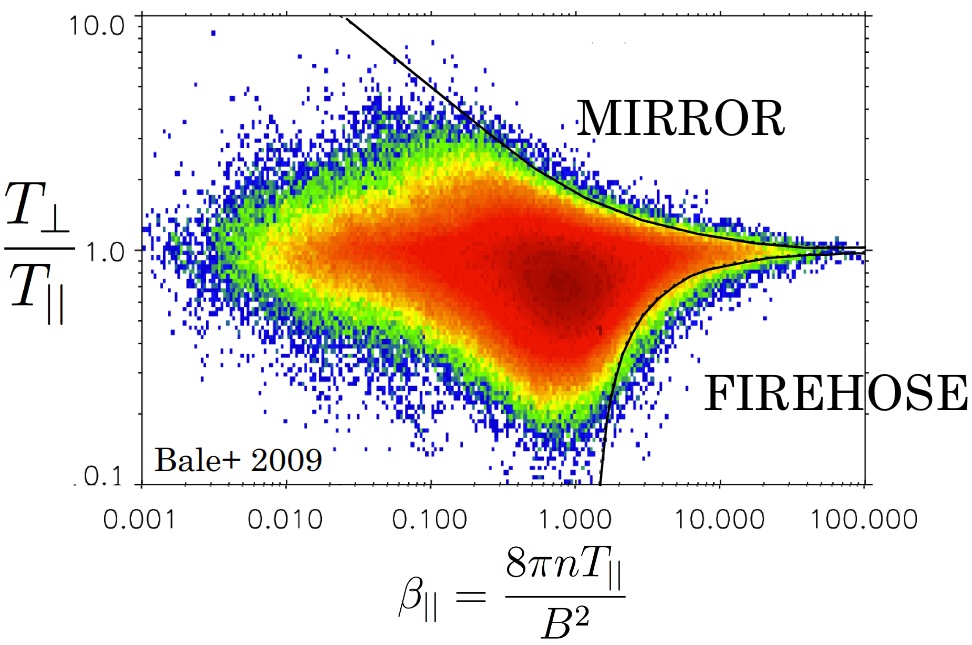
The expanding solar wind provides the cleanest natural laboratory for these anisotropy-driven instabilities.
As the plasma expands, \(T_\perp /T_\parallel \) is driven away from unity, but the proton distribution is observed to remain
bounded by the mirror and oblique-firehose thresholds rather than wandering freely in anisotropy space
Hellinger et al. (2006); Bale et al. (2009). That is a beautiful confirmation of the kinetic-MHD point of
view: the plasma evolves under low-frequency MHD-like dynamics, but kinetic microinstabilities regulate
the pressure tensor.
15.6 Example: flowing ions and trapped electrons
A second kinetic closure problem.
The mirror and firehose calculations taught us that a low-frequency instability can look MHD-like in its
force balance while depending decisively on a kinetic closure. A second useful example is the
magnetoacoustic instability discussed by Perkins in the context of solar-wind heat conduction
Perkins (1973), building on the collisionless damping and drift-instability work of Barnes, Forslund, and
Schulz and Eviatar Barnes (1967); Forslund (1970); Schulz and Eviatar (1972). The physics is
not pressure anisotropy. It is frame separation: outward ions move through a dense electron
core/halo that is electrostatically trapped, or nearly stationary in the solar frame. A small
fast strahl may carry the return current, but the low-frequency compressional wave mainly
resonates with the dense trapped-electron component Boldyrev et al. (2020). This gives a clean
example of a kinetic free-energy source that is invisible if one only writes a single-fluid sound
speed.
Local WKB setup.
Use a nearly straight background field and take
\[\B _0=B_0\vect {e}_z, \qquad \vect {k}=k_\perp \vect {e}_x+k_\parallel \vect {e}_z, \qquad \delta \propto \exp \left [-i\omega t+i k_\perp x+i k_\parallel z\right ]. \tag{15.45}\]
Let the ions stream with \(U_i=U\), while the dense electron component has \(U_e\simeq 0\) in the solar frame. The Doppler-shifted
species frequency is \[\omega _s\equiv \omega -k_\parallel U_s, \qquad \zeta _s\equiv \frac {\omega _s}{k_\parallel v_{{\rm th}s}}, \qquad v_{{\rm th}s}\equiv \sqrt {\frac {2T_s}{m_s}}. \tag{15.46}\]
The equilibrium distributions are isotropic drifting Maxwellians, \[f_{0s} = \frac {n_0}{\pi ^{3/2}v_{{\rm th}s}^{3}} \exp \left [ -\frac {v_\perp ^2+(v_\parallel -U_s)^2}{v_{{\rm th}s}^{2}} \right ]. \tag{15.47}\]
This is the simplest closure model. It represents the dense electron core/halo as the resonant
population and leaves the detailed strahl kinetics to a more complete distribution-function
calculation.
The drift-kinetic equation and its solution.
The linear drift-kinetic equation for the low-frequency response is
\[-i\left (\omega _s-k_\parallel w_\parallel \right )h_s + \left ( \frac {q_s}{m_s}E_\parallel -\frac {i k_\parallel \mu }{m_s}\delta B_\parallel \right ) \pp {f_{0s}}{w_\parallel } =0, \qquad w_\parallel \equiv v_\parallel -U_s, \tag{15.48}\]
where \(\mu =m_s v_\perp ^2/(2B_0)\) and \(E_\parallel =-i k_\parallel \phi \). Since \(\pp {f_{0s}}{w_\parallel }=-(m_s w_\parallel /T_s)f_{0s}\), the resonant part of the response can be written \[\boxed { h_s = \frac {k_\parallel w_\parallel } {\omega _s-k_\parallel w_\parallel } \left ( \frac {q_s\phi }{T_s} + \frac {\mu \,\delta B_\parallel }{T_s} \right )f_{0s}. } \tag{15.49}\]
This is the whole kinetic mechanism in one line. The numerator describes the parallel electric and mirror
forces; the denominator remembers particles whose parallel velocity matches the wave phase velocity in the
species frame. The Landau contour through that denominator is what turns the pressure closure into a
complex function. Most importantly for the flowing case, the resonance is not at \(\omega /k_\parallel \), but at the
Doppler-shifted value \(\omega _s/k_\parallel =(\omega -k_\parallel U_s)/k_\parallel \). That shift is what later feeds directly into the moment closures for \(\delta n_s\) and
\(\delta p_{\perp s}\).
Complex response functions.
Reuse the notation already introduced in Eq. (15.14). In the present flowing problem one
simply evaluates the same response function at the species-dependent Doppler-shifted argument,
\[R_s\equiv 1+\zeta _s Z(\zeta _s), \qquad \zeta _s=\frac {\omega -k_\parallel U_s}{k_\parallel v_{{\rm th}s}}, \tag{15.50}\]
with the Landau contour understood. The real part of \(R_s\) changes the compressibility of the wave. The
imaginary part gives Landau damping or growth, depending on the slope of the distribution at the
resonant velocity. In this flowing-ion, trapped-electron problem the ion pole is evaluated at \(\omega _i/k_\parallel \), while the
electron pole is evaluated at \(\omega /k_\parallel \), because the dense electron population is nearly at rest in the solar
frame.
Where the Doppler shift comes from in the moments.
The shifted frequency does not come from the induction equation. It comes from the resonance
denominator inside the parallel-velocity integrals themselves. Schematically, the ion density and pressure
moments contain integrals of the form
\[I_i^{(\ell )} \sim \int _{-\infty }^{\infty } \frac {G_\ell (w_\parallel )} {\omega -k_\parallel U-k_\parallel w_\parallel } F_i(w_\parallel )\,dw_\parallel , \tag{15.51}\]
where \(w_\parallel =v_\parallel -U\) is the velocity measured relative to the ion drift, and \(G_\ell \) stands for the moment weight appropriate to
the chosen closure. For a drifting Maxwellian, \[F_i(w_\parallel ) = \frac {n_0}{\sqrt {\pi }\,v_{{\rm th}i}} \exp \!\left (-\frac {w_\parallel ^2}{v_{{\rm th}i}^2}\right ), \qquad x\equiv \frac {w_\parallel }{v_{{\rm th}i}}, \tag{15.52}\]
so \[I_i^{(\ell )} \sim \int _{-\infty }^{\infty } \frac {\widehat {G}_\ell (x)}{\zeta _i-x}\, \frac {e^{-x^2}}{\sqrt {\pi }}\,dx, \qquad \zeta _i=\frac {\omega -k_\parallel U}{k_\parallel v_{{\rm th}i}}. \tag{15.53}\]
That is exactly the same Gaussian integral as in the nonflowing case, but with \(\omega \) replaced by \(\omega -k_\parallel U\). The response
function \(R_i=1+\zeta _i Z(\zeta _i)\) is therefore nothing more than the old Landau integral evaluated at the Doppler-shifted
pole.
The same point is visible in the most extreme toy model. If the ions were concentrated at one parallel
velocity,
\[F_i(w_\parallel )=n_0\,\delta (w_\parallel -w_0), \tag{15.54}\]
then Eq. (15.51) would reduce to \[I_i^{(\ell )} \sim \frac {G_\ell (w_0)} {\omega -k_\parallel (U+w_0)}. \tag{15.55}\]
For a cold beam centered on the drift (\(w_0=0\)), any moment whose weight is nonzero at the beam speed carries
the same pole at \(\omega -k_\parallel U=0\). The Maxwellian case simply smooths that same Doppler-shifted resonance into the
familiar \(Z(\zeta _i)\) function.
Compressional closure in two fields.
Let \(b\) be the transverse displacement amplitude defined so that the magnetic compression is proportional to
\(k_\perp b\). With the phase convention used below,
\[\frac {\delta B_\parallel }{B_0}=-i k_\perp b, \qquad u_\perp =-i\omega b . \tag{15.56}\]
The induction and perpendicular force laws are kept in the lab frame. The background drift \(U\) therefore
enters only through the ion kinetic response \(h_i\) and the shifted argument of \(R_i\), not through a convective
derivative in the MHD part of the equations.
The perpendicular force balance is still Eq. (15.4).
The flowing case does not need a new force law. It only needs the isotropic, drifting specialization of
Eq. (15.4). Here
\[p_{\perp 0}=p_{\parallel 0}\equiv p_0, \qquad \vect {\xi }_\perp = b\,\vect {e}_x, \qquad \frac {\delta B}{B_0}=\frac {\delta B_\parallel }{B_0}=-ik_\perp b, \tag{15.57}\]
so the anisotropy term drops out and the \(x\)-component of Eq. (15.4) becomes \[-\omega ^2 \rho _0 b = -ik_\perp \left ( \delta p_\perp +\frac {B_0\delta B_\parallel }{\muo } \right ) -k_\parallel ^2\frac {B_0^2}{\muo }b. \tag{15.58}\]
Now use Eq. (15.56) to write \[-ik_\perp \frac {B_0\delta B_\parallel }{\muo } = -ik_\perp \frac {B_0(-ik_\perp B_0 b)}{\muo } = -k_\perp ^2\frac {B_0^2}{\muo }b. \tag{15.59}\]
Together with the tension term, this gives \[-ik_\perp \frac {B_0\delta B_\parallel }{\muo } -k_\parallel ^2\frac {B_0^2}{\muo }b = -\frac {B_0^2}{\muo }(k_\perp ^2+k_\parallel ^2)b = -\rho _0 v_A^2 k^2 b. \tag{15.60}\]
Therefore the same perpendicular force balance reduces to \[\boxed { \left (m_i\omega ^2-m_i v_A^2 k^2\right )b -k_\perp \sum _s\frac {\delta p_{\perp s}}{n_0}=0. } \tag{15.61}\]
This is the direct flowing-ion analog of the mirror-mode step in which Eq. (15.38) became Eq. (15.41): the
magnetic part is still the usual compressive fast-wave restoring force, and the kinetic closure only changes
the pressure term. Now return to Eq. (15.49). Since the resonance denominator there contains \(\omega _s-k_\parallel w_\parallel \), the
velocity integrals that produce the density and pressure moments are the same Gaussian integrals as
before, but evaluated at the shifted argument \(\zeta _s=\omega _s/(k_\parallel v_{{\rm th}s})\). That is the only place the background flow enters the
scalar closures: \[\begin{aligned}\frac {\delta n_s}{n_0} &= R_s\frac {q_s\phi }{T_s} -k_\perp R_s b, \\ \frac {\delta p_{\perp s}}{n_0} &= R_s q_s\phi +2T_s(1-R_s)k_\perp b .\end{aligned} \tag{15.62}\]
with \(R_s=R(\zeta _s)\). The ion flow therefore does not add a new tensor structure to the closure. It simply evaluates the
same drift-kinetic response function at the Doppler-shifted resonance appropriate to each species. The
electrostatic potential is not optional: quasineutrality,
\[\delta n_i=\delta n_e, \tag{15.64}\]
determines \(E_\parallel \) through the different ion and electron resonant responses. The perpendicular force balance is
now already in hand as Eq. (15.61). To keep the role of the flow visible, write \( R_i^\star \equiv R\!\bigl ((\omega -k_\parallel U)/(k_\parallel v_{{\rm th}i})\bigr ) \) and \( R_e^\star \equiv R\!\bigl (\omega /(k_\parallel v_{{\rm th}e})\bigr ) \). The
ions therefore feel the Doppler-shifted resonance \(\omega -k_\parallel U\), while the nearly stationary electrons do
not.
Large-drift asymptotic form.
If the ion resonance lies well outside the bulk of the ion distribution,
\[\left |\zeta _i^\star \right | \equiv \left |\frac {\omega -k_\parallel U}{k_\parallel v_{{\rm th}i}}\right | \gg 1, \tag{15.65}\]
then the standard large-argument expansion of the Landau response gives \[R_i^\star = 1+\zeta _i^\star Z(\zeta _i^\star ) \simeq -\frac {1}{2(\zeta _i^\star )^2} -\frac {3}{4(\zeta _i^\star )^4} \cdots \tag{15.66}\]
or, with \(\omega _D\equiv \omega -k_\parallel U\), \[R_i^\star \simeq -\frac 12\frac {k_\parallel ^2 v_{{\rm th}i}^2}{\omega _D^2} -\frac 34\frac {k_\parallel ^4 v_{{\rm th}i}^4}{\omega _D^4} \cdots . \tag{15.67}\]
In that limit the ion kinetic closure becomes an explicit algebraic function of \(\omega _D\), while the MHD restoring
force remains the ordinary lab-frame fast wave factor \(\omega ^2-v_A^2k^2\) in Eq. (15.61).
Small-\(\zeta _e\) electron response.
Because the trapped electrons are nearly stationary in the solar frame, it is convenient to write
\[R_e^\star \equiv R_e \equiv R\!\left (\frac {\omega }{k_\parallel v_{{\rm th}e}}\right ), \qquad \zeta _e\equiv \frac {\omega }{k_\parallel v_{{\rm th}e}}. \tag{15.68}\]
If \(|\zeta _e|\ll 1\), then \[Z(\zeta _e) = i\sqrt {\pi }-2\zeta _e+O(\zeta _e^3). \tag{15.69}\]
More explicitly, the Landau contour gives \[Z(\zeta _e) = \frac {1}{\sqrt {\pi }} \;\operatorname {PV}\!\!\int _{-\infty }^{\infty } \frac {e^{-x^2}}{x-\zeta _e}\,dx \;+\; i\sqrt {\pi }\,e^{-\zeta _e^2}, \tag{15.70}\]
and the principal-value part may be written as the Hilbert transform of a Gaussian, \[\frac {1}{\sqrt {\pi }} \;\operatorname {PV}\!\!\int _{-\infty }^{\infty } \frac {e^{-x^2}}{x-\zeta _e}\,dx = -2\,F(\zeta _e), \tag{15.71}\]
where \(F(\zeta )\equiv e^{-\zeta ^2}\int _0^\zeta e^{t^2}\,dt\) is Dawson’s integral. For \(|\zeta _e|\ll 1\), \[F(\zeta _e)=\zeta _e-\frac {2}{3}\zeta _e^3+O(\zeta _e^5), \tag{15.72}\]
so the principal-value contribution is \(-2\zeta _e+O(\zeta _e^3)\), while the imaginary Landau term is \(i\sqrt {\pi }\,e^{-\zeta _e^2}\simeq i\sqrt {\pi }\). Thus Eq. (15.69) is the small-\(\zeta _e\)
limit of the exact principal-value plus pole decomposition. Consequently, \[R_e = 1+\zeta _e Z(\zeta _e) \simeq 1-2\zeta _e^2+i\sqrt {\pi }\,\zeta _e+O(\zeta _e^4). \tag{15.73}\]
The principal-value part is the real correction \(1-2\zeta _e^2+\cdots \), while the Landau term is the imaginary contribution
\(i\sqrt {\pi }\,\zeta _e\).
Mixed asymptotic form of Eq. (15.83).
Using only the leading ion term from Eq. (15.67), define
\[\alpha _i \equiv \frac {k_\parallel ^2 v_{{\rm th}i}^2}{2\omega _D^2}, \qquad \eta _e \equiv \sqrt {\pi }\,\zeta _e . \tag{15.74}\]
Then \(R_i^\star \simeq -\alpha _i\) and \(R_e\simeq 1-2\zeta _e^2+i\eta _e\), so the algebraic system (15.83) becomes \[\begin{aligned}\left [ \;-\frac {\alpha _i}{T_i} \;+\; \frac {1}{T_e}\left (1-2\zeta _e^2+i\eta _e\right ) \right ]\varphi \;+\; k_\perp \left [ 1+\alpha _i-2\zeta _e^2+i\eta _e \right ]b &\simeq 0, \\ k_\perp \left [ 1+\alpha _i-2\zeta _e^2+i\eta _e \right ]\varphi \;+\; \Bigl [ m_i(\omega ^2-v_A^2k^2) \notag \\ \qquad -2k_\perp ^2 \Bigl ( T_i(1+\alpha _i) + T_e\left (2\zeta _e^2-i\eta _e\right ) \Bigr ) \Bigr ]b &\simeq 0.\end{aligned} \tag{15.75}\]
Keeping only the real part gives the approximate determinant
\[\boxed { \begin {aligned} D_R^{\rm asym} \simeq \;& \Bigl [ m_i(\omega ^2-v_A^2k^2) -2k_\perp ^2T_i(1+\alpha _i) -4k_\perp ^2T_e\zeta _e^2 \Bigr ] \Bigl [ \frac {1-2\zeta _e^2}{T_e} -\frac {\alpha _i}{T_i} \Bigr ] \\ &\qquad -k_\perp ^2\left (1+\alpha _i-2\zeta _e^2\right )^2 =0 . \end {aligned} } \tag{15.77}\]
This is the real magnetosonic branch dressed by an ion response that depends explicitly on \(\omega _D\) through \(\alpha _i=k_\parallel ^2 v_{{\rm th}i}^2/(2\omega _D^2)\). The
electron Landau damping then enters separately through the imaginary terms proportional to
\(i\eta _e\).
If the kinetic corrections are now turned off by taking \(\alpha _i\rightarrow 0\) and \(\zeta _e\rightarrow 0\), then Eq. (15.77) reduces immediately to
\[\frac {1}{T_e} \Bigl [ m_i(\omega ^2-v_A^2k^2) -2k_\perp ^2T_i \Bigr ] -k_\perp ^2 =0, \tag{15.78}\]
or \[\boxed { \omega ^2 = v_A^2k^2 + \frac {k_\perp ^2}{m_i}(T_e+2T_i). } \tag{15.79}\]
This is the warm fast-wave / quasi-perpendicular magnetosonic limit of the real part. It is the same
compressive branch obtained earlier from the ideal MHD dispersion relation (14.17), now written in the
quasi-perpendicular limit. There is no \(\omega _D\) in Eq. (15.78) because that step deliberately turns off the ion drift
correction by taking \(\alpha _i\to 0\).
If instead the leading ion compressibility correction is kept, while the electron principal-value correction is
neglected (\(\zeta _e^2\to 0\)), then Eq. (15.77) becomes
\[\Bigl [ m_i(\omega ^2-v_A^2k^2) -2k_\perp ^2T_i(1+\alpha _i) \Bigr ] \Bigl [ \frac {1}{T_e} -\frac {\alpha _i}{T_i} \Bigr ] -k_\perp ^2(1+\alpha _i)^2 =0. \tag{15.80}\]
Keeping only terms through first order in \(\alpha _i\) gives \[\omega _D^2 \left [ \omega ^2-v_A^2k^2 -\frac {k_\perp ^2}{m_i}(T_e+2T_i) \right ] \simeq k_\parallel ^2\frac {T_i}{m_i} \left [ \frac {T_e}{T_i}(\omega ^2-v_A^2k^2) +2k_\perp ^2\frac {T_i}{m_i} \right ]. \tag{15.81}\]
Equation (15.81) makes the structure explicit: the left-hand factor is the ordinary warm fast-wave branch,
while the right-hand side is the leading ion-frame compressibility correction written in terms of
\(\omega _D=\omega -k_\parallel U\).
Connection to the fully convected magnetosonic wave.
If the background drift is promoted all the way into the one-fluid convective derivative, then the entire
compressive branch is Doppler shifted and one recovers the standard uniform-flow magnetosonic quartic
\[\boxed { \omega _D^4 -k^2(c_s^2+v_A^2)\omega _D^2 +k_\parallel ^2k^2c_s^2v_A^2 =0, \qquad \omega _D\equiv \omega -k_\parallel U . } \tag{15.82}\]
This is the same ideal-MHD fast/slow structure as Eq. (14.17), but with \(\omega \) replaced by \(\omega _D\). The present
reduction does not assume that full convective shift in the MHD part of the equations; instead it keeps the
MHD restoring force in the lab frame and lets the flow enter through the ion kinetic response.
That is why Eqs. (15.78) and (15.81) are useful side by side: the former shows the ordinary
magnetosonic backbone, while the latter shows how the first ion-frame correction begins to reintroduce
\(\omega _D\).
Substituting Eqs. (15.62) and (15.63) gives a closed pair of algebraic equations for \(\varphi =e\phi \) and \(b\):
\[\begin{aligned}\left (\frac {R_i^\star }{T_i}+\frac {R_e^\star }{T_e}\right )\varphi +k_\perp (R_e^\star -R_i^\star )b &=0, \\ k_\perp (R_e^\star -R_i^\star )\varphi +\left [ m_i\omega ^2-m_i v_A^2k^2 -2k_\perp ^2\Bigl (T_i(1-R_i^\star )+T_e(1-R_e^\star )\Bigr ) \right ]b&=0 .\end{aligned} \tag{15.83}\]
Their determinant is the drift-kinetic dispersion relation
\[\begin {aligned} D_{\rm DK} &= \left [ m_i\left (\omega ^2-v_A^2k^2\right ) -2k_\perp ^2\Bigl (T_i(1-R_i^\star )+T_e(1-R_e^\star )\Bigr ) \right ] \left (\frac {R_i^\star }{T_i}+\frac {R_e^\star }{T_e}\right ) \\ &\qquad -k_\perp ^2(R_e^\star -R_i^\star )^2 =0 . \end {aligned} \tag{15.85}\]
If the kinetic response is replaced by an ordinary fluid compressibility, this same force balance reduces to
the usual magnetosonic dispersion. The novelty in Eq. (15.85) is that the compressibility is a complex
resonant function of the wave phase speed in each species frame.
Weak-growth form.
For explicit inspection, write
\[D_{\rm DK}(\omega ,\vect {k})=D_R+iD_I, \tag{15.86}\]
with \(R_s=R_{sR}+iR_{sI}\), and define \[\begin{aligned}\mathcal {A}_R &= m_i(\omega ^2-v_A^2k^2) -2k_\perp ^2\sum _sT_s(1-R_{sR}), \notag \\ \mathcal {A}_I &= 2k_\perp ^2\sum _sT_sR_{sI}, \notag \\ \mathcal {B}_R &= \frac {R_{iR}}{T_i}+\frac {R_{eR}}{T_e}, \qquad \mathcal {B}_I = \frac {R_{iI}}{T_i}+\frac {R_{eI}}{T_e}, \notag \\ \mathcal {C}_R &= R_{eR}-R_{iR}, \qquad \mathcal {C}_I = R_{eI}-R_{iI}.\end{aligned} \tag{15.87}\]
Then
\[\begin{aligned}D_R &= \mathcal {A}_R\mathcal {B}_R -\mathcal {A}_I\mathcal {B}_I -k_\perp ^2(\mathcal {C}_R^2-\mathcal {C}_I^2), \\ D_I &= \mathcal {A}_R\mathcal {B}_I +\mathcal {A}_I\mathcal {B}_R -2k_\perp ^2\mathcal {C}_R\mathcal {C}_I .\end{aligned} \tag{15.88}\]
For weak growth or damping, products quadratic in \(R_{sI}\) are higher order. The real wave is therefore found
from
\[D_R^{(0)} = \mathcal {A}_R\mathcal {B}_R -k_\perp ^2\mathcal {C}_R^2 =0. \tag{15.90}\]
Equivalently, after eliminating \(\varphi \), the real part may be written as a kinetic compressibility correction to the
fast-wave force balance, \[\omega ^2-v_A^2k^2-k_\perp ^2\mathcal {Q}_R(\omega _r,\vect {k})=0, \tag{15.91}\]
where \[\mathcal {Q}_R = \frac {1}{m_i} \left [ 2\sum _sT_s(1-R_{sR}) + \frac {(R_{eR}-R_{iR})^2} {R_{iR}/T_i+R_{eR}/T_e} \right ]. \tag{15.92}\]
If the closure is replaced by an isotropic fluid response, \[\mathcal {Q}_R \rightarrow \frac {c_s^2\omega ^2}{\omega ^2-k_\parallel ^2c_s^2}, \tag{15.93}\]
and Eq. (15.91) becomes the ordinary magnetosonic dispersion, \[\omega ^4 -k^2(v_A^2+c_s^2)\omega ^2 +k_\parallel ^2k^2v_A^2c_s^2=0. \tag{15.94}\]
The resonant part is kept to first order, \[D_I^{(1)} = \mathcal {A}_R\mathcal {B}_I +\mathcal {A}_I\mathcal {B}_R -2k_\perp ^2\mathcal {C}_R\mathcal {C}_I . \tag{15.95}\]
If \(\omega =\omega _r+i\gamma \) and \(|\gamma |\ll |\omega _r|\), then \[\boxed { \gamma = -\frac {D_I^{(1)}(\omega _r,\vect {k})} {\left .\pp {D_R^{(0)}}{\omega }\right |_{\omega _r}} . } \tag{15.96}\]
This form is often the most honest way to discuss the instability. The real part says which compressional
wave is being tested; the imaginary part tells which resonant population gives energy to, or takes energy
from, that wave.
How the ion drift enters the resonance.
For the low-\(\beta \) compressive branch, the real frequency remains close to the ordinary fast-wave root in the lab
frame,
\[\omega _r^2\simeq k^2 v_A^2, \qquad \omega _r\simeq -k v_A, \qquad \cos \theta \equiv \frac {k_\parallel }{k}. \tag{15.97}\]
The ion drift then enters only through the shifted kinetic denominator, \[\zeta _i=\frac {\omega _r-k_\parallel U}{k_\parallel v_{{\rm th}i}}, \qquad \frac {\omega _r-k_\parallel U}{k_\parallel } = \frac {\omega _r}{k_\parallel }-U. \tag{15.98}\]
In switchback applications it is often useful to rewrite the same statement in the ion frame as
\[\omega _r-k_\parallel U\simeq -k v_A \qquad \Longleftrightarrow \qquad \frac {\omega _r}{k_\parallel } = U-\frac {v_A}{\cos \theta }, \tag{15.99}\]
but this is an interpretation of the solved root, not an additional assumption in the derivation above. The
dense trapped electrons can drive the wave when the solar-frame phase velocity lies between the electron
center and the ion center: \[0<\frac {\omega _r}{k_\parallel }<U. \tag{15.100}\]
The left inequality gives the transparent low-\(\beta \) threshold \[\boxed { M_A\equiv \frac {U}{v_A}>\sec \theta . } \tag{15.101}\]
This is why the problem is naturally tied to trans-Alfvénic expansion: below the Alfvén point there is no
oblique fast-wave phase speed that samples the dense trapped-electron distribution in the right
way.
What the drift-kinetic picture misses.
Equation (15.85) keeps the \(n=0\) Landau and transit-time resonances. It does not keep finite-Larmor-radius
Bessel functions or the \(n=\pm 1\) cyclotron harmonics. Therefore the drift-kinetic growth rate can keep increasing
with \(k\), while the full hot-plasma problem eventually turns over when ion cyclotron damping
becomes important. Codes that solve the full electromagnetic hot-plasma tensor, such as PLUME
Klein et al. (2025), are the right next step when the upper \(k_\perp \rho _i\) cutoff matters. The drift-kinetic
calculation is still the best first calculation because it shows clearly where the free energy
lives: in the relative motion of outward ions through a dense trapped-electron population, with
quasineutrality creating the parallel electric field that allows the electron Landau channel to
participate.
15.7 Adding back two-fluid effects: inertial and kinetic Alfvén waves
Why this comes after the mirror and firehose discussion.
Up to this point the lecture has stayed within strict kinetic MHD: the low-frequency MHD force law is
kept, but the pressure closure is replaced by the drift-kinetic response. The next step is a
genuine change in approach. One now begins to add back the two-fluid corrections that were
dropped on the way from the generalized Ohm law (3.10) to ideal MHD. That is where inertial
Alfvén waves, kinetic Alfvén waves, and eventually finite- Larmor-radius corrections begin to
appear.
What has to be added.
The force balance of Lecture 17 already contains the correct Alfvénic geometry: field-line bending supplies
the restoring force, while compressibility enters through \(\delta n\), \(\delta p\), and \(E_\parallel \). What strict kinetic MHD suppressed
was the part of generalized Ohm’s law that allows a small but finite parallel electric field. In
the notation written in Eq. (3.10), the relevant straight-field, collisionless, isotropic limit is
\[E_\parallel = - \frac {T_e}{e}\vect {b}\cdot \grad \left (\frac {\delta n}{n_0}\right ) - \frac {m_e}{n_0 e^2}\pp {J_\parallel }{t}. \tag{15.102}\]
The first term is the adiabatic or Boltzmann electron response along the field line; the second is electron
inertia. Those are precisely the terms that generate kinetic and inertial Alfvén waves Hasegawa and
Chen (1975, 1976); Goertz and Boswell (1979); Lysak and Lotko (1996).
Shear geometry with finite \(E_\parallel \).
Take an isotropic equilibrium with
\[\B _0 = B_0 \vect {e}_z, \qquad \vect {k}=k_\perp \vect {e}_x + k_\parallel \vect {e}_z, \qquad \propto e^{-i\omega t + i k_\perp x + i k_\parallel z}, \tag{15.103}\]
and choose the usual shear-Alfvén polarization \[\delta \B = \delta B_y \vect {e}_y, \qquad \uvec _\perp = u_y \vect {e}_y. \tag{15.104}\]
Represent the perturbation with a parallel vector potential \(A_\parallel \) and electrostatic potential \(\Phi \): \[\delta B_y = - i k_\perp A_\parallel , \qquad E_x = - i k_\perp \Phi , \qquad E_\parallel = - i k_\parallel \Phi + i\omega A_\parallel . \tag{15.105}\]
How Eq. (15.4) becomes the shear-Alfvén balance.
In the present isotropic shear-Alfvén polarization,
\[\delta p = 0, \qquad \delta B_\parallel = 0, \qquad \vect {\xi } = \xi _y \vect {e}_y, \tag{15.106}\]
so the perpendicular force law already written in Eq. (15.4) loses its compressive term and reduces to
\[-\omega ^2 \rho _0 \xi _y = -k_\parallel ^2 \frac {B_0^2}{\muo }\xi _y. \tag{15.107}\]
That is just the ordinary shear-Alfvén tension equation written in the same \(\vect {\xi }\)-language as Eq. (15.4).
How \(\Phi \) is tied to \(\xi _\perp \).
The dominant perpendicular motion is still the \(E\times B\) drift, so
\[u_y = \frac {i k_\perp \Phi }{B_0}, \tag{15.108}\]
and at the same time \[u_y = -i\omega \xi _y. \tag{15.109}\]
Therefore \[\boxed { \xi _y = -\frac {k_\perp }{\omega B_0}\Phi . } \tag{15.110}\]
The same displacement produces the shear magnetic perturbation \[\delta B_y = i k_\parallel B_0 \xi _y, \tag{15.111}\]
while Eq. (15.105) gives \[\delta B_y = - i k_\perp A_\parallel . \tag{15.112}\]
Equating Eqs. (15.111) and (15.112), \[A_\parallel = -\frac {k_\parallel B_0}{k_\perp }\xi _y. \tag{15.113}\]
The same force balance written in \((\Phi ,A_\parallel )\).
Equation (15.107) may also be written in the equivalent velocity form
\[-i\omega \rho _0 u_y = \frac {B_0}{\muo } i k_\parallel \delta B_y. \tag{15.114}\]
Using Eqs. (15.108) and (15.105), this becomes \[\boxed { \Phi = \frac {k_\parallel v_A^2}{\omega }A_\parallel . } \tag{15.115}\]
Equivalently, Eqs. (15.110) and (15.113) show how the same result is encoded in the displacement
picture.
Density response from continuity.
For \(k_\perp \gg k_\parallel \), the perpendicular ion motion has two pieces,
\[\vect {u}_{i\perp } = \vect {u}_E + \vect {u}_p. \tag{15.116}\]
Here \(\vect {u}_E = \vect {E}_\perp \times \vect {B}_0/B_0^2\) is the \(E\times B\) drift and \(\vect {u}_p\) is the ion polarization drift. In the shear-Alfvén reduction used here, the vector
potential is taken to be \(\vect {A}=A_\parallel \vect {b}_0\), so the inductive electric field \(-\partial _t \vect {A}\) is parallel to \(\vect {B}_0\). The perpendicular electric field
therefore comes only from the electrostatic potential, \(\vect {E}_\perp = -\grad _\perp \Phi \), which is why \(A_\parallel \) does not appear directly in \(\delta n/n_0\). Instead \(A_\parallel \)
enters the density response only indirectly through the perpendicular force balance \(\Phi \leftrightarrow A_\parallel \) relation,
Eq. (15.115).
In a uniform field \(\divergence \vect {u}_E = 0\), so the \(E\times B\) motion is incompressible. The only perpendicular drift here with a nonzero
divergence is the polarization drift. Using
\[u_{px} = -\frac {1}{\Omega _i}\pp {u_y}{t}, \tag{15.117}\]
one has \[u_{px} = - \frac {\omega k_\perp \Phi }{\Omega _i B_0}. \tag{15.118}\]
the density response comes from the ion polarization current, \[\vect {J}_{\rm pol} = e n_0 \vect {u}_{p}. \tag{15.119}\]
Then continuity gives \[\omega \delta n = n_0 k_\perp u_{px}, \tag{15.120}\]
and therefore \[\boxed { \frac {\delta n}{n_0} = - k_\perp ^2 \rho _s^2 \frac {e\Phi }{T_e}, \qquad \rho _s^2 \equiv \frac {T_e}{m_i\Omega _i^2} = \frac {c_s^2}{\Omega _i^2}. } \tag{15.121}\]
Equivalently, one may start from quasineutral current continuity, \[\divergence \vect {J} = 0, \qquad \Longrightarrow \qquad i k_\parallel J_\parallel + i k_\perp J_{{\rm pol},x}=0, \tag{15.122}\]
with \(J_{{\rm pol},x}=e n_0 u_{px}\). Using the electron continuity relation \(-i\omega \delta n + i k_\parallel n_0 u_{e\parallel }=0\) together with \(J_\parallel = - e n_0 u_{e\parallel }\), one recovers Eq. (15.120). The density
response may therefore be viewed either as ion continuity or as \(\divergence \vect {J}=0\); the physical content is that the
divergence of the ion polarization current must be compensated by a parallel current. In the
present ordering that parallel current is carried mainly by the electrons. The appearance of \(T_e\) in
Eq. (15.121) is a matter of organization rather than new physics. Continuity by itself gives
\[\frac {\delta n}{n_0} = - \frac {k_\perp ^2 e\Phi }{m_i\Omega _i^2}, \tag{15.123}\]
because \(1/(\Omega _i B_0)=e/(m_i\Omega _i^2)\). We then multiply and divide by \(T_e\) so that the density response is written in the same
dimensionless normalization used by the adiabatic electron response. This identifies the natural transverse
scale \[\rho _s^2 \equiv \frac {T_e}{m_i\Omega _i^2} = \frac {c_s^2}{\Omega _i^2}, \qquad c_s^2 \equiv \frac {T_e}{m_i}, \tag{15.124}\]
which is why \(\rho _s\) is called the ion-sound gyroradius. In the \(d_e\to 0\) limit, Eq. (15.102) reduces to the adiabatic
electron balance \[E_\parallel = -\frac {T_e}{e}\vect {b}\cdot \grad \left (\frac {\delta n}{n_0}\right ), \tag{15.125}\]
which integrates to \[\frac {\delta n}{n_0} = \frac {e}{T_e}\left (\Phi -\frac {\omega }{k_\parallel }A_\parallel \right ) \tag{15.126}\]
for adiabatic electrons along the field line, since \(E_\parallel =-ik_\parallel \Phi + i\omega A_\parallel \). So in the fully electromagnetic case the adiabatic electron
response depends on the gauge-invariant parallel potential \(\Phi -\omega A_\parallel /k_\parallel \), not on \(\Phi \) alone. The simpler form \(\delta n/n_0 \simeq e\Phi /T_e\) is the
additional electrostatic or weak-inductive limit in which \(|\omega A_\parallel /k_\parallel | \ll |\Phi |\). The derivation below does not make that extra
approximation; \(A_\parallel \) is retained explicitly in Ohm’s law and the coupled electromagnetic system is then solved.
The kinetic Alfvén limit may therefore be viewed as Alfvénic tension plus ion polarization plus adiabatic
electrons.
The remaining algebra to the dispersion relation.
In the present straight-field geometry the Hall term does not contribute to the parallel component, so
Eq. (15.102) gives
\[- i k_\parallel \Phi + i\omega A_\parallel = - \frac {T_e}{e} i k_\parallel \frac {\delta n}{n_0} - i\omega d_e^2 k_\perp ^2 A_\parallel , \qquad d_e^2 \equiv \frac {m_e}{\muo n_0 e^2}. \tag{15.127}\]
Insert Eq. (15.121): \[\omega A_\parallel \left (1+k_\perp ^2 d_e^2\right ) = k_\parallel \Phi \left (1+k_\perp ^2 \rho _s^2\right ). \tag{15.128}\]
Now substitute Eq. (15.115): \[\omega A_\parallel \left (1+k_\perp ^2 d_e^2\right ) = \frac {k_\parallel ^2 v_A^2}{\omega } \left (1+k_\perp ^2 \rho _s^2\right )A_\parallel . \tag{15.129}\]
Cancel \(A_\parallel \) and multiply by \(\omega \). One obtains \[\boxed { \omega ^2 = k_\parallel ^2 v_A^2 \frac {1+k_\perp ^2 \rho _s^2} {1+k_\perp ^2 d_e^2}. } \tag{15.130}\]
This is the clean Lecture-17-style result: the same Alfvénic tension law, modified only by the response that
determines \(E_\parallel \).
What the names mean.
Equation (15.130) contains two familiar limits.
\[\begin{aligned}\text {inertial Alfv\'en:}\qquad \omega ^2 &\simeq \frac {k_\parallel ^2 v_A^2}{1+k_\perp ^2 d_e^2}, \qquad k_\perp ^2 \rho _s^2 \ll k_\perp ^2 d_e^2, \\[4pt] \text {kinetic Alfv\'en:}\qquad \omega ^2 &\simeq k_\parallel ^2 v_A^2 \left (1+k_\perp ^2 \rho _s^2\right ), \qquad k_\perp ^2 d_e^2 \ll k_\perp ^2 \rho _s^2.\end{aligned} \tag{15.131}\]
The word “inertial” means that \(E_\parallel \) is sustained mainly by electron inertia. The word “kinetic”
means that \(E_\parallel \) is sustained mainly by the Boltzmann/electron-pressure response together with ion
polarization. In both cases the geometry is still that of a shear Alfvén wave; what changes is the
closure that relates \(\delta n\), \(J_\parallel \), and \(E_\parallel \) Hasegawa and Chen (1976); Goertz and Boswell (1979); Lysak and
Lotko (1996).
How this fits the present lecture.
The strict ordering of Eq. (15.1) deliberately set aside Hall, electron-pressure, and electron-inertia
corrections in the induction law. That is why inertial and kinetic Alfvén waves do not appear in the earlier
sections automatically. But the force-balance framework already contains the right structure: once it is
supplemented with the parallel Ohm law (15.102), these two standard dispersions follow almost
immediately. This is also the point in the notes where one begins to see how other non-MHD effects can
enter. Restoring more of the two-fluid terms in Eq. (3.10) leads naturally toward Hall physics and, with
the addition of finite-gyroradius corrections, toward FLR modifications of the shear-Alfvén
branch.
Caution
Kinetic MHD is still a reduced theory. It assumes \(\omega \ll \Omega _i\) and \(k_\perp \rho _i\ll 1\). Once finite-Larmor-radius
corrections, cyclotron resonances, or strongly non-Maxwellian particle populations
become essential, one must go beyond kinetic MHD as well.
Takeaways
Kinetic MHD separates a familiar macroscopic force law from a kinetic closure.
-
1.
- The force law remains MHD-like: field-line bending, magnetic compression, and
anisotropic stress appear exactly where fluid intuition says they should.
-
2.
- The closure is where the kinetic information lives. Equations (15.18)–(15.21) replace
the double-adiabatic laws.
-
3.
- The shear firehose is primarily a tension instability and is already captured by
anisotropic fluid theory, whereas the mirror mode and the oblique compressive
firehose test the pressure closure.
-
4.
- A relative drift between species can also enter through the closure. In the flowing-ion
example, the force law is still the compressional fast-wave force law, but \(R_i\) and \(R_e\) sample
different rest frames.
-
5.
- In the isotropic limit, the same Alfvénic geometry also produces inertial and
kinetic Alfvén waves once the parallel generalized Ohm law is restored, leading to
Eq. (15.130).
Bibliography
G. F. Chew, M. L. Goldberger, and F. E. Low. The Boltzmann equation and the one-fluid hydromagnetic equations in the absence of particle collisions. Proceedings of the Royal Society of London. Series A. Mathematical and Physical Sciences, 236(1204):112–118, 1956. doi:10.1098/rspa.1956.0116.
R. M. Kulsrud. Mhd description of plasma. In A. A. Galeev and R. N. Sudan, editors, Handbook of Plasma Physics, Volume 1: Basic Plasma Physics I, chapter 1.4, pages 115–145. North-Holland, Amsterdam, 1983. Series editors: M. N. Rosenbluth and R. Z. Sagdeev.
A. A. Vedenov and R. Z. Sagdeev. Some properties of a plasma with an anisotropic ion velocity distribution in a magnetic field. In M. A. Leontovich, editor, Plasma Physics and the Problem of Controlled Thermonuclear Reactions, volume 3, pages 332–339. Pergamon Press, New York, 1958a. This classic mirror-instability reference is cited in the literature with variant publication years (1958, 1959, or 1961) depending on whether one cites the original Russian proceedings or the translated Pergamon edition.
A. A. Vedenov and R. Z. Sagdeev. On some properties of a plasma with an anisotropic ion-velocity distribution in a magnetic field. Soviet Physics Doklady, 3:278, 1958b. Common shorthand citation used in later plasma-physics literature for the original mirror-instability paper.
Akira Hasegawa. Drift mirror instability in the magnetosphere. Physics of Fluids, 12(12):2642–2650, 1969. doi:10.1063/1.1692407.
David J. Southwood and Margaret G. Kivelson. Mirror instability: 1. physical mechanism of linear instability. Journal of Geophysical Research: Space Physics, 98(A6):9181–9187, 1993. doi:10.1029/92ja02837.
S. D. Bale, J. C. Kasper, G. G. Howes, E. Quataert, C. Salem, and D. Sundkvist. Magnetic fluctuation power near proton temperature anisotropy instability thresholds in the solar wind. Physical Review Letters, 103:211101, 2009. doi:10.1103/PhysRevLett.103.211101.
P. Hellinger, P. Trávní cek, J. C. Kasper, and A. J. Lazarus. Solar wind proton temperature anisotropy: Linear theory and WIND/SWE observations. Geophysical Research Letters, 33:L09101, 2006. doi:10.1029/2006GL025925.
F. W. Perkins. Heat conductivity, plasma instabilities, and the radio star scintillations in the solar wind. Astrophysical Journal, 179:637–646, 1973. doi:10.1086/151904.
A. Barnes. Collisionless damping of hydromagnetic waves. Physics of Fluids, 10:2427–2439, 1967. doi:10.1063/1.1762019.
D. W. Forslund. Instabilities associated with heat conduction in the solar wind and their consequences. Journal of Geophysical Research, 75:17–28, 1970. doi:10.1029/JA075i001p00017.
M. Schulz and A. Eviatar. Electron drift instabilities in the solar wind. Cosmic Electrodynamics, 2:402–421, 1972.
Stanislav Boldyrev, Cary Forest, and Jan Egedal. Electron temperature of the solar wind. Proceedings of the National Academy of Sciences of the United States of America, 117(17):9232–9240, 2020. doi:10.1073/pnas.1917905117.
Kristopher G. Klein, Gregory G. Howes, and Collin R. Brown. PLUME: Plasma in a linear uniform magnetized environment. Research Notes of the American Astronomical Society, 9(4):102, 2025. doi:10.3847/2515-5172/add1c2.
Akira Hasegawa and Liu Chen. Kinetic process of plasma heating due to Alfvén wave excitation. Physical Review Letters, 35(6):370–373, 1975. doi:10.1103/PhysRevLett.35.370.
Akira Hasegawa and Liu Chen. Kinetic processes in plasma heating by resonant mode conversion of Alfvén wave. Physics of Fluids, 19(12):1924–1934, 1976. doi:10.1063/1.861427.
C. K. Goertz and R. W. Boswell. Magnetosphere-ionosphere coupling. Journal of Geophysical Research, 84(A12):7239–7246, 1979. doi:10.1029/JA084iA12p07239.
R. L. Lysak and W. Lotko. On the kinetic dispersion relation for shear Alfvén waves. Journal of Geophysical Research, 101(A3):5085–5094, 1996. doi:10.1029/95JA03712.
Guided Exercises
Work through the steps in order. The aim is not only to obtain the stated result, but also to check a useful
limit and explain the physics in words.
Problem 15.1. From the drift-kinetic equation to fluid moments
-
(a)
- Starting from Eq. (15.11), derive Eq. (15.13). Keep the signs of \(E_\parallel \) and \(\delta B\) explicit and identify the
resonant denominator.
-
(b)
- Use Eqs. (15.15)–(15.16) to derive the density and pressure moments (15.18)–(15.20). State
which velocity-space moment produces each response.
-
(c)
- Repeat the slow-ordering reduction for isotropic electrons and anisotropic ions. How do the
coefficients of \(\delta p_\perp \) and \(\delta p_\parallel \) change?
-
(d)
- Check the adiabatic and rapid-streaming limits and explain when a local fluid closure can
reproduce the kinetic response.
Problem 15.2. Firehose and mirror stability with a kinetic closure
-
(a)
- Show directly that the shear-polarized firehose dispersion (15.34) is independent of the kinetic
pressure response. What geometric property of the displacement causes this?
-
(b)
- Starting from Eq. (15.38), derive the threshold (15.44) and identify where \(k_\perp \gg k_\parallel \) enters.
-
(c)
- Compare the kinetic result with the CGL threshold (14.54). Separate the common force-balance
step from the closure-dependent pressure response.
-
(d)
- Explain physically why the firehose is a loss of field-line tension, whereas the mirror mode is a
compressive feedback involving both magnetic and particle pressure.
Problem 15.3. Flowing resonances and dispersive Alfvén waves
-
(a)
- Starting from Eq. (15.99), show that the backward fast wave in the ion frame can resonate with
the dense trapped electron component only when \(M_A>\sec \theta \). Explain why increasing obliquity both helps
the resonance and increases its cost.
-
(b)
- Starting from Eqs. (15.115), (15.121), and (15.127), eliminate the density and potentials to
obtain Eq. (15.130).
-
(c)
- Recover the inertial and kinetic Alfvén limits (15.131) and (15.132). State which physical scale
controls each correction.
-
(d)
- Check that ideal shear-Alfvén propagation is recovered when both electron inertia and
finite-ion-gyroradius effects are removed.