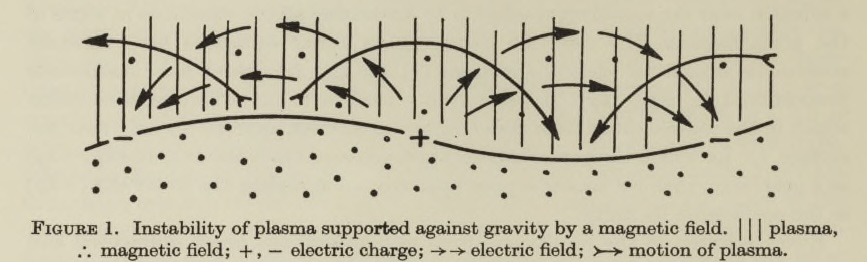
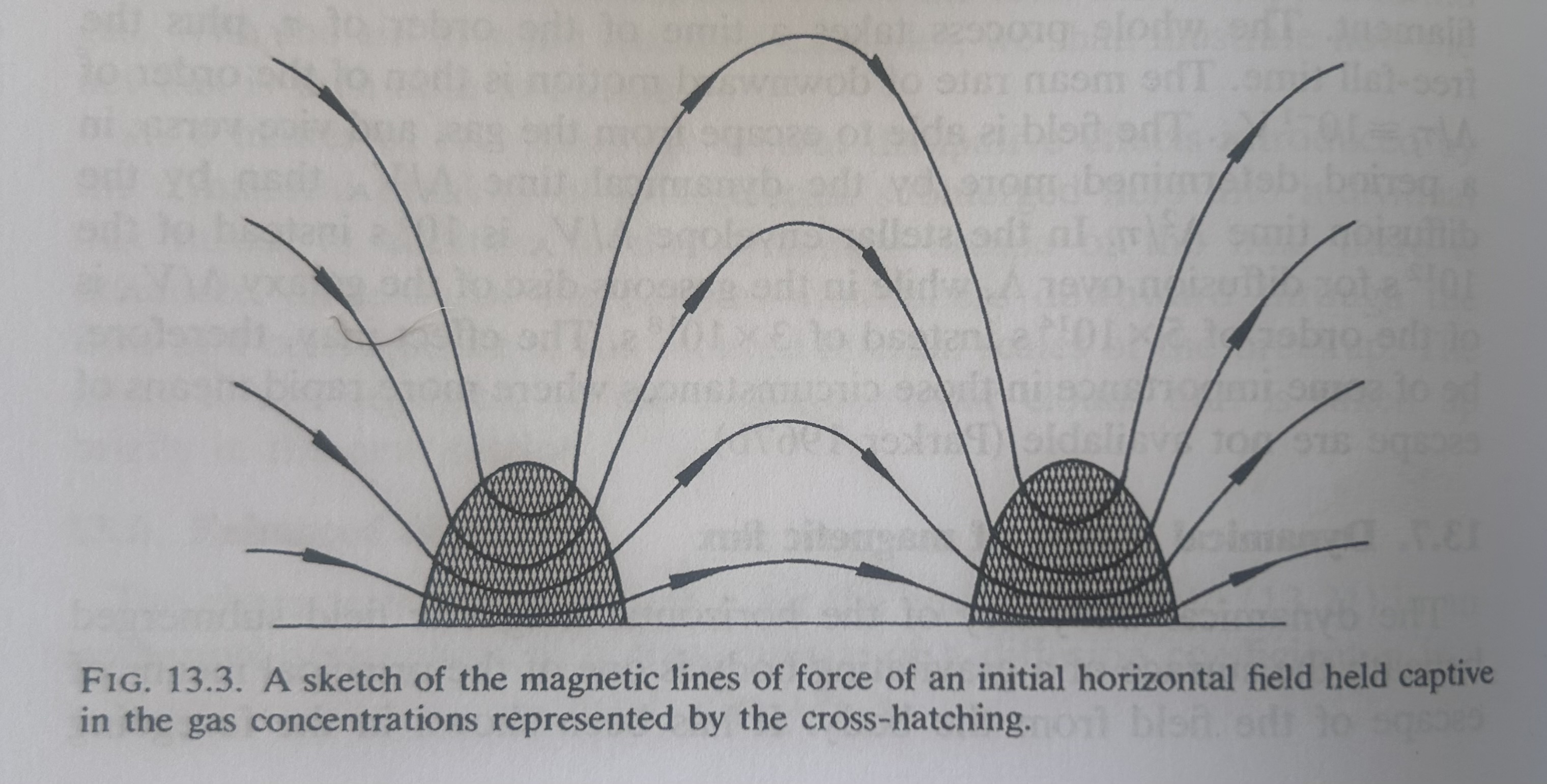
Lecture 16
Gravitational Interchange
Overview
Gravitational buoyancy provides the simplest setting in which equilibrium gradients can either
restore a displacement or amplify it. The same balance appears in three increasingly rich
forms:
-
1.
- Ordinary buoyancy: a stratified gas in gravity, leading to the Schwarzschild
criterion and the Brunt–Väisälä frequency.
-
2.
- Magnetic interchange: a stratified plasma supported in part by magnetic pressure,
with \(k_\parallel =0\) so that field lines are exchanged but not bent.
-
3.
- Parker or undular instability: long-wavelength motion along the magnetic field,
which allows plasma to drain from the crests of rising flux tubes and turns interchange
into the prototype of ballooning.
Together these problems show how equilibrium profiles, compressibility, and field-line tension
determine stability. The same interface physics reappears in Lecture 31 as the
Richtmyer–Meshkov instability, where a shock seeds the perturbation and subsequent
deceleration sustains Rayleigh–Taylor growth.
Historical Perspective
The history forms a remarkably continuous line. Rayleigh’s work on convection
and Schwarzschild’s criterion for stellar atmospheres gave the first modern stability
criteria for a stratified fluid Rayleigh (1916); Schwarzschild (1906). Brunt and Väisälä
identified the buoyancy oscillation frequency of a stably stratified atmosphere
Väisälä (1925); Brunt (1927). Kruskal and Schwarzschild then translated the same
physical idea into magnetized plasmas, showing how a magnetic field can support
plasma against gravity and how that support can fail through interchange Kruskal and
Schwarzschild (1954). Newcomb recast the problem in the language of the ideal-MHD
energy principle Newcomb (1961). Parker’s later work on magnetic buoyancy in the
solar interior made clear that literal “heavy fluid on light fluid” is not required: magnetic
support can alter the vertical stratification, while motion along the field lets plasma
drain from a rising flux tube Parker (1955a,b). These ideas lead directly to magnetic
interchange, ballooning, and solar flux emergence.
16.1 Buoyancy Without Magnetic Field
We begin with a static atmosphere in a uniform gravitational field \(\vect {g}=-g\,\ez \). Adding gravity to the momentum
equation in Eq. (1.8) and setting \(\uvec _0=\vect {0}\), \(\B _0=\vect {0}\), the equilibrium condition is the usual hydrostatic balance
\[\frac {dp_0}{dz}=-\rho _0 g. \tag{16.1}\]
Parcel derivation of the Brunt–Väisälä frequency.
Displace a fluid parcel upward by a small distance \(\xi _z\). Pressure adjusts rapidly enough that the parcel stays
in pressure balance with its surroundings, but the displacement is fast enough thermodynamically that the
parcel evolves adiabatically. Thus
\[\left (\frac {p}{\rho ^\gamma }\right )_{\rm parcel}=\text {const}, \qquad p_{\rm parcel}(z+\xi _z)=p_0(z+\xi _z).\]
Expand the adiabatic relation to first order: \[\begin{aligned}\frac {p_0(z+\xi _z)}{\rho _{\rm parcel}^\gamma (z+\xi _z)} &= \frac {p_0(z)}{\rho _0^\gamma (z)}, \nonumber \\ \frac {p_0+\xi _z p_0'}{\bigl (\rho _0+\rho _{\rm parcel,1}\bigr )^\gamma } &= \frac {p_0}{\rho _0^\gamma }, \nonumber \\ \left (1+\xi _z\frac {p_0'}{p_0}\right ) \left (1-\gamma \frac {\rho _{\rm parcel,1}}{\rho _0}\right ) &=1,\end{aligned}\]
so that
\[\rho _{\rm parcel,1} = \frac {\rho _0}{\gamma p_0}\,p_0'\,\xi _z. \tag{16.4}\]
The ambient density at the displaced position is instead \[\rho _0(z+\xi _z)=\rho _0+\rho _0'\xi _z.\]
Hence the density contrast between parcel and environment is \[\Delta \rho \equiv \rho _{\rm parcel}(z+\xi _z)-\rho _0(z+\xi _z) = \left (\frac {\rho _0}{\gamma p_0}p_0'-\rho _0'\right )\xi _z. \tag{16.6}\]
The buoyancy force per unit mass is \(-g\Delta \rho /\rho _0\), so the parcel obeys \[\ddot {\xi }_z = -g\left (\frac {1}{\gamma p_0}\frac {dp_0}{dz}-\frac {1}{\rho _0}\frac {d\rho _0}{dz}\right )\xi _z \equiv -N^2\xi _z. \tag{16.7}\]
Therefore \[\boxed { N^2 = \frac {g}{\gamma }\frac {d}{dz}\ln \!\left (\frac {p_0}{\rho _0^\gamma }\right ) = g\left (\frac {1}{\gamma p_0}\frac {dp_0}{dz}-\frac {1}{\rho _0}\frac {d\rho _0}{dz}\right ). } \tag{16.8}\]
If \(N^2>0\), the atmosphere supports stable buoyancy oscillations. If \(N^2<0\), the displacement grows exponentially and the
atmosphere overturns.
Tutorial
Entropy from the Sackur–Tetrode equation and why \(p/\rho ^\gamma \) is an entropy proxy.
For a classical monatomic ideal gas, the Sackur–Tetrode equation gives the entropy as
\[S = N k_B \left [ \ln \!\left ( \frac {V}{N} \left ( \frac {4\pi m U}{3 N h^2} \right )^{3/2} \right ) +\frac {5}{2} \right ],\]
where \(N\) is the particle number, \(V\) the volume, \(U\) the internal energy, and \(m\) the particle
mass.
For a monatomic ideal gas,
\[U = \frac {3}{2} N k_B T, \qquad pV = N k_B T.\]
Substituting \(U=\tfrac 32 N k_B T\) into Sackur–Tetrode gives \[\frac {S}{N k_B} = \ln \!\left (\frac {V}{N}\right ) +\frac {3}{2}\ln T +\text {const}.\]
Now introduce the number density \(n=N/V\), so that \(V/N=1/n\). Then \[\frac {S}{N k_B} = -\ln n + \frac {3}{2}\ln T + \text {const}.\]
Using the ideal-gas law \(p=n k_B T\), we may write \[T = \frac {p}{n k_B},\]
and therefore \[\begin{aligned}\frac {S}{N k_B} &= -\ln n + \frac {3}{2}\ln \!\left (\frac {p}{n k_B}\right ) + \text {const} \nonumber \\ &= -\ln n + \frac {3}{2}\ln p - \frac {3}{2}\ln n + \text {const} \nonumber \\ &= \frac {3}{2}\ln p - \frac {5}{2}\ln n + \text {const}.\end{aligned}\]
Since a monatomic gas has
\[\gamma = \frac {5}{3}, \qquad \frac {1}{\gamma -1}=\frac {3}{2},\]
this becomes \[\frac {S}{N k_B} = \frac {1}{\gamma -1} \ln \!\left (\frac {p}{n^\gamma }\right ) +\text {const}.\]
Finally, for a fixed species \(n=\rho /m\), so \[\frac {S}{N k_B} = \frac {1}{\gamma -1} \ln \!\left (\frac {p}{\rho ^\gamma }\right ) +\text {const},\]
where the factor \(m^\gamma \) has been absorbed into the additive constant.
Thus the entropy per particle is proportional to
\[\boxed { \frac {S}{N} = \frac {k_B}{\gamma -1} \ln \!\left (\frac {p}{\rho ^\gamma }\right ) +\text {const} }\]
and the specific entropy per unit mass is \[\boxed { s = \frac {k_B}{m(\gamma -1)} \ln \!\left (\frac {p}{\rho ^\gamma }\right ) +\text {const}. }\]
So \(p/\rho ^\gamma \) is not literally the entropy; rather, it is a monotonic proxy for entropy:
\[K \equiv \frac {p}{\rho ^\gamma }, \qquad s \propto \ln K.\]
Because the logarithm is monotonic, comparing \(K\) is equivalent to comparing entropy.
This is why buoyancy and interchange criteria are often written in terms of the gradient of \(p/\rho ^\gamma \).
For adiabatic motion of an ideal-gas fluid element,
\[\frac {d}{dt}\left (\frac {p}{\rho ^\gamma }\right )=0 \qquad \Longleftrightarrow \qquad \frac {ds}{dt}=0.\]
In other words, \(p/\rho ^\gamma \) is the conserved adiabatic label carried by the fluid element.
Thus the Schwarzschild criterion can be viewed as a statement about the ordering of the entropy proxy \(K=p/\rho ^\gamma \): a
stratification is buoyantly stable when entropy increases upward.
Why this matters in stars.
This criterion is not a side remark about atmospheres; it is one of the main structural constraints on
stars. In regions where radiative transport would require \(\nabla _{\rm rad}>\nabla _{\rm ad}\), convection turns on and rapidly
reorganizes the stratification toward marginality, \(\nabla \approx \nabla _{\rm ad}\). That is the origin of stellar convection zones and
of the familiar language of convective envelopes and convective cores Schwarzschild (1906).
Those convection zones matter to MHD because rotating, stratified convection is one of the
principal ingredients in large-scale magnetic-field generation: the Sun’s magnetic cycle, for
example, is inseparable from turbulent convection, differential rotation, and magnetic buoyancy
Charbonneau (2010); Parker (1979). Even without building a full stellar model here, the lesson is already
clear: the entropy proxy \(K=p/\rho ^\gamma \), its gradient, and the Schwarzschild boundary \(\nabla _{\rm rad}=\nabla _{\rm ad}\) are the natural language for
understanding where convection turns on and why those convective regions become magnetically
important.
Adiabatic lapse rate.
For an ideal gas, \(p_0\propto \rho _0 T_0\), so Eq. (16.8) can be rewritten as
\[\begin{aligned}N^2 &= \frac {g}{\gamma }\frac {d}{dz}\ln \!\left (p_0^{1-\gamma }T_0^\gamma \right ) \nonumber \\ &= \frac {g}{T_0}\left (\frac {dT_0}{dz}-\left .\frac {dT}{dz}\right |_{\rm ad}\right ),\end{aligned}\]
where
\[\left .\frac {dT}{dz}\right |_{\rm ad} = -(\gamma -1)\frac {g}{c_s^2}T_0, \qquad c_s^2=\frac {\gamma p_0}{\rho _0}. \tag{16.23}\]
Thus the atmosphere is convectively unstable when the temperature falls with height faster than the
adiabatic lapse rate. For dry air near room temperature this gives the familiar value of roughly
\(10\,^{\circ }{\rm C}/{\rm km}\).
The same result from the energy principle.
To connect directly to later lectures, it is worth deriving the Schwarzschild criterion from the
ideal-MHD energy principle with \(\B _0=\vect {0}\). For adiabatic perturbations in a static stratified atmosphere,
\[2\delta W = \int dV\, \left [ \gamma p_0(\divergence \vect {\xi })^2 +(\vect {\xi }\cdot \grad p_0)(\divergence \vect {\xi }) +(\vect {\xi }\cdot \vect {g})\bigl (\vect {\xi }\cdot \grad \rho _0+\rho _0\divergence \vect {\xi }\bigr ) \right ]. \tag{16.24}\]
For plane-parallel stratification, \[\vect {\xi }\cdot \grad p_0=\xi _z\frac {dp_0}{dz}, \qquad \vect {\xi }\cdot \grad \rho _0=\xi _z\frac {d\rho _0}{dz}, \qquad \vect {\xi }\cdot \vect {g}=-g\xi _z.\]
Using hydrostatic balance, Eq. (16.1), this becomes \[\begin{aligned}2\delta W &= \int dV\, \left [ \gamma p_0(\divergence \vect {\xi })^2 -2\rho _0 g\,\xi _z\divergence \vect {\xi } -g\frac {d\rho _0}{dz}\,\xi _z^2 \right ].\end{aligned}\]
Now complete the square:
\[\begin{aligned}2\delta W &= \int dV\, \Biggl [ \gamma p_0\left (\divergence \vect {\xi }-\frac {\rho _0 g}{\gamma p_0}\xi _z\right )^2 +\left (-g\frac {d\rho _0}{dz}-\frac {\rho _0^2g^2}{\gamma p_0}\right )\xi _z^2 \Biggr ] \nonumber \\ &= \int dV\, \Biggl [ \gamma p_0\left (\divergence \vect {\xi }-\frac {\rho _0 g}{\gamma p_0}\xi _z\right )^2 +\rho _0 N^2\xi _z^2 \Biggr ].\end{aligned} \tag{16.27}\]
The first term is positive definite and will always be stabilizing. Nature will find a way around this by
having
\[\divergence \vect {\xi }=\frac {\rho _0 g}{\gamma p_0}\xi _z\]
to minimize the first term. IN this case, the sign of \(\delta W\) is controlled by \(N^2\). This is the energy-principle version of
the Schwarzschild criterion.
16.2 Plasma supported by magnetic field against gravity
We can start now to consider how magnetic fields change this story by considering cold fluid that is
supported from underneath by a magnetic field. Imagine a magnetic field which is decreasing vertically
with a density that that is rising vertically.
Assume:
- No gas pressure: \(p_0 = 0\)
- Straight magnetic field \(\vect {B}_0 = B_0(z)\vect {e}_x\)
- Gravity \(\vect {g} = -g \vect {e}_z\)
The equilibrium condition becomes
\[\frac {d}{dz}\frac {B_0^2(z) }{2\mu _0} = -\rho _0(z) g\]
The energy variation reduces to
\[\begin{aligned}2\delta W & = \int dV \left [ \frac {|\vect {Q}|^2}{\mu _0} +\vect {\xi }\cdot \vect {g}\,\nabla \cdot (\rho _0\vect {\xi }) \right ].\end{aligned}\]
Choose interchange-type perturbations:
\[\vect {k}\perp \vect {B}_0, \qquad k_\parallel = 0,\]
so that field lines are exchanged but not bent.
In this case
\[\vect {Q}_\perp = i k_\parallel B \vect {\xi }_\perp = 0;\]
the perturbed magnetic field is entirely compressional and parallel to \(\vect {B}_0\), and can be minimized by careful
choice: \[\begin{aligned}\vect {Q} & = \nabla \times \bm {\xi } \times \bm {B}_0\\ & = -\bm {B} \nabla \cdot \bm {\xi }_\perp -\bm {\xi }_\perp \cdot \nabla \bm {B} \\ \left | \bm {Q}^2 \right | & = B_0^2 \left (\nabla \cdot \bm {\xi }_\perp + \bm \xi _\perp \cdot \frac {\nabla B_0}{B_0}\right )^2 \\ \mbox {Choose } & \Rightarrow \quad \nabla \cdot \vect {\xi }_\perp = - \vect {\xi }_\perp \cdot \nabla \ln B_0.\end{aligned}\]
to mimimize \(\delta W\).
Substituting into \(\delta W\) gives
\[\begin{aligned}2\delta W &= \int dV \, \cancel {\left |\vect {Q}^2\right |} + \vect {\xi }\cdot \vect {g} \, \left ( \vect {\xi }_\perp \cdot \nabla \rho _0 + \rho _0 \underbrace {\nabla \cdot \vect {\xi }_\perp }_{ - \vect {\xi }_\perp \cdot \nabla \ln B_0} \right ) \nonumber \\ &= -\int dV \, \rho _0 g \, \xi _z \left ( \vect {\xi }_\perp \cdot \nabla \ln \frac {\rho _0}{B} \right ) \nonumber \\ &= -\int dV \, \rho _0 g \, \frac {d}{dz} \left (\ln \frac {\rho _0}{B_0} \right ) \xi _z^2\end{aligned} \tag{16.37}\]
\[ \boxed { \text {Magnetic interchange instability if } \frac {d}{dz}\left (\frac {\rho _0}{B_0}\right ) > 0 } \]
Physically: heavy flux tubes above light ones are unstable Kruskal and Schwarzschild (1954).
16.3 Magnetic Buoyancy and Flute-Like Interchange
Now let a horizontal magnetic field help support the atmosphere,
\[\vect {B}_0=B_0(z)\,\vect {e}_y, \qquad \vect {g}=-g\,\ez ,\]
where \(\vect {e}_y\) is the horizontal field direction. The static equilibrium condition is \[\frac {d}{dz}\left (p_0+\frac {B_0^2}{2\mu _0}\right )=-\rho _0 g. \tag{16.39}\]
We consider flute or interchange perturbations with \[k_\parallel =0, \qquad \vect {\xi }=\xi _x\,\vect {e}_x+\xi _z\,\ez , \tag{16.40}\]
so field lines are exchanged but not bent.
Field perturbation for interchange modes.
Recall the linear perturbation of the magnetic field from Eq. (13.4),
\[\vect {Q} \equiv \B _1 = \curl (\vect {\xi }\times \B _0) = \cancel {(\B \cdot \grad )\vect {\xi }_\perp } - (\vect {\xi }_\perp \cdot \grad )\B - \B \,\divergence \vect {\xi }_\perp\]
reduces for \(k_\parallel =0\) to a purely parallel perturbation, \[\vect {Q} = -B_0\left (\divergence \vect {\xi }+\xi _z\frac {d\ln B_0}{dz}\right )\vect {e}_y. \tag{16.42}\]
such that the field lines remain straight. The equilibrium current is \[\vect {J}_0 = \frac {\curl \vect {B}_0}{\mu _0} = -\frac {1}{\mu _0}\frac {dB_0}{dz}\,\vect {e}_x. \tag{16.43}\]
Energy principle for flute modes.
The ideal-MHD potential energy including gravity is
\[2\delta W = \int dV\, \left [ \frac {|\vect {Q}|^2}{\mu _0} +\gamma p_0(\divergence \vect {\xi })^2 +(\vect {\xi }\cdot \grad p_0)(\divergence \vect {\xi }) -\vect {\xi }\cdot (\vect {J}_0\times \vect {Q}) +(\vect {\xi }\cdot \vect {g})\bigl (\vect {\xi }\cdot \grad \rho _0+\rho _0\divergence \vect {\xi }\bigr ) \right ]. \tag{16.44}\]
Substitute Eqs. (16.42) and (16.43). First, \[\begin{aligned}\frac {|\vect {Q}|^2}{\mu _0} &= \frac {B_0^2}{\mu _0} \left (\divergence \vect {\xi }+\xi _z\frac {d\ln B_0}{dz}\right )^2, \nonumber \\ -\vect {\xi }\cdot (\vect {J}_0\times \vect {Q}) &= -\xi _z\frac {d}{dz}\left (\frac {B_0^2}{2\mu _0}\right ) \left (\divergence \vect {\xi }+\xi _z\frac {d\ln B_0}{dz}\right ).\end{aligned}\]
Therefore
\[\begin{aligned}2\delta W &= \int dV\, \Biggl [ \frac {B_0^2}{\mu _0} \left (\divergence \vect {\xi }+\xi _z\frac {d\ln B_0}{dz}\right )^2 +\gamma p_0(\divergence \vect {\xi })^2 +\xi _z\frac {dp_0}{dz}\,\divergence \vect {\xi } \nonumber \\ &\hspace {7em} -\xi _z\frac {d}{dz}\left (\frac {B_0^2}{2\mu _0}\right ) \left (\divergence \vect {\xi }+\xi _z\frac {d\ln B_0}{dz}\right ) -g\xi _z\left (\xi _z\frac {d\rho _0}{dz}+\rho _0\divergence \vect {\xi }\right ) \Biggr ].\end{aligned} \tag{16.46}\]
Now expand the magnetic square:
\[\begin{aligned}\frac {B_0^2}{\mu _0} \left (\divergence \vect {\xi }+\xi _z\frac {d\ln B_0}{dz}\right )^2 &= \frac {B_0^2}{\mu _0}(\divergence \vect {\xi })^2 +2\frac {B_0}{\mu _0}\frac {dB_0}{dz}\,\xi _z\divergence \vect {\xi } +\frac {1}{\mu _0}\left (\frac {dB_0}{dz}\right )^2\xi _z^2.\end{aligned}\]
The current term subtracts
\[\frac {B_0}{\mu _0}\frac {dB_0}{dz}\,\xi _z\divergence \vect {\xi } + \frac {1}{\mu _0}\left (\frac {dB_0}{dz}\right )^2\xi _z^2,\]
so one copy of the mixed term remains and the \(\xi _z^2\) magnetic term cancels entirely. Hence \[\begin{aligned}2\delta W &= \int dV\, \Biggl [ \left (\gamma p_0+\frac {B_0^2}{\mu _0}\right )(\divergence \vect {\xi })^2 +\left (\frac {dp_0}{dz}+\frac {B_0}{\mu _0}\frac {dB_0}{dz}-\rho _0 g\right )\xi _z\divergence \vect {\xi } -g\frac {d\rho _0}{dz}\,\xi _z^2 \Biggr ].\end{aligned}\]
Using equilibrium, Eq. (16.39), the mixed term becomes \(-2\rho _0 g\,\xi _z\divergence \vect {\xi }\), and therefore
\[2\delta W = \int dV\, \Biggl [ \left (\gamma p_0+\frac {B_0^2}{\mu _0}\right )(\divergence \vect {\xi })^2 -2\rho _0 g\,\xi _z\divergence \vect {\xi } -g\frac {d\rho _0}{dz}\,\xi _z^2 \Biggr ]. \tag{16.50}\]
Define \[c_s^2=\frac {\gamma p_0}{\rho _0}, \qquad v_A^2=\frac {B_0^2}{\mu _0\rho _0}.\]
Then Eq. (16.50) becomes \[\begin{aligned}2\delta W &= \int dV\, \Biggl [ \rho _0(c_s^2+v_A^2)(\divergence \vect {\xi })^2 -2\rho _0 g\,\xi _z\divergence \vect {\xi } -g\frac {d\rho _0}{dz}\,\xi _z^2 \Biggr ].\end{aligned}\]
Complete the square once more:
\[\begin{aligned}2\delta W &= \int dV\, \Biggl [ \rho _0(c_s^2+v_A^2) \left (\divergence \vect {\xi }-\frac {g}{c_s^2+v_A^2}\xi _z\right )^2 +\left (-g\frac {d\rho _0}{dz}-\frac {\rho _0 g^2}{c_s^2+v_A^2}\right )\xi _z^2 \Biggr ].\end{aligned} \tag{16.53}\]
The coefficient of \(\xi _z^2\) can be rewritten as
\[\begin{aligned}-g\frac {d\rho _0}{dz}-\frac {\rho _0 g^2}{c_s^2+v_A^2} &= \frac {g}{c_s^2+v_A^2} \left [ -(c_s^2+v_A^2)\frac {d\rho _0}{dz} +\frac {dp_0}{dz} +\frac {B_0}{\mu _0}\frac {dB_0}{dz} \right ] \nonumber \\ &= \frac {g\rho _0}{c_s^2+v_A^2} \left [ v_A^2\frac {d}{dz}\ln \!\left (\frac {B_0}{\rho _0}\right ) +\frac {c_s^2}{g}N^2 \right ].\end{aligned}\]
Thus
\[2\delta W = \int dV\, \rho _0 \left [ (c_s^2+v_A^2) \left (\divergence \vect {\xi }-\frac {g}{c_s^2+v_A^2}\xi _z\right )^2 +N_M^2\xi _z^2 \right ], \tag{16.55}\]
Now \[\mbox {Choose } \qquad \divergence \vect {\xi }-\frac {g}{c_s^2+v_A^2}\xi _z \Rightarrow \quad \nabla \cdot \vect {\xi }_\perp = - \vect {\xi }_\perp \cdot \nabla \ln B_0.\]
to minimize compression so that \[\boxed { N_M^2 \equiv \frac {g}{c_s^2+v_A^2} \left [ v_A^2\frac {d}{dz}\ln \!\left (\frac {B_0}{\rho _0}\right ) +\frac {c_s^2}{g}N^2 \right ]. } \tag{16.57}\]
This is the magnetic analogue of the Brunt–Väisälä frequency for flute modes. Stability requires
\(N_M^2>0\).
Cold-plasma limit.
If \(p_0\to 0\), then \(c_s^2\to 0\) and Eq. (16.57) reduces to
\[N_M^2 \longrightarrow g\frac {d}{dz}\ln \!\left (\frac {B_0}{\rho _0}\right ).\]
Therefore a cold plasma supported by magnetic pressure is unstable when \[\boxed { \frac {d}{dz}\left (\frac {\rho _0}{B_0}\right )>0. } \tag{16.59}\]
This is the Kruskal–Schwarzschild interchange criterion: the unstable ordering is the magnetic analogue of
putting heavy fluid on top of light fluid. Here the relevant quantity is not density alone but mass per unit
flux.
Finite-\(\beta \) interpretation from a thin flux tube.
Equation (16.57) can be understood directly from flux freezing. Along a moving element,
the induction and continuity equations imply the familiar frozen-in relation from Eq. (2.7),
\[\frac {B}{\rho }=\text {const along a fluid element}. \tag{16.60}\]
Hence \[\frac {B_1}{B_0}=\frac {\rho _1}{\rho _0}. \tag{16.61}\]
From this, one can derive that \[\begin{aligned}\delta \rho & = \rho _0 \frac {\delta B^2/2 }{B_0^2} \\ & \frac {1}{v_A^2} \delta (B^2/2 \mu _0)\end{aligned} \tag{16.63}\]
Magnetic pressure as a \(\gamma =2\) fluid.
Equation (16.60) has an important thermodynamic reading. For these flute/interchange motions the field
is simply carried with the mass, so along a moving element one has \(B\propto \rho \). Therefore the magnetic pressure
\[p_B\equiv \frac {B^2}{2\mu _0} \propto \rho ^2, \qquad \Longrightarrow \qquad \frac {p_B}{\rho ^2}=\text {const along a fluid element}. \tag{16.64}\]
In that restricted sense the magnetic field behaves like a compressive medium with an effective adiabatic
index \(\gamma _B=2\). This is stiffer than a monatomic gas, for which \(p\propto \rho ^{5/3}\): under compression the magnetic pressure
rises faster, and under expansion it falls faster. The corresponding incremental stiffness is
\[\left .\frac {dp_B}{d\rho }\right |_{\text {frozen-flux}} = \frac {B^2}{\mu _0\rho } = v_A^2,\]
which is exactly why Eq. (16.63) contains the combination \(c_s^2+v_A^2\). In other words, for these \(k_\parallel =0\) buoyancy motions
the field contributes to the restoring force like an extra pressure law with \(\gamma =2\). One should not push the
analogy too far: the field is not a true scalar gas because in general it also carries anisotropic tension. But
for flute modes, where field lines are exchanged without being bent, this \(\gamma =2\) picture captures the essential
magnetic compressibility. In that sense, the quantity \(p_B/\rho ^2\) plays much the same bookkeeping role for the field
that \(p/\rho ^\gamma \) plays for an adiabatic gas parcel.
Physical picture.
For a tube displaced upward by \(\xi _z\), pressure balance with the surrounding atmosphere at the new height
gives
\[\begin{aligned}\delta \left ( p + \frac {B^2}{2 \mu _0} \right )_{\rm parcell} & = \xi _z\frac {d}{dz}\left (p_0+\frac {B_0^2}{2\mu _0}\right ) \nonumber \\ \left ( \pp {p}{\rho } + \pp {p_B} {\rho } \right ) \rho _1 & = -\rho _0 g\,\xi _z \nonumber \\ (c_s^2 + v_A^2) \rho _1 & = -\rho _0 g\,\xi _z \nonumber\end{aligned}\]
The surrounding atmosphere at the new height has density \(\rho _0+\xi _z\rho _0'\), so the density contrast is
\[\Delta \rho = \rho _1-\xi _z\frac {d\rho _0}{dz}.\]
The vertical equation of motion is therefore \[\begin{aligned}\ddot {\xi }_z & = -g\frac {\Delta \rho }{\rho _0} \nonumber \\ & =-\frac {g}{\rho _0} \left ( -\frac {\rho _0 g}{c_s^2+v_A^2}\,\xi _z -\frac {d\rho _0}{dz} \xi _z\right ) \nonumber \\ & =-\frac {g}{\rho _0} \left ( \frac {1}{c_s^2+v_A^2} \left ( \dd {p_0}{z} + \frac {d}{dz} \frac {B^2}{2 \mu _0} \right ) -\frac {d\rho _0}{dz} \right ) \xi _z \nonumber \\ & =- \frac {g}{c_s^2+v_A^2} \left ( \frac {1}{\rho _0} \left ( \dd {p_0}{z} + \frac {d}{dz} \frac {B^2}{2 \mu _0} \right ) - \frac {c_s^2 + v_A^2}{\rho _0} \frac {d\rho _0}{dz} \right ) \xi _z \nonumber \\ & =- \frac {g}{c_s^2+v_A^2} \left ( \frac {1}{\rho _0} \frac {d}{dz} \frac {B^2}{2 \mu _0} + \frac { v_A^2}{\rho _0}\frac {d\rho _0}{dz} + c_s^2 \left ( \frac {1}{\gamma p_0} \dd {p_0}{z} - \frac {1}{\rho _0} \frac {d\rho _0}{dz} \right ) \right ) \xi _z \nonumber \\ & =- \frac {g}{c_s^2+v_A^2} \left ( \frac {1}{\rho _0} \frac {d}{dz} \frac {B^2}{2 \mu _0} - \frac { v_A^2}{\rho _0}\frac {d\rho _0}{dz} + c_s^2 \left ( \frac {1}{\gamma p_0} \dd {p_0}{z} - \frac {1}{\rho _0} \frac {d\rho _0}{dz} \right ) \right ) \xi _z \nonumber \\ & =- \frac {g}{c_s^2+v_A^2} \left ( v_A^2 \frac {d}{dz} \ln \frac {B}{\rho _0} + c_s^2 N^2 \right ) \xi _z \nonumber \\ &= -N_M^2\xi _z,\end{aligned} \tag{16.67}\]
and one recovers exactly Eq. (16.57). The first piece of \(N_M^2\) measures how magnetic support changes with
height; the second is the ordinary Schwarzschild buoyancy term.
Caution
Flute versus Parker. For \(k_\parallel =0\), field lines are exchanged but not bent, and the problem
is controlled by the magnetic buoyancy frequency \(N_M\). The Parker problem is qualitatively
different because one allows a small but finite \(k_\parallel \): field lines bend, plasma drains along
them, and a new competition appears between buoyancy and line tension. That is the
gravitational ancestor of ballooning theory.
16.4 The Parker Instability
Magnetic buoyancy plays a central role in connecting the deep-seated solar dynamo to the magnetic
structures observed at the solar surface. In dynamo theory, as already discussed in Lecture 8, differential
rotation stretches poloidal field into strong toroidal field in the solar interior through the \(\Omega \)–effect.
Once the toroidal field becomes sufficiently strong, magnetic pressure partially replaces gas
pressure within the field concentration, reducing the plasma density relative to the surrounding
medium.
In a gravitationally stratified atmosphere this configuration becomes buoyant. As first described by Parker,
undular perturbations of a horizontal magnetic field allow plasma to drain along the field from the tops of
rising arches into adjacent troughs. This drainage enhances the density deficit at the crest of the
loop, driving the exponential growth of buoyant magnetic structures. These rising loops are
widely believed to be the progenitors of sunspot pairs and active regions emerging through the
photosphere.
Magnetic buoyancy therefore provides the physical mechanism that transports magnetic flux from the
dynamo region to the solar surface. The classical theoretical framework originates in Parker’s early work
on magnetic buoyancy and solar dynamos Parker (1955b, 1966, 1979), together with the general
stability theory of stratified magnetized plasmas developed by Newcomb and Chandrasekhar
Newcomb (1961); Chandrasekhar (1961). Modern numerical work on thin flux tubes rising through the
solar convection zone has shown that buoyant loops with strengths of order \(10^4\)–\(10^5\) G reproduce many observed
properties of active regions, including emergence latitudes and systematic tilts consistent with Joy’s law
Fan et al. (1993); Caligari et al. (1995). Despite this success, several key questions remain
unresolved. It is still debated where the toroidal field is generated and stored (tachocline versus
distributed convection-zone dynamos), how strong the magnetic field must be to survive turbulent
shredding during buoyant rise, and how rotation and convection combine with magnetic tension to
produce the observed properties of emerging sunspot pairs. Magnetic buoyancy thus remains a
crucial nonlinear link between solar dynamo theory and the surface manifestations of solar
activity.
The additional degree of freedom.
The energy-principle argument becomes an undular calculation when a long but finite wavelength is
admitted along the magnetic field Kulsrud (2005). The perpendicular displacement still raises or lowers a
slender flux tube, but the plasma can now slip along that tube. The total compression is therefore \[ \nabla \cdot \vect {\xi } = \nabla \cdot \vect {\xi }_\perp +ik_\parallel \xi _\parallel . \] The
new terms have opposite roles. Field-line bending contributes the positive energy \(k_\parallel ^2B_0^2\xi _\perp ^2/\muo \), whereas parallel motion
couples to buoyancy through \[ i(\vect {g}\cdot \vect {\xi }_\perp )\rho _0k_\parallel \xi _\parallel =-ik_\parallel \xi _zg\rho _0\xi _\parallel . \] The latter contribution can be negative because the relative phase of \(\xi _\parallel \) and \(\xi _z\) is
free to adjust. This phase freedom is the variational expression of plasma draining from the crest of a rising
field line.
The low-pressure calculation makes this competition explicit.
Low-pressure limit.
For \(c_s^2=0\), or equivalently \(\beta =c_s^2/v_A^2\ll 1\), the magnetic-compression energy is minimized by the condition already used in
Eq. (16.37):
\[\begin{aligned}\nabla \cdot \vect {\xi }_\perp & = - \vect {\xi }_\perp \cdot \nabla \ln B \mbox { or equivalently}\\ i k_\perp \xi _\perp & = -\xi _z \frac {d}{dz} \ln B_0 \mbox { that leads directly to } \\ k_\perp ^2 \xi _\perp ^2 & = \frac {g^2}{v_A^4} \xi _z^2.\end{aligned}\]
Adding field-line bending and the coupling to parallel motion gives
\[\begin{aligned}2\delta W &= \int dV \, \underbrace {k_\parallel ^2 \frac {B_0^2}{\mu _0} \xi _\perp ^2}_{\rm field\, line \,bending } - \rho _0 g \, \xi _z^2 \left ( \dd {}{z} \ln \frac {\rho _0}{B_0} \right ) + \underbrace {2 i \rho _0 g\xi _z k_\parallel \xi _\parallel }_{\rm parallel \, streaming} .\end{aligned}\]
The factor of two comes from \(\vect {\xi }_\parallel \cdot \vect {J}_0\times \vect {Q}_\perp =i\rho _0g\xi _zk_\parallel \xi _\parallel \). The competition is transparent if \(\xi _z\) is chosen real and \(\xi _\parallel =iA \xi _z\), placing the
parallel motion \(90^\circ \) out of phase with the vertical displacement. The energy principle then becomes
\[\begin{aligned}2\delta W &= \int dV \, \rho _0 g \left [ \frac {k_\parallel ^2}{k_\perp ^2} \frac {g}{v_A^2} - \, \left ( \dd {}{z} \ln \frac {\rho _0}{B_0} \right ) - 2 A k_\parallel \right ] \xi _z^2\end{aligned}\]
and for instability
\[k_\parallel A = k_\parallel \frac {|\xi _\parallel |}{|\xi _z|} > \frac {k_\parallel ^2}{k_\perp ^2} \frac {g}{v_A^2} - \, \left ( \dd {}{z} \ln \frac {\rho _0}{B_0} \right )\]
For sufficiently small \(k_\parallel \), the line-bending term is weak while parallel drainage remains available. The undular
mode can therefore be unstable even when \(d\ln (\rho _0/B_0)/dz<0\), a profile that would be stable to a purely interchange
perturbation.
The solar tachocline.
The base of the solar convection zone (near the tachocline at \(r \approx 0.71R_\odot \)) is a strongly high–\(\beta \) plasma, meaning that
gas pressure greatly exceeds magnetic pressure. Typical thermodynamic conditions there are \(p \sim 10^{13}\)–\(10^{14}\,\mathrm {Pa}\) and \(\rho \sim 0.2\,\mathrm {kg\,m^{-3}}\).
Even if the solar dynamo produces strong toroidal magnetic fields of order \(1\)–\(10\,\mathrm {T}\), the plasma beta
\[\beta = \frac {2\mu _0 p}{B^2} = \frac {c_s^2}{v_A^2}\]
remains extremely large, typically \[ \beta \sim 10^{5} - 10^{7}. \]
- Thus the equilibrium structure of the plasma is primarily determined by gas pressure and
gravity, while magnetic fields act as a relatively small perturbation embedded in the fluid.
- If entropy decreases with height, the Schwarzschild criterion predicts convective overturning.
The resulting convection drives the stratification toward marginality, consistent with
helioseismology and standard solar models.
- Magnetic forces play only a weak role in the background equilibrium, and self-organized
convection maintains \(N^2\approx 0\).
- Near the interface between the turbulent convection zone and the radiative interior—the
tachocline—differential rotation continually winds poloidal field into toroidal field through the
\(\Omega \)-effect described in Lecture 8.
This high–\(\beta \) regime is precisely the one assumed in Parker’s theory of magnetic buoyancy
Parker (1955a, 1979), where a modest reduction in gas pressure inside a magnetic flux tube
produces a density deficit that allows the tube to rise through the stratified convection zone.
Parker’s question was how a long, thin tube of toroidal magnetic flux, wound up by differential
rotation near the tachocline, could detach, rise through the turbulent convection zone without
being shredded, emerge as a sunspot pair, and contribute to the \(\alpha \)-effect that closes the dynamo
loop.
High-\(\beta \) undular modes.
At high \(\beta \), the displacement is fully three-dimensional and the pressure energy depends on the total
compression rather than only on perpendicular compression. The additional terms separate into parallel
compression and the coupling between the equilibrium pressure gradient and parallel displacement:
\[\begin{aligned}2\delta W &= \int dV \, k_\parallel ^2 \frac {B_0^2}{\mu _0} \xi _\perp ^2 + \frac {g\rho _0}{ c_s^2 + v_A^2} \left ( v_A^2 \dd {}{z} \ln \frac {B_0}{\rho _0} + \frac {c_s^2}{g} N^2 \right ) \xi _z^2 + 2 i \rho _0 g\xi _z k_\parallel \xi _\parallel \\ & + \gamma p_0 \left [ (\nabla \cdot \bm {\xi })^2 - (\nabla \cdot \bm {\xi }_\perp )^2\right ] + (\bm {\xi }_\perp \cdot \nabla p_0)(\nabla \cdot \bm {\xi }_\parallel )\end{aligned}\]
The identities needed to collect these terms are
\[\begin{aligned}(\nabla \cdot \bm {\xi })^2 - (\nabla \cdot \bm {\xi }_\perp )^2 & = i k_\parallel \xi _\parallel \nabla \cdot \vect {\xi }_\perp ^* - i k_\parallel \xi _\parallel ^* \nabla \cdot \vect {\xi }_\perp + k_\parallel ^2 \xi _\parallel ^2 \\ \nabla \cdot \vect {\xi }_\parallel & = i k_\parallel \xi _\parallel \\ \nabla \cdot \vect {\xi }_\perp = \xi _z \frac {g}{( c_s^2 + v_A^2 )} & \rightarrow \xi _\perp ^2 = \frac {g^2}{k_\perp ^2 (c_s^2 + v_A^2)^2} \xi _z^2\end{aligned}\]
With these pieces
\[\begin{aligned}2\delta W &= \int dV \, k_\parallel ^2 \frac {B_0^2}{\mu _0} \xi _\perp ^2 + \frac {g\rho _0}{ c_s^2 + v_A^2} \left ( v_A^2 \dd {}{z} \ln \frac {B_0}{\rho _0} + \frac {c_s^2}{g} N^2 \right ) \xi _z^2 \nonumber \\ + 2 i \rho _0 g\xi _z k_\parallel \xi _\parallel \nonumber \\ & + \gamma p_0 \left ( i k_\parallel (\xi _\parallel \xi _z^* -\xi _\parallel ^* \xi _z) \frac {g}{( c_s^2 + v_A^2 )} + k_\parallel ^2 \xi _\parallel ^2\right ) + \xi _z \dd {p_0}{z} i k_\parallel \xi _\parallel \nonumber \\ &= \int dV \, k_\parallel ^2 \frac {B_0^2}{\mu _0} \xi _\perp ^2 + \gamma p_0 k_\parallel ^2 \xi _\parallel ^2 + \frac {g\rho _0}{ c_s^2 + v_A^2} \left ( v_A^2 \dd {}{z} \ln \frac {B_0}{\rho _0} + \frac {c_s^2}{g} N^2 \right ) \xi _z^2 \nonumber \\ & + i k_\parallel \left ( \left ( 2 \rho _0 g + \dd {p_0}{z} \right ) \xi _z \xi _\parallel + \rho _0 g \frac {c_s^2}{ c_s^2 + v_A^2 } (\xi _\parallel \xi _z^* -\xi _\parallel ^* \xi _z) \right ) \nonumber \\ &= \int dV \, \rho _0 k_\parallel ^2 (v_A^2 \xi _\perp ^2 + c_s^2 \xi _\parallel ^2) + \frac {g\rho _0}{ c_s^2 + v_A^2} \left ( v_A^2 \dd {}{z} \ln \frac {B_0}{\rho _0} + \frac {c_s^2}{g} N^2 \right ) \xi _z^2 \nonumber \\ & + i k_\parallel \left ( \left ( 2 \rho _0 g + \dd {p_0}{z} \right ) \xi _z \xi _\parallel + \rho _0 g \frac {c_s^2}{ c_s^2 + v_A^2 } (\xi _\parallel \xi _z^* -\xi _\parallel ^* \xi _z) \right ) \nonumber\end{aligned}\]
The pressure term changes the quantitative stability boundary, but the phase relation remains decisive: the
last line can be negative when \(\xi _\parallel \) and \(\xi _z\) acquire the appropriate relative phase. Unlike the low-\(\beta \) limit, however,
pressure now resists drainage along the field.
Newcomb carried the minimization through and showed that the undular mode is unstable when
Newcomb (1961)
\[- \frac {d\rho }{dz}<\frac {\rho ^2 g}{\gamma p}\]
or equivalently \[\frac {B}{\mu _0 } \frac {d B}{dz} < - \frac {\gamma p N^2}{g}\]
For \(N^2\approx 0\), the condition reduces to \(dB/dz<0\): a horizontal field that weakens with height is vulnerable to a sufficiently
long-wavelength undular displacement. The variational criterion determines whether the mode exists;
the flux-tube picture supplies the corresponding physical image of rising crests and draining
plasma.
Why long-wavelength motion along the field matters.
In a flute mode the displacement has \(k_\parallel =0\), so there is no field-line bending energy and no opportunity for mass
to drain from the crest of a rising perturbation to neighboring troughs. Once we allow a small but finite \(k_\parallel \),
two new effects appear simultaneously:
-
1.
- magnetic tension adds a stabilizing term of order \(\rho _0 v_A^2 k_\parallel ^2|\xi _z|^2\),
-
2.
- parallel motion lets plasma slip along the field, which can lighten the crest of a rising arch and
thereby increase the buoyancy drive.
The Parker instability is the statement that for sufficiently long parallel wavelength, the second effect can
beat the first.
A clean long-wavelength estimate.
Take a horizontal flux tube whose crest is displaced upward by \(\xi _z\). Let
\[H_B^{-1}\equiv -\frac {d\ln \rho _0}{dz}\]
be the density scale height of the background atmosphere and \[H_p\equiv \frac {c_s^2}{g}\]
the gas-pressure scale height along the field line. In a long-wavelength undular mode, pressure equilibrates
rapidly along the field, so the crest density of the displaced tube follows the gas-pressure law rather than
the full magnetostatic law. To first order, \[\rho _{\rm crest}\simeq \rho _0\left (1-\frac {\xi _z}{H_p}\right ), \qquad \rho _{\rm ext}\simeq \rho _0\left (1-\frac {\xi _z}{H_B}\right ).\]
Thus \[\Delta \rho \equiv \rho _{\rm crest}-\rho _{\rm ext} = -\rho _0\left (\frac {1}{H_p}-\frac {1}{H_B}\right )\xi _z. \tag{16.85}\]
The buoyancy force density is \(-g\Delta \rho \), while field-line bending supplies a restoring force density \(-\rho _0 v_A^2k_\parallel ^2\xi _z\). Therefore
\[\ddot {\xi }_z = \left [ g\left (\frac {1}{H_p}-\frac {1}{H_B}\right )-v_A^2k_\parallel ^2 \right ]\xi _z. \tag{16.86}\]
The long-wavelength undular mode is unstable when \[\boxed { k_\parallel ^2 < \frac {g}{v_A^2}\left (\frac {1}{H_p}-\frac {1}{H_B}\right ). } \tag{16.87}\]
Equivalently, only sufficiently long parallel wavelengths are unstable: \[\lambda _\parallel > \lambda _c \equiv \frac {2\pi v_A}{\sqrt {g(H_p^{-1}-H_B^{-1})}}. \tag{16.88}\]
This estimate is deliberately simple, but it captures the central Parker idea: magnetic support changes the
background scale height, while parallel drainage makes the crest obey the gas-pressure scale height
instead.
Connection with the exact energy-principle criterion.
The full Newcomb treatment is more careful than the estimate above, but it leads to the same lesson: long
parallel wavelength and parallel drainage make the configuration easier to destabilize than a purely flute
perturbation Newcomb (1961). In the high-\(\beta \) limit the instability condition can be written in the compact
form
\[\boxed { \frac {B_0}{\mu _0}\frac {dB_0}{dz} < -\frac {\gamma p_0}{g}N^2. } \tag{16.89}\]
If the atmosphere is close to adiabatic, so that \(N^2\approx 0\), this reduces to the simple statement that a horizontal
field which decreases with height is Parker unstable provided the parallel wavelength is long
enough.
Bridge to magnetic curvature.
In a torus, true gravity is no longer essential. Magnetic curvature and pressure gradient combine to
produce an effective buoyancy drive. In that sense, bad curvature in a tokamak or stellarator plays the role
that gravity played here, while long parallel wavelength and localization along a field line produce the
ballooning structure. The gravitational interchange problem is therefore the clean prototype for magnetic
interchange and ballooning theory: first learn the buoyancy physics here, then replace gravity by curvature
in the confinement geometry.
Takeaways
- The Brunt–Väisälä frequency \(N\) measures whether a stratified atmosphere restores or
amplifies a vertical displacement.
- In a magnetized atmosphere with \(k_\parallel =0\), the relevant restoring quantity is the magnetic
buoyancy frequency \(N_M\), Eq. (16.57).
- The cold-plasma interchange criterion depends on \(\rho /B\), not on \(\rho \) alone: mass per unit
magnetic flux is the quantity that gets exchanged.
- Allowing finite \(k_\parallel \) changes the problem qualitatively. Parallel drainage can overcome
line tension and produce Parker’s undular instability, the gravitational prototype of
ballooning.
Bibliography
Lord Rayleigh. On convection currents in a horizontal layer of fluid, when the higher temperature is on the under side. Philosophical Magazine, 32:529–546, 1916. doi:10.1080/14786441608635602.
K. Schwarzschild. On the equilibrium of the Sun's atmosphere. Nachrichten von der Gesellschaft der Wissenschaften zu Göttingen, pages 41–53, 1906.
V. Väisälä. Über die wirkung der windschwankungen auf die pilotballonaufstiege. Annales Academiae Scientiarum Fennicae, 24:1–41, 1925.
D. Brunt. The period of simple vertical oscillations in the atmosphere. Quarterly Journal of the Royal Meteorological Society, 53:30–32, 1927. doi:10.1002/qj.49705322103.
M. D. Kruskal and M. Schwarzschild. Some instabilities of a completely ionized plasma. Proceedings of the Royal Society of London A, 223:348–360, 1954. doi:10.1098/rspa.1954.0120.
W. A. Newcomb. Convective instability induced by gravity in a plasma with a frozen-in magnetic field. Physics of Fluids, 4:391–396, 1961. doi:10.1063/1.1706342.
Eugene N Parker. The formation of sunspots from the solar toroidal field. The Astrophysical Journal, 121:491, 1955a. doi:10.1086/146010.
E. N. Parker. Hydromagnetic dynamo models. Astrophysical Journal, 122:293–314, 1955b. doi:10.1086/146087.
P. Charbonneau. Dynamo models of the solar cycle. Living Reviews in Solar Physics, 7:3, 2010. doi:10.12942/lrsp-2010-3.
E. N. Parker. Cosmical Magnetic Fields: Their Origin and Activity. Oxford University Press, 1979.
E. N. Parker. The dynamical state of the interstellar gas and field. Astrophysical Journal, 145:811–833, 1966. doi:10.1086/148828.
S. Chandrasekhar. Hydrodynamic and Hydromagnetic Stability. Clarendon Press, Oxford, 1961.
Y. Fan, G. H. Fisher, and E. E. DeLuca. The rise of magnetic flux tubes in the solar convection zone. Astrophysical Journal, 405:390–401, 1993.
P. Caligari, F. Moreno-Insertis, and M. Schüssler. Emerging flux tubes in the solar convection zone. Astrophysical Journal, 441:886–902, 1995. doi:10.1086/175410.
Russell M. Kulsrud. Plasma Physics for Astrophysics. Princeton University Press, Princeton, NJ, 2005. ISBN 9780691120737.
Guided Exercises
Work through the steps in order. The aim is not only to obtain the stated result, but also to check a useful
limit and explain the physics in words.
Problem 16.1. Buoyancy as an energy-principle problem
-
(a)
- Starting from Eq. (16.24), complete the square and verify Eq. (16.27).
-
(b)
- Show that \(\delta W\ge 0\) for every admissible displacement if and only if \(N^2\ge 0\). Construct a localized trial
displacement that lowers the energy when \(N^2<0\).
-
(c)
- Explain in parcel language why the sign of \(N^2\) determines whether a vertical displacement is
restored or amplified.
Problem 16.2. Magnetic buoyancy and its limiting cases
-
(a)
- Starting from Eq. (16.57), take \(v_A\to 0\) and recover the ordinary Brunt–Väisälä frequency.
-
(b)
- Take \(c_s\to 0\) and recover the Kruskal–Schwarzschild criterion (16.59). Identify the magnetic analogue
of the parcel’s compressional stiffness.
-
(c)
- Use Eq. (16.86) to derive the critical wavelength (16.88).
-
(d)
- Explain why long parallel wavelengths are destabilizing in the Parker problem: distinguish
gravitational release from stabilizing field-line bending.