Lecture 25
Toroidal Alfvén Eigenmodes
Overview
Toroidal Alfvén eigenmodes are a classic tokamak problem. They show, in unusually
compact form, how geometry changes the spectrum of ideal MHD. In a cylinder the
shear-Alfvén branch is a continuum of local field-line resonances. In a torus, neighboring
poloidal harmonics couple, the continuum crossing becomes an avoided crossing, and a
spectral gap opens between the split branches. A discrete global mode can occupy that
gap and avoid the strongest local continuum resonance. Energetic particles can then
drive the mode and be redistributed or expelled by it.
This is the first calculation in which toroidicity enters explicitly. Its leading effect is a nearest-neighbor
coupling of poloidal harmonics in the wave spectrum. The same \(R=R_0+r\cos \theta \) geometry reappears in toroidal
internal-kink corrections and in the curvature and field-line couplings of Mercier and ballooning theory.
The TAE is therefore the cleanest spectral introduction to a geometric effect that recurs throughout
toroidal stability.
Historical Perspective
The modern TAE story sits on top of several older layers. Alfvén’s original wave is
already present in the local ideal-MHD system, but in a torus one must also confront the
fact that each magnetic surface has its own parallel wave number and therefore its own
local shear-Alfvén frequency. Newcomb’s one-dimensional variational formulation gave
the clean language for radial singularities and continua Newcomb (1960). Kieras and
Tataronis then gave an especially transparent formulation of the shear-Alfvén continuous
spectrum in axisymmetric toroidal equilibria Kieras and Tataronis (1982). The
large-aspect-ratio analyses of Cheng, Chen, and Chance made the key observation that
the first toroidal correction couples neighboring poloidal harmonics and therefore opens
a gap in the Alfvén continuum Cheng et al. (1985); Cheng and Chance (1987). Fu and
Van Dam then pointed out the consequence that mattered for fusion: alpha particles
and other energetic ions can resonate with a discrete gap mode and drive it unstable Fu
and Van Dam (1989). The TFTR observations of beam-driven TAEs turned that point
from an elegant theoretical possibility into an experimental reality Wong et al. (1991).
The DIII-D beam-driven studies and the early global-mode comparison between theory
and experiment made the same lesson concrete in a different experimental setting
Heidbrink et al. (1991); Turnbull et al. (1993). Since then the field has broadened into
a full spectroscopy of Alfvénic fluctuations—TAEs, EAEs, NAEs, RSAEs, BAEs—with
continuum damping, kinetic corrections, and energetic-particle transport all becoming
central parts of the subject Berk et al. (1991); Mett and Mahajan (1992); Fasoli
et al. (2007); Lauber (2013); Chen and Zonca (2016); Heidbrink (2008); Heidbrink
and White (2020).
The calculation begins from the earlier large-aspect-ratio Newcomb analysis and uses the same field-line
mismatch
\[\Delta _m(r)\equiv n-\frac {m}{q(r)}, \tag{25.1}\]
and the same radial displacement \(\xi _m(r)\). Adding inertia converts the static Newcomb functional into a wave
functional; its singular points form the Alfvén continuum, and its leading toroidal harmonic opens the
TAE gap.
25.1 Physical picture
Start in a cylinder.
For a Fourier harmonic
\[\xi _r(r,\theta ,\varphi ,t)=\xi _m(r)e^{i(m\theta -n\varphi )-i\omega t}, \tag{25.2}\]
the large-aspect-ratio parallel wave number is \[k_{\parallel m}(r) = \frac {1}{R_0}\left (n-\frac {m}{q(r)}\right ) = \frac {\Delta _m(r)}{R_0}. \tag{25.3}\]
If \(q\) varies with radius, then \(k_{\parallel m}\) varies from one magnetic surface to the next. The local shear-Alfvén frequency
also varies with radius, \[\omega _{A,m}(r) = \left |k_{\parallel m}(r)\right |v_A(r) = \left |\Delta _m(r)\right |\frac {v_A(r)}{R_0}, \qquad v_A(r)=\frac {B_0}{\sqrt {\mu _0\rho (r)}}. \tag{25.4}\]
The cylinder therefore does not give one global shear-Alfvén frequency. It gives a family of local field-line
resonances: the shear-Alfvén continuum.
Now add toroidicity.
In a large-aspect-ratio tokamak the major radius varies around the poloidal angle,
\[R(r,\theta )=R_0+r\cos \theta , \qquad \epsilon (r)\equiv \frac {r}{R_0}\ll 1. \tag{25.5}\]
Because of the magnetic field variation within a flux surface, the \(\cos \theta \) couples neighboring poloidal harmonics \(m\leftrightarrow m\pm 1\),
while preserving the same toroidal mode number \(n\). Where two neighboring cylindrical continuum branches
would have crossed, toroidicity converts the exact crossing into an avoided crossing. The interval between
the split branches is the toroidicity-induced Alfvén gap.
Why that matters.
A discrete mode can localize radially in that gap and thereby avoid the strongest ideal continuum
resonances over the region where the mode lives. It is not undamped, but the leading continuum
singularity has been pushed aside. At that point geometry has done its job; the stability question is handed
to energetic particles, kinetic damping, and the detailed global mode structure.
Caution
A gap is not yet a global mode. The local gap is a statement about the spectrum on
each surface. A true TAE still needs radial localization and boundary conditions. Only
after the coupled radial problem is solved does one obtain a discrete global eigenmode.
25.2 Newcomb Lagrangian for waves
Tutorial
Step 1: start from the same ideal-MHD variational structure.
For ideal MHD linearized about a static equilibrium,
\[\rho _0\,\partial _t^2\boldsymbol {\xi } = \mathcal {F}(\boldsymbol {\xi }), \tag{25.6}\]
where \(\mathcal {F}\) is the self-adjoint linearized force operator. With \(e^{-i\omega t}\) time dependence, \[\mathcal {F}(\hat {\boldsymbol {\xi }})+\omega ^2\rho _0\hat {\boldsymbol {\xi }}=0. \tag{25.7}\]
The corresponding Lagrangian is \[\mathcal {L}[\hat {\boldsymbol {\xi }}] = \delta W[\hat {\boldsymbol {\xi }}]-\omega ^2K[\hat {\boldsymbol {\xi }}], \tag{25.8}\]
where \[\delta W = -\frac 12\int d^3x\,\hat {\boldsymbol {\xi }}^{\,*}\cdot \mathcal {F}(\hat {\boldsymbol {\xi }}), \qquad K=\frac 12\int d^3x\,\rho _0|\hat {\boldsymbol {\xi }}|^2. \tag{25.9}\]
For an exact eigenfunction, \(\omega ^2=\delta W/K\). But the more useful statement here is that \(\delta \mathcal {L}=0\) gives the wave
equation.
A schematic Alfvén-wave view of the same functional.
Before reducing to one dimension, it is helpful to keep in mind the simplest shear-Alfvén
balance inside the energy principle:
\[\delta W_A \sim \frac 12\int d^3x\,\frac {B^2}{\mu _0}\left |\nabla _\parallel \xi _\perp \right |^2, \qquad \omega ^2K \sim \frac 12\int d^3x\,\rho \,\omega ^2|\xi _\perp |^2 . \tag{25.10}\]
For a local Fourier harmonic with \(\nabla _\parallel \to i k_\parallel \), this reduces schematically to \[\delta W_A \sim \frac 12\int d^3x\,\rho v_A^2 k_\parallel ^2 |\xi _\perp |^2, \qquad \omega ^2K \sim \frac 12\int d^3x\,\rho \omega ^2 |\xi _\perp |^2, \tag{25.11}\]
so stationarity gives the familiar local relation \[\omega ^2 \sim k_\parallel ^2 v_A^2. \tag{25.12}\]
In a torus, the key change is that the line-bending coefficient is not uniform around the surface.
The factor \(B^2/B_0^2\) multiplying \(|\nabla _\parallel \xi _\perp |^2\) is, at large aspect ratio, \[\frac {B^2}{B_0^2} \simeq \frac {R_0^2}{R^2(r,\theta )} = 1-2\epsilon (r)\cos \theta +O(\epsilon ^2). \tag{25.13}\]
That \(\cos \theta \) variation is the seed of toroidal coupling. After Fourier projection it feeds directly into
the off-diagonal \(m\leftrightarrow m\pm 1\) terms, while the surface-averaged part populates the diagonal \(f_m\) and \(g_m\)
coefficients.
Step 2: separate the static Newcomb coefficients from inertia.
The Rosenbluth–Bussac coefficients describe potential energy. To keep that distinction explicit,
denote them first by \(f_m^{(W)}\) and \(g_m^{(W)}\). The wave coefficients appear only after subtracting \(\omega ^2K\):
\[\mathcal {L}_m(\omega ) = \delta W_m-\omega ^2K_m. \tag{25.14}\]
For the radial displacement variable \(\xi _m\), the leading cylindrical kinetic energy is not just an edge
term. Use the Rosenbluth–Bussac normalization \[\mathcal {N}\equiv \frac {2\pi ^2R_0}{\mu _0}. \tag{25.15}\]
The small but important point is that an incompressible shear-Alfvén perturbation is not a
purely radial displacement. Once \(\xi _r=\xi _m\) is specified, incompressibility also fixes the binormal
component \(\xi _{\eta m}\). On a cylindrical magnetic surface define \[\vect {e}_{\eta ,m} = \frac {(m/r)\vect {e}_{\theta } -(n/R_0)\vect {e}_\varphi } {\left (m^2/r^2+n^2/R_0^2\right )^{1/2}}, \qquad k_{\eta m}^2\equiv \frac {m^2}{r^2}+\frac {n^2}{R_0^2} =\frac {M_m}{r^2}, \tag{25.16}\]
where \[M_m\equiv m^2+\frac {n^2r^2}{R_0^2}. \tag{25.17}\]
Thus, to the accuracy needed here, the physical displacement is \[\vect {\xi }_m = \xi _m\vect {e}_r+\xi _{\eta m}\vect {e}_{\eta ,m}, \tag{25.18}\]
with any remaining transverse component chosen zero because it would add inertia without
helping satisfy incompressibility. The divergence constraint is then \[\nabla \cdot \vect {\xi }_m = \frac {1}{r}(r\xi _m)' + i k_{\eta m}\xi _{\eta m} =0, \tag{25.19}\]
so \[\xi _{\eta m} = \frac {i}{\sqrt {M_m}}(r\xi _m)', \qquad |\xi _{\eta m}|^2 = \frac {|(r\xi _m)'|^2}{M_m}. \tag{25.20}\]
This is the whole origin of the derivative inertia. The kinetic energy contains both \(|\xi _r|^2\) and \(|\xi _\eta |^2\):
\[\frac {\omega ^2K_m}{\mathcal {N}} = \frac 12\int _0^a \mu _0\rho \omega ^2 r \left [ |\xi _m|^2+|\xi _{\eta m}|^2 \right ]dr = \frac 12\int _0^a \mu _0\rho \omega ^2 \left [ r|\xi _m|^2+ \frac {r}{M_m}\left |(r\xi _m)'\right |^2 \right ]dr . \tag{25.21}\]
So the derivative term is not a boundary correction and it is not an extra assumption. It is
simply the inertia of the binormal displacement required by \(\nabla \cdot \boldsymbol {\xi }=0\).
To put (25.21) into Newcomb’s standard \(f,g\) form, expand the second term:
\[\frac {r}{M_m}|(r\xi _m)'|^2 = \frac {r}{M_m}|r\xi _m'+\xi _m|^2 = \frac {r^3}{M_m}|\xi _m'|^2 + \frac {r}{M_m}|\xi _m|^2 + \frac {r^2}{M_m}\frac {d}{dr}|\xi _m|^2. \tag{25.22}\]
The last term is the only part that becomes a surface contribution. With a nonuniform density,
\[\int _0^a \mu _0\rho \omega ^2 \frac {r^2}{M_m}\frac {d}{dr}|\xi _m|^2dr = \left [ \mu _0\rho \omega ^2\frac {r^2}{M_m}|\xi _m|^2 \right ]_0^a - \int _0^a \mu _0\omega ^2 \left (\frac {\rho r^2}{M_m}\right )' |\xi _m|^2dr . \tag{25.23}\]
Therefore the bulk kinetic coefficients are \[f_m^{(K)}(r)=\mu _0\rho \frac {r^3}{M_m}, \tag{25.24}\]
\[g_m^{(K)}(r)= \mu _0 \left [ \rho \left (r+\frac {r}{M_m}\right ) - \left (\frac {\rho r^2}{M_m}\right )' \right ]. \tag{25.25}\]
Since the wave functional is \(\delta W_m-\omega ^2K_m\), the full Newcomb wave coefficients are \[f_m(r,\omega )= f_m^{(W)}(r)-\omega ^2 f_m^{(K)}(r) = f_m^{(W)}(r)-\mu _0\rho \omega ^2\frac {r^3}{M_m}, \tag{25.26}\]
\[g_m(r,\omega )= g_m^{(W)}(r)-\omega ^2 g_m^{(K)}(r) = g_m^{(W)}(r) - \mu _0\omega ^2 \left [ \rho \left (r+\frac {r}{M_m}\right ) - \left (\frac {\rho r^2}{M_m}\right )' \right ]. \tag{25.27}\]
The integration by parts also changes the natural edge term by \[\mathcal {B}(\omega ) = \mathcal {B}^{(W)}- \mu _0\rho (a)\omega ^2\frac {a^2}{M_m(a)} \tag{25.28}\]
for a free boundary. For the fixed-boundary internal problem this edge term is irrelevant, but
the bulk terms in (25.26) and (25.27) remain. This is where the \(\rho \omega ^2\) terms enter Newcomb’s \(f_m\) and
\(g_m\).
Step 3: write the one-dimensional wave functional with f and g.
After this subtraction has been made, a single harmonic has the form
\[\mathcal {L}_m[\xi _m;\omega ] = \frac 12\int _0^a \left [ f_m(r,\omega )|\xi _m'|^2+g_m(r,\omega )|\xi _m|^2 \right ]dr +\frac 12\mathcal {B}(\omega )|\xi _m(a)|^2. \tag{25.29}\]
Step 4: vary it once, carefully.
Let \(\xi _m\rightarrow \xi _m+\varepsilon \chi \). The term linear in \(\varepsilon \) is
\[\delta \mathcal {L}_m = \Re \left \{ \int _0^a \left [ f_m\xi _m'\chi ^{*\prime }+g_m\xi _m\chi ^* \right ]dr + \mathcal {B}\xi _m(a)\chi ^*(a) \right \}. \tag{25.30}\]
Integrating the derivative term by parts, \[\int _0^a f_m\xi _m'\chi ^{*\prime }dr = \left [f_m\xi _m'\chi ^*\right ]_0^a - \int _0^a (f_m\xi _m')'\chi ^*dr. \tag{25.31}\]
Since \(\chi \) is arbitrary in the interior, the Euler–Lagrange equation is \[-\frac {d}{dr}\left (f_m\frac {d\xi _m}{dr}\right )+g_m\xi _m=0. \tag{25.32}\]
If several harmonics are retained, \(\xi (r,\theta ,\varphi )=\sum _m \xi _m(r)e^{i(m\theta -n\varphi )}\), then the same variational step is carried out independently
with respect to each \(\xi _m^*\). The result is one Euler–Lagrange equation for every retained harmonic,
together with the corresponding coupling terms. If the edge is free rather than fixed, the
natural boundary condition is \[f_m(a)\xi _m'(a)+\mathcal {B}\xi _m(a)=0. \tag{25.33}\]
Equivalently, if \(\xi _m(a)\neq 0\), \[\frac {\xi _m'(a)}{\xi _m(a)}=-\frac {\mathcal {B}(\omega )}{f_m(a)}. \tag{25.34}\]
For a fixed perfectly conducting wall located at the boundary flux surface one instead imposes \(\xi _m(a)=0\).
This is the same distinction between a natural free-edge condition and a prescribed wall
displacement that appears in the earlier Newcomb-style chapters.
Step 5: why continua appear in this same equation.
The highest-derivative coefficient is \(f_m(r,\omega )\). If \(f_m\) is smooth and nonzero on \(0<r<a\), the radial
problem is an ordinary regular eigenvalue problem. If \(f_m(r_A,\omega )=0\) at an interior surface, the
differential operator is singular. That singular Newcomb solution is the ideal-MHD
continuum.
25.3 The leading large-aspect-ratio wave functional
Use the same definitions as Lecture 24:
\[\Delta _m(r)=n-\frac {m}{q(r)}, \qquad \Sigma _m(r)=n+\frac {m}{q(r)}, \qquad F_m=-\frac {B_0}{R_0}\Delta _m. \tag{25.35}\]
The leading large-aspect-ratio Newcomb coefficients are \[\begin{aligned}f_{m}^{(W)}(r) &= \frac {B_0^2r^3}{m^2R_0^2}\Delta _m^2 \;{\color {blue}\Bigl (\times \frac {R_0^2}{R^2(r,\theta )}\Bigr )}, \\ g_{m}^{(W)}(r) &= \frac {B_0^2r}{m^2R_0^2}(m^2-1)\Delta _m^2 \;{\color {blue}\Bigl (\times \frac {R_0^2}{R^2(r,\theta )}\Bigr )} + \frac {2n^2r^2}{m^2R_0^2}\mu _0p'(r).\end{aligned} \tag{25.36}\]
The superscript \((W)\) reminds us that these are the potential-energy pieces; the inertial pieces still have to be
added before this becomes a wave functional.
Add the inertial term explicitly.
With this normalization, the leading kinetic contribution from (25.21) reduces, for \(n^2r^2/R_0^2\ll m^2\) and slowly varying
density, to
\[\frac {\omega ^2K_{m}}{\mathcal {N}} = \frac 12\int _0^a \mu _0\rho \omega ^2 \left [ \frac {r^3}{m^2}|\xi _m'|^2 + \frac {m^2-1}{m^2}r|\xi _m|^2 \right ]dr +\hbox {surface term}. \tag{25.38}\]
The surface term is zero for a fixed boundary and regular axis, but the two bulk terms are not
optional. The static potential-energy coefficients are still the same \(f_m^{(W)}\) and \(g_m^{(W)}\) written above. The blue
parenthetical factor is only a reminder at this stage. The one-harmonic coefficients above are
obtained after angular projection. To recover the toroidal coupling, one must restore \(R_0^2/R^2(r,\theta )=1-2\epsilon \cos \theta +\cdots \) before
that projection, so that the \(\cos \theta \) term can connect \(m\) to \(m\pm 1\). The kinetic coefficients from (25.38) are
\[f_{m}^{(K)}=\mu _0\rho \frac {r^3}{m^2}, \qquad g_{m}^{(K)}=\mu _0\rho \frac {m^2-1}{m^2}r . \tag{25.39}\]
Subtracting \(\omega ^2K_{m}\) from the static leading-order coefficients therefore gives \[f_{m}(r,\omega ) = f_{m}^{(W)}-\omega ^2 f_{m}^{(K)} = \frac {r^3}{m^2} \left [ \frac {B_0^2}{R_0^2}\Delta _m^2(r)-\mu _0\rho (r)\omega ^2 \right ], \tag{25.40}\]
\[g_{m}(r,\omega ) = g_{m}^{(W)}-\omega ^2 g_{m}^{(K)} = \frac {m^2-1}{m^2}r \left [ \frac {B_0^2}{R_0^2}\Delta _m^2(r)-\mu _0\rho (r)\omega ^2 \right ] + \frac {2n^2r^2}{m^2R_0^2}\mu _0p'(r). \tag{25.41}\]
Equivalently, \[f_{m}=\frac {r^3}{m^2}\mathcal {A}_m, \qquad g_{m}=\frac {m^2-1}{m^2}r\mathcal {A}_m + \frac {2n^2r^2}{m^2R_0^2}\mu _0p', \tag{25.42}\]
where \[\mathcal {A}_m(r,\omega ) \equiv \frac {B_0^2}{R_0^2}\Delta _m^2(r)-\mu _0\rho (r)\omega ^2 = \mu _0\rho (r)\left [\omega _{A,m}^2(r)-\omega ^2\right ]. \tag{25.43}\]
This is the answer to the apparent mystery in the derivative term: the coefficient multiplying \(\xi _m'\) is the
line-bending coefficient \(r^3B_0^2\Delta _m^2/(m^2R_0^2)\) minus the derivative part of the kinetic metric, \(\mu _0\rho \omega ^2r^3/m^2\). Factoring out \(r^3/m^2\) leaves \(\mathcal {A}_m\). Thus the
leading one-harmonic wave functional is \[\frac {\mathcal {L}_{m}}{\mathcal {N}} = \frac 12\int _0^a \left [ f_{m}(r,\omega )|\xi _m'|^2+ g_{m}(r,\omega )|\xi _m|^2 \right ]dr . \tag{25.44}\]
For the elementary TAE derivation below we set the pressure-gradient term aside. That is the low-\(\beta \),
shear-Alfvén limit.
The useful rule is therefore not “use the static \(f\) and \(g\) unchanged.” It is
\[f_m=f_m^{(W)}-\omega ^2 f_m^{(K)}, \qquad g_m=g_m^{(W)}-\omega ^2 g_m^{(K)}. \tag{25.45}\]
At leading order, this rule is equivalent to replacing \[\frac {B_0^2}{R_0^2}\Delta _m^2 \quad \longrightarrow \quad \frac {B_0^2}{R_0^2}\Delta _m^2-\mu _0\rho \omega ^2 \tag{25.46}\]
inside the leading line-bending pieces of both \(f_m\) and \(g_m\).
The explicit one-dimensional wave equation.
Varying (25.44) gives the Newcomb wave equation
\[-\frac {d}{dr} \left [ f_{m}(r,\omega )\frac {d\xi _m}{dr} \right ] + g_{m}(r,\omega )\xi _m =0. \tag{25.47}\]
Using (25.40)–(25.41), this is \[-\frac {d}{dr} \left [ \frac {r^3}{m^2}\mathcal {A}_m(r,\omega )\frac {d\xi _m}{dr} \right ] + \left [ \frac {m^2-1}{m^2}r\mathcal {A}_m(r,\omega ) + \frac {2n^2r^2}{m^2R_0^2}\mu _0p'(r) \right ]\xi _m =0. \tag{25.48}\]
The fixed-boundary version uses regularity at the magnetic axis and \(\xi _m(a)=0\) at a perfectly conducting wall. A free
edge instead uses the natural boundary condition from (25.33), or equivalently the slope condition \(\xi _m'(a)/\xi _m(a)=-\mathcal {B}(\omega )/f_m(a)\) from
(25.34).
Where the singularity is.
The coefficient of the highest radial derivative vanishes when
\[\mathcal {A}_m(r_A,\omega )=0, \tag{25.49}\]
or equivalently \[D_m(r_A,\omega ) \equiv \omega ^2-\omega _{A,m}^2(r_A) = \omega ^2-\omega _A^2(r_A)\Delta _m^2(r_A) =0, \tag{25.50}\]
where \(\omega _A(r)=v_A(r)/R_0\). The two signs are useful for different purposes: \[\mathcal {A}_m=-\mu _0\rho D_m. \tag{25.51}\]
Newcomb’s singular-surface language is equivalent to \(\mathcal {A}_m=0\), because \(\mathcal {A}_m\) multiplies the highest derivative. The
continuum language is naturally phrased as \(D_m=0\), because \(D_m\) is the local oscillator denominator.
Local form of the singular solution.
Assume \(r_A\) is a simple resonance, so
\[\mathcal {A}_m(r,\omega ) \simeq \mathcal {A}'_{mA}(r-r_A), \qquad \mathcal {A}'_{mA}\equiv \left .\frac {\partial \mathcal {A}_m}{\partial r}\right |_{r_A}. \tag{25.52}\]
The leading singular part of (25.48) is then \[-\frac {d}{dr} \left [ (r-r_A)\frac {d\xi _m}{dr} \right ] \simeq 0, \tag{25.53}\]
where smooth nonzero factors have been divided out. Integrating twice, \[(r-r_A)\xi _m'=C_1, \qquad \xi _m(r)=C_0+C_1\ln |r-r_A|. \tag{25.54}\]
Thus the ideal-MHD continuum is more than the algebraic formula \(\omega =\omega _{A,m}(r)\). In the full radial Newcomb problem it
is a logarithmic singularity caused by the vanishing of the highest-derivative coefficient.
Caution
Do not confuse two different uses of “resonance.” The rational surface \(\Delta _m=0\) is the place
where \(k_{\parallel m}=0\), so the local shear-Alfvén frequency of that harmonic is zero. A finite-frequency
Alfvén continuum resonance satisfies \(D_m=0\), i.e. \(\omega ^2=\omega _A^2\Delta _m^2\). For a fixed nonzero \(\omega \), the resonant surface is
generally not the rational surface.
25.4 Toroidal coupling
Where the coupling comes from: project the cosine term explicitly.
The off-diagonal coupling is not contained in the already-projected one-harmonic coefficients \(f_m\) and \(g_m\). It
appears only if the poloidal dependence of the toroidal metric is kept before the Fourier projection. The
specific factor being expanded is the one multiplying the shear-Alfvén line-bending energy, \(B^2/B_0^2\), which in a
large-aspect-ratio tokamak with dominantly toroidal field is equivalently \(R_0^2/R^2(r,\theta )\). For circular flux surfaces,
\[\frac {R_0^2}{R^2(r,\theta )} = 1-2\epsilon (r)\cos \theta +O(\epsilon ^2), \qquad \epsilon (r)=\frac {r}{R_0}. \tag{25.55}\]
With the scalar displacement amplitude written out before the angular integrations, the large-aspect-ratio
expansion keeps both the radial-derivative and algebraic pieces explicit. Define \[ \xi (r,\theta ,\varphi ) = e^{-in\varphi }\sum _m \xi _m(r)e^{im\theta }, \qquad S(r,\theta ,\varphi ) \equiv e^{-in\varphi }\sum _m \Delta _m(r)\xi _m(r)e^{im\theta }, \] \[ S_r(r,\theta ,\varphi ) \equiv e^{-in\varphi }\sum _m \Delta _m(r)\frac {r}{m}\frac {d\xi _m}{dr}\,e^{im\theta }, \qquad S_0(r,\theta ,\varphi ) \equiv e^{-in\varphi }\sum _m \sqrt {\frac {m^2-1}{m^2}}\, \Delta _m(r)\xi _m(r)e^{im\theta }, \] \[ \Xi _r(r,\theta ,\varphi ) \equiv e^{-in\varphi }\sum _m \frac {r}{m}\frac {d\xi _m}{dr}\,e^{im\theta }, \qquad \Xi _0(r,\theta ,\varphi ) \equiv e^{-in\varphi }\sum _m \sqrt {\frac {m^2-1}{m^2}}\, \xi _m(r)e^{im\theta }, \] \[ \frac {\mathcal {L}}{\mathcal {N}} = \frac 12\int dr\,\mu _0\rho r \int _0^{2\pi }\frac {d\varphi }{2\pi } \int _0^{2\pi }\frac {d\theta }{2\pi } \Bigg [ \underbrace { \omega _A^2(r)\frac {R_0^2}{R^2(r,\theta )} \Bigl (|S_r|^2+|S_0|^2\Bigr ) }_{\text {toroidally modulated line bending}} - \underbrace { \omega ^2\Bigl (|\Xi _r|^2+|\Xi _0|^2\Bigr ) }_{\text {inertia}} \Bigg ], \] \[ \frac {R_0^2}{R^2(r,\theta )} = \underbrace {1}_{\text {diagonal one-harmonic piece}} \;+\; \underbrace {\bigl (-2\epsilon (r)\cos \theta \bigr )}_{\text {source of }m\leftrightarrow m\pm 1\text { coupling}} \;+\; O(\epsilon ^2). \] Because every coupled
sideband carries the same toroidal factor \(e^{-in\varphi }\), the \(\varphi \) integration is trivial and \(n\) remains a good quantum number.
One is then left with the \(\theta \) integrals that produce the diagonal orthogonality term from the first underbrace
and the nearest-neighbor cosine selection rule from the second. The metric factor \(R_0^2/R^2(r,\theta )\) multiplies the whole
line-bending density \(|S|^2\); it may equivalently be written as \(|(R_0/R)S|^2\), but not as a term-by-term modification of the
Fourier sum itself. After angular projection, the line-bending and inertial pieces recombine harmonic by
harmonic into the same diagonal factor \(\omega _A^2\Delta _m^2-\omega ^2\), which is exactly the resonant combination appearing in (25.43)
and in the full radial wave functional (25.44). The selection rule is just the Fourier identity
\[\cos \theta \,e^{i(m\theta -n\varphi )} = \frac 12e^{i[(m+1)\theta -n\varphi ]} + \frac 12e^{i[(m-1)\theta -n\varphi ]}. \tag{25.56}\]
For shorthand after the trivial \(\varphi \) integral, write the local line-bending amplitude as \[S(r,\theta ) \equiv \sum _m \Delta _m(r)\xi _m(r)e^{im\theta }, \tag{25.57}\]
where the common factor \(e^{-in\varphi }\) has already been suppressed. Likewise, \[S_r(r,\theta ) \equiv \sum _m \Delta _m(r)\frac {r}{m}\frac {d\xi _m}{dr}\,e^{im\theta }, \qquad S_0(r,\theta ) \equiv \sum _m \sqrt {\frac {m^2-1}{m^2}}\,\Delta _m(r)\xi _m(r)e^{im\theta }. \tag{25.58}\]
The diagonal part follows from ordinary orthogonality, \[\left \langle e^{i(m-\ell )\theta }\right \rangle _\theta =\delta _{m\ell }, \qquad \left \langle |S|^2\right \rangle _\theta = \sum _m\Delta _m^2|\xi _m|^2. \tag{25.59}\]
The off-diagonal part follows from the same identity with one factor of \(\cos \theta \): \[\left \langle \cos \theta \,e^{i(m-\ell )\theta } \right \rangle _\theta = \frac 12\left (\delta _{\ell ,m+1}+\delta _{\ell ,m-1}\right ). \tag{25.60}\]
Using (25.60) in the derivative and algebraic pieces gives \[\left \langle \cos \theta \,|S_r|^2\right \rangle _\theta = \frac 12\sum _m \Delta _m\Delta _{m+1} \frac {r^2}{m(m+1)} \left ( \xi _m^{\prime *}\xi _{m+1}'+\xi _{m+1}^{\prime *}\xi _m' \right ). \tag {28.87a}\]
The same quantity may equally well be written as \[\left \langle \cos \theta \,|S_r|^2\right \rangle _\theta = \frac 12\sum _m \Delta _m\Delta _{m-1} \frac {r^2}{m(m-1)} \left ( \xi _m^{\prime *}\xi _{m-1}'+\xi _{m-1}^{\prime *}\xi _m' \right ), \tag {28.87a$'$}\]
and \[\left \langle \cos \theta \,|S_0|^2\right \rangle _\theta = \frac 12\sum _m \Delta _m\Delta _{m+1} \sqrt {\frac {m^2-1}{m^2}} \sqrt {\frac {(m+1)^2-1}{(m+1)^2}} \left ( \xi _m^*\xi _{m+1}+\xi _{m+1}^*\xi _m \right ). \tag {28.87b}\]
or equivalently \[\left \langle \cos \theta \,|S_0|^2\right \rangle _\theta = \frac 12\sum _m \Delta _m\Delta _{m-1} \sqrt {\frac {m^2-1}{m^2}} \sqrt {\frac {(m-1)^2-1}{(m-1)^2}} \left ( \xi _m^*\xi _{m-1}+\xi _{m-1}^*\xi _m \right ). \tag {28.87b$'$}\]
The primed forms are identical to the unprimed ones after a dummy-index shift, so the later coupled
equations may be written using either neighboring pair \((m,m+1)\) or \((m,m-1)\). These are the crux. The factor \(1/2\) comes from
the cosine selection rule, while the metric perturbation carries the factor \(-2\epsilon \cos \theta \). Their product is \(-\epsilon \). The projected
wave functional is therefore \[\frac {\mathcal {L}}{\mathcal {N}} = \frac 12\int dr\,\mu _0\rho (r)r \left [ \omega _A^2(r) \left \langle \bigl (1-2\epsilon (r)\cos \theta \bigr )\Bigl (|S_r|^2+|S_0|^2\Bigr ) \right \rangle _\theta - \omega ^2 \left \langle |\Xi _r|^2+|\Xi _0|^2 \right \rangle _\theta \right ]. \tag{25.61}\]
s
Eigenmode Equations
If only the pair \((m,m+1)\) is kept, the derivative part of (25.61) gives the reduced two-harmonic wave functional
\[\frac {\mathcal {L}_{m,m+1}}{\mathcal {N}} = \frac 12\int dr\, \Bigg [ \frac {r^3}{m^2}\mathcal {A}_m|\xi _m'|^2 + \frac {r^3}{(m+1)^2}\mathcal {A}_{m+1}|\xi _{m+1}'|^2 - \epsilon (r)\frac {r^3B_0^2}{R_0^2} \frac {\Delta _m\Delta _{m+1}}{m(m+1)} \left ( \xi _m^{\prime *}\xi _{m+1}'+\xi _{m+1}^{\prime *}\xi _m' \right ) + \frac {m^2-1}{m^2}r\,\mathcal {A}_m|\xi _m|^2 + \frac {(m+1)^2-1}{(m+1)^2}r\,\mathcal {A}_{m+1}|\xi _{m+1}|^2 \Bigg ]. \tag{25.62}\]
This is the point where the later off-diagonal derivative block first appears: the term proportional to \(\epsilon \,\Delta _m\Delta _{m+1}\,\xi _m^{\prime *}\xi _{m+1}'\) is the
ancestor of the off-diagonal entries in \(\bm P_\xi \). If one starts instead from the adjacent pair \((m-1,m)\), the reduced functional
is \[\frac {\mathcal {L}_{m-1,m}}{\mathcal {N}} = \frac 12\int dr\, \Bigg [ \frac {r^3}{(m-1)^2}\mathcal {A}_{m-1}|\xi _{m-1}'|^2 + \frac {r^3}{m^2}\mathcal {A}_{m}|\xi _{m}'|^2 - \epsilon (r)\frac {r^3B_0^2}{R_0^2} \frac {\Delta _{m-1}\Delta _{m}}{(m-1)m} \left ( \xi _{m-1}^{\prime *}\xi _{m}'+\xi _{m}^{\prime *}\xi _{m-1}' \right ) + \frac {(m-1)^2-1}{(m-1)^2}r\,\mathcal {A}_{m-1}|\xi _{m-1}|^2 + \frac {m^2-1}{m^2}r\,\mathcal {A}_{m}|\xi _{m}|^2 \Bigg ]. \tag {28.89$'$}\]
After the dummy-index relabel \(j=m-1\), this becomes precisely \(\mathcal {L}_{j,j+1}\). So the recursive use of a single neighboring pair
in (25.62) is justified: every adjacent pair is described by the same template, differing only by which local
crossing \(\Delta _j\simeq \Delta _{j+1}\) is chosen.
Apply Euler-Lagrange:
Varying (25.62) with respect to \(\xi _m^*\) and \(\xi _{m+1}^*\) gives the coupled radial equations
\[\begin{aligned}-\frac {d}{dr} \left [ \frac {r^3}{m^2}\mathcal {A}_m\xi _m' \right ] \;+\; \frac {d}{dr} \left [ \epsilon (r)\frac {r^3B_0^2}{R_0^2} \frac {\Delta _m\Delta _{m+1}}{m(m+1)}\xi _{m+1}' \right ] \;+\; \frac {m^2-1}{m^2}r\,\mathcal {A}_m\xi _m &=0, \\ -\frac {d}{dr} \left [ \frac {r^3}{(m+1)^2}\mathcal {A}_{m+1}\xi _{m+1}' \right ] \;+\; \frac {d}{dr} \left [ \epsilon (r)\frac {r^3B_0^2}{R_0^2} \frac {\Delta _m\Delta _{m+1}}{m(m+1)}\xi _m' \right ] \;+\; \frac {(m+1)^2-1}{(m+1)^2}r\,\mathcal {A}_{m+1}\xi _{m+1} &=0.\end{aligned} \tag{25.63}\]
After changing to \(x=r/a\), introducing \(\lambda =(\omega R_0/v_A)^2\) and \(D_\ell =\lambda -\Delta _\ell ^2\), and absorbing overall factors, these become the compact matrix
operator written in the next section. Only after freezing the radial coefficients on one surface does one
arrive at the local algebraic continuum matrix used to read off the gap.
Thus, in the low-\(\beta \) shear-Alfvén limit, the coupled \((m,m+1)\) problem may be written directly for the
harmonic-amplitude pair \(\mathbf {y}=(\xi _m,\xi _{m+1})^T\) as
\[\frac {d}{dx} \left [ \bm {P}_{\xi }(x,\lambda )\frac {d\mathbf {y}}{dx} \right ] - \bm {Q}_{\xi }(x,\lambda )\mathbf {y} =0, \tag{25.65}\]
with \[\bm {P}_{\xi }= \begin {pmatrix} x^3D_m & \epsilon \lambda x^4\\[3pt] \epsilon \lambda x^4 & x^3D_{m+1} \end {pmatrix}, \qquad \bm {Q}_{\xi }= \begin {pmatrix} (m^2-1)xD_m & 0\\[3pt] 0 & \left [(m+1)^2-1\right ]xD_{m+1} \end {pmatrix}, \tag{25.66}\]
where \[D_{\ell }(x,\lambda ) \equiv \lambda -\Delta _{\ell }^{2}(x), \qquad \Delta _{\ell }(x)\equiv n-\frac {\ell }{q(x)}, \qquad \lambda \equiv \left (\frac {\omega R_0}{v_A}\right )^2. \tag{25.67}\]
This is the direct \(\xi _r\) version of the Fu–Van Dam radial system. An equivalent two-harmonic formulation was
written earlier by Cheng, Chen, and Chance Cheng et al. (1985); Cheng and Chance (1987), and the
benchmark shooting version used below was written by Fu and Van Dam Fu and Van Dam (1989). In
ideal MHD, \[\delta \vect {E} = -\partial _t \boldsymbol {\xi }\times \vect {B}_0 = i\omega \boldsymbol {\xi }\times \vect {B}_0 , \tag{25.68}\]
so for a dominantly toroidal equilibrium field \(\vect {B}_0\simeq B_0\vect {e}_\varphi \), \[E_{\theta m}\simeq -\,i\omega B_0\,\xi _m . \tag{25.69}\]
Thus the Fu–Van Dam equations are simply the same coupled radial problem written in \(E_\theta \) rather than
\(\xi _r\).
The gap is already visible in the highest-order derivatives.
To see the local continuum structure, freeze the slowly varying radial coefficients on a chosen surface and
focus on the highest-order derivative terms. Then the common \(d^2/dx^2\) factor multiplies the matrix \(\bm {P}_{\xi }\), so the local
singular surfaces are determined by
\[\det \bm {P}_{\xi }=0. \tag{25.70}\]
Since \[\det \bm {P}_{\xi } = x^6\left [D_mD_{m+1}-\epsilon ^2\lambda ^2x^2\right ], \tag{25.71}\]
the local continuum condition is \[D_mD_{m+1}-\epsilon ^2\lambda ^2x^2=0. \tag{25.72}\]
After dividing out the harmless common factor \(x^3\), this is equivalent to the local two-by-two algebraic system
\[\begin {pmatrix} \lambda -\Delta _m^2 & \epsilon \lambda x\\[4pt] \epsilon \lambda x & \lambda -\Delta _{m+1}^2 \end {pmatrix} \begin {pmatrix} \xi _m\\ \xi _{m+1} \end {pmatrix} \simeq 0, \tag{25.73}\]
which is the same avoided-crossing matrix written in dimensionless form.
Keep only the two harmonics that cross.
Near the crossing of the \(m\) and \(m+1\) branches, keep only those two amplitudes. Freezing the coefficients in
(25.63)–(25.64) on a single surface reduces the radial system to
\[\begin {pmatrix} \omega ^2-\omega _A^2\Delta _m^2 & \epsilon \omega _A^2\Delta _m\Delta _{m+1} \\[4pt] \epsilon \omega _A^2\Delta _m\Delta _{m+1} & \omega ^2-\omega _A^2\Delta _{m+1}^2 \end {pmatrix} \begin {pmatrix} \xi _m\\ \xi _{m+1} \end {pmatrix} =0. \tag{25.74}\]
A nontrivial solution requires \[\left (\omega ^2-\omega _A^2\Delta _m^2\right ) \left (\omega ^2-\omega _A^2\Delta _{m+1}^2\right ) - \epsilon ^2\omega _A^4\Delta _m^2\Delta _{m+1}^2 =0. \tag{25.75}\]
Solving for \(\omega ^2\), \[\omega _\pm ^2 = \frac {\omega _A^2}{2}\left (\Delta _m^2+\Delta _{m+1}^2\right ) \pm \omega _A^2 \left [ \left (\frac {\Delta _m^2-\Delta _{m+1}^2}{2}\right )^2 + \epsilon ^2\Delta _m^2\Delta _{m+1}^2 \right ]^{1/2}. \tag{25.76}\]
This is the avoided-crossing formula.
Evaluate it at the crossing.
At the uncoupled crossing,
\[\Delta _m=-\Delta _{m+1}, \qquad |\Delta _m|=|\Delta _{m+1}|=\frac {1}{2q_c}, \tag{25.77}\]
so \[\omega _0 = \frac {v_A}{2q_cR_0}. \tag{25.78}\]
Equation (25.76) reduces to \[\omega _\pm ^2 = \omega _0^2(1\pm \epsilon _c), \qquad \epsilon _c\equiv \frac {r_c}{R_0}. \tag{25.79}\]
Therefore \[\Delta (\omega ^2)=\omega _+^2-\omega _-^2=2\epsilon _c\omega _0^2, \qquad \Delta \omega \equiv \omega _+-\omega _- \simeq \epsilon _c\omega _0 \quad (\epsilon _c\ll 1). \tag{25.80}\]
The cylinder would have given an exact crossing. The torus gives a gap whose fractional width is of order
inverse aspect ratio.
What is being plotted in the continuum figures.
For each surface one first draws the uncoupled cylindrical continua
\[\omega _{A,m}(r)=\left |\Delta _m(r)\right |\frac {v_A(r)}{R_0}, \qquad \omega _{A,m+1}(r)=\left |\Delta _{m+1}(r)\right |\frac {v_A(r)}{R_0}. \tag{25.81}\]
Then one retains only the crossing pair \(m\) and \(m+1\), solves the local two-by-two system (25.74) on that surface,
and plots its two eigenvalues \(\omega _\pm (r)\) from (25.76). The solid split branches in the figures below are therefore the
local toroidal continuum obtained by diagonalizing the coupled continuum matrix on each surface. They
are not yet the discrete global TAE eigenfunction; the radial envelope problem still comes
afterward.
Takeaways
The leading cylindrical Newcomb equation gives singular continuum surfaces where
\(D_m=0\). Toroidicity does not remove the continuum everywhere; it couples neighboring
singular branches. At the branch crossing, that coupling splits the two local continuum
frequencies and opens a gap. A TAE is a global mode that can live in that gap.
25.5 A Fu–Van Dam benchmark
Choose a simple monotone safety-factor profile.
Take
\[q(r)=q_0+(q_a-q_0)\left (\frac {r}{a}\right )^2, \qquad q_0\simeq 1, \qquad q_a\simeq 2. \tag{25.82}\]
For arithmetic let \(q_0=1\) and \(q_a=2\). Then \[q(r)=1+\frac {r^2}{a^2}. \tag{25.83}\]
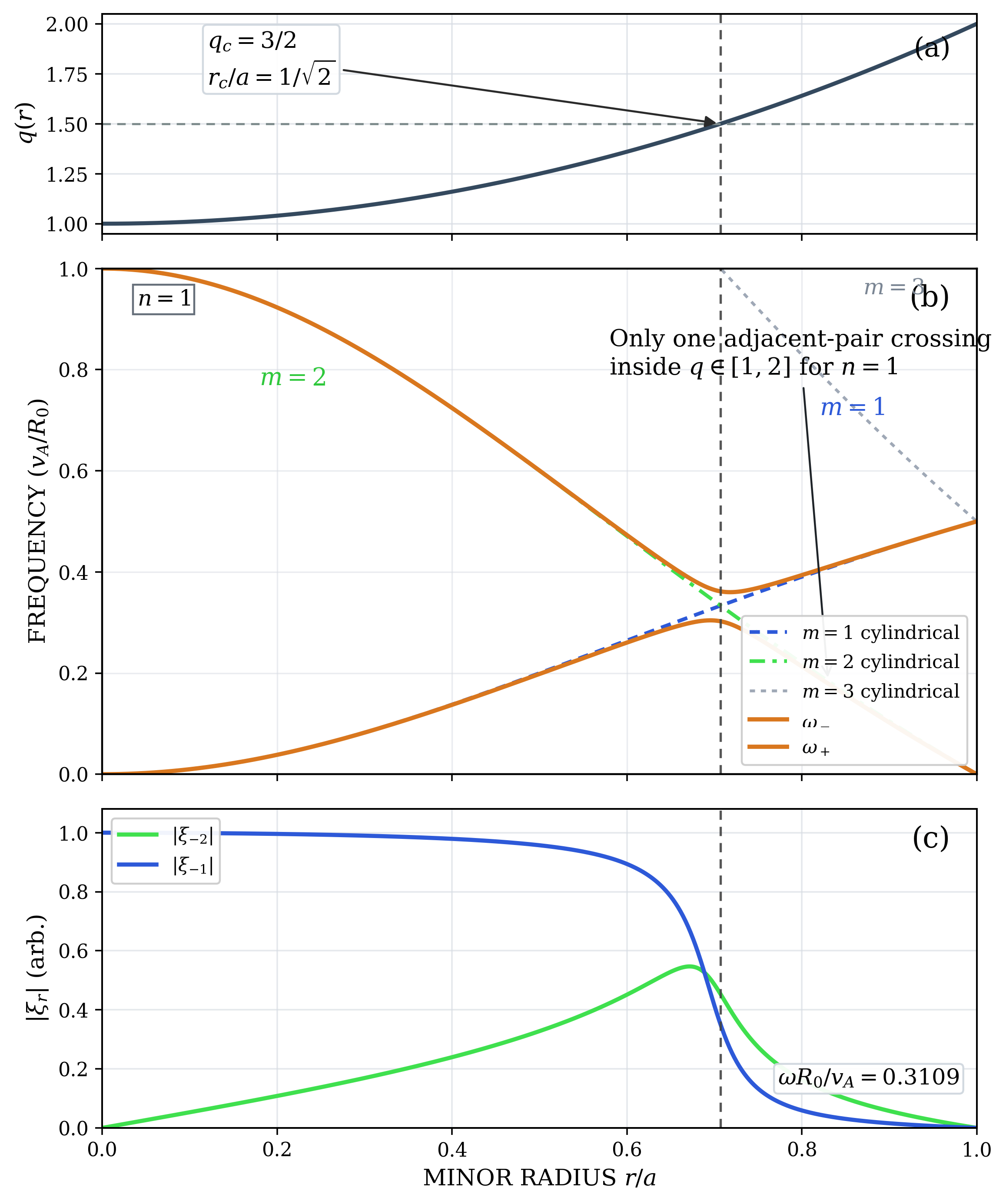
Figure 25.1 is organized around this same benchmark profile. Its top panel shows \(q(r)\), the middle panel shows
the local \(n=1\) continua, and the bottom panel shows the corresponding global eigenmode. A faint \(m=3\) cylindrical
branch is included in the continuum panel only to show that it remains far above the gap
frequency and therefore does not obviously threaten the benchmark mode with nearby continuum
damping.
Toroidal mode number is conserved.
Axisymmetry couples eigenfunctions with the same toroidal mode number \(n\). The basic TAE pair is
therefore
\[(m,n)=(-2,-1), \qquad (m+1,n)=(-1,-1), \tag{25.84}\]
At the crossing however the \(\Delta _m\), hence \(k_\parallel \) are of opposite signs.
Locate the uncoupled crossing.
The two cylindrical continuum branches cross when their local Alfvén frequencies are equal,
\[\omega _A^2\Delta _m^2=\omega _A^2\Delta _{m+1}^2. \tag{25.85}\]
The crossing relevant to a TAE has opposite parallel wave numbers, \[\Delta _m=-\Delta _{m+1}. \tag{25.86}\]
Using \(\Delta _m=n-m/q\), \[n-\frac {m}{q_c} = -\left (n-\frac {m+1}{q_c}\right ),\]
so \[q_c=\frac {m+\tfrac 12}{n}. \tag{25.88}\]
For \(m=-2\) and \(n=-1\), \[q_c=\frac 32. \tag{25.89}\]
With (25.83), \[\frac {r_c}{a} = \left (\frac {q_c-q_0}{q_a-q_0}\right )^{1/2} = \left (\frac {1.5-1}{2-1}\right )^{1/2} = \frac {1}{\sqrt {2}} \simeq 0.707. \tag{25.90}\]
At this radius, \[\Delta _{-2}(r_c)=-1+\frac {2}{1.5}=+\frac 13, \qquad \Delta _{-1}(r_c)=-1+\frac {1}{1.5}=-\frac 13. \tag{25.91}\]
Thus both branches satisfy the same continuum-resonance condition at the same radius when
\[\omega _0 = \omega _A(r_c)|\Delta _{-2}(r_c)| = \omega _A(r_c)|\Delta _{-1}(r_c)| = \frac {v_A(r_c)}{3R_0}. \tag{25.92}\]
This is the surface where toroidicity will open the gap.
The rational surfaces are nearby but different.
For the same profile,
\[\Delta _{-2}=0 \quad \Longleftrightarrow \quad q=2 \quad \Longrightarrow \quad \frac {r}{a}=1, \tag{25.93}\]
and \[\Delta _{-1}=0 \quad \Longleftrightarrow \quad q=1 \quad \Longrightarrow \quad \frac {r}{a}=0. \tag{25.94}\]
Those are the zero-frequency continuum points. The TAE crossing at \(r_c/a\simeq 0.707\) lies between them, where \(\Delta _{-2}\) and \(\Delta _{-1}\) have
opposite signs but equal magnitude.
State the local gap in the benchmark notation.
For \(q_c=3/2\),
\[\omega _0=\frac {v_A(r_c)}{3R_0}, \qquad \omega _\pm ^2=\omega _0^2(1\pm \epsilon _c), \qquad \epsilon _c=\frac {r_c}{R_0}=\frac {a}{\sqrt {2}R_0}. \tag{25.95}\]
Thus the local TAE gap opens around \(v_A/(3R_0)\) at the radius where \(q=1.5\). This is the simplest concrete example of the
continuum crossing becoming an avoided crossing. The top two panels of Fig. 25.1 summarize exactly this
benchmark construction.
Pose the global shooting problem directly.
The local determinant condition and the refined split branches have already been derived above. The next
step is simply to impose boundary conditions on the coupled radial operator (25.65) and solve for the
discrete frequencies \(\omega \) that admit nontrivial radial eigenfunctions.
Global eigenmodes from the shooting method.
The simplest successful gap-mode solve is the Fu–Van Dam example with
\[n=-1,\qquad m=-2,\qquad \epsilon =\frac {3a}{2R_0}=0.375,\qquad q(x)=1+x^2, \tag{25.96}\]
constant density, regularity at the magnetic axis, and a fixed conducting wall \[\xi _m(1)=0,\qquad \xi _{m+1}(1)=0. \tag{25.97}\]
Shooting the two regular axis solutions to the wall gives the eigenvalue \[\lambda = 0.09665780, \qquad \frac {\omega R_0}{v_A}=0.31089838. \tag{25.98}\]
At the continuum crossing \(q=3/2\), where \(x_c=\sqrt {1/2}\), this becomes \[\frac {\omega }{|k_{\parallel m}v_A|_{q=1.5}} = \frac {\omega R_0/v_A}{|\Delta _m(x_c)|} = 0.932695, \tag{25.99}\]
in agreement with the quoted Fu–Van Dam value \(0.93\). This is the first fully global demonstration in the notes
that the toroidicity-induced gap indeed supports a discrete eigenmode. The bottom panel of Fig. 25.1
shows the corresponding \(\xi _r\) eigenfunction.
Scope of the example.
This fixed-wall calculation is intentionally illustrative. It is performed in the same low-\(\beta \), pressure-free
shear-Alfvén limit used to derive the gap, so the pressure-gradient and compressibility terms have already
been dropped before the shooting problem is posed. It also keeps only the crossing pair \(m\) and \(m+1\). That is
enough to show that a finite set of coupled poloidal harmonics can form a discrete gap mode, but it should
not be read as a claim that a realistic tokamak TAE consists of only two harmonics. In more complete
calculations, additional sidebands and profile effects refine both the frequency and the mode
structure.
25.6 More complete multimode solutions
Why a radial problem is still necessary.
The local gap calculation gives the split continuum branches on each surface, but the discrete mode above
exists only because the coupled radial system (25.65) is solved with boundary conditions. After the
two-mode system is diagonalized locally, the envelope satisfies a bound-state problem of the schematic
form
\[\frac {d^2A}{dr^2}+k_r^2(r,\omega )A=0. \tag{25.100}\]
If \(k_r^2>0\) in some interval and \(k_r^2<0\) outside, the mode oscillates in the allowed interval and decays outside it. The
TAE is then trapped in a radial cavity.
How this emerges from the earlier local analysis.
The local two-by-two matrix in the gap section gives two surface-by-surface branches \(\omega _\pm (r)\). Equivalently, for a
fixed \(\omega \) it gives two local roots \(k_r^2(r,\omega )\) for the radial envelope problem. Near the gap center, diagonalizing
the coupled \((m,m+1)\) system therefore produces a single slowly varying branch on which the envelope
satisfies (25.100). In this sense the WKB cavity picture is not a new piece of physics; it is
the radial continuation of the same local avoided-crossing analysis that produced \(\omega _\pm (r)\) on each
surface.
Quantization of the cavity.
In a WKB treatment the bound-state condition is
\[\int _{r_1}^{r_2}k_r(r,\omega )dr \simeq \pi \left (\ell +\frac 12\right ), \qquad \ell =0,1,2,\ldots . \tag{25.101}\]
This is the step that converts the local gap into a discrete ladder of global eigenvalues.
At higher \(n\), one usually keeps a packet of neighboring harmonics.
The two-harmonic truncation is the cleanest way to exhibit one isolated TAE gap, but a more
complete high-\(n\) calculation usually keeps a band of harmonics around the dominant crossing,
\[\xi (r,\theta ,\varphi ) = e^{-in\varphi }\sum _{j=-M}^{M}\xi _{m_0+j}(r)e^{i(m_0+j)\theta }. \tag{25.102}\]
Each retained harmonic then satisfies a coupled radial equation of the form \[-\frac {d}{dr} \left [ f_m(r,\omega )\xi _m' + c_{m,m+1}(r,\omega )\xi _{m+1}' + c_{m,m-1}(r,\omega )\xi _{m-1}' \right ] + g_m(r,\omega )\xi _m =0, \tag{25.103}\]
where \(f_m\) and \(g_m\) are the one-harmonic Newcomb coefficients and the leading toroidal couplings are
nearest-neighbor derivative terms \[c_{m,m\pm 1}(r,\omega ) \sim -\,\epsilon (r)\frac {r^3B_0^2}{R_0^2} \frac {\Delta _m\Delta _{m\pm 1}}{m(m\pm 1)} . \tag{25.104}\]
The envelope becomes a banded matrix problem.
Collecting the retained amplitudes into \(\boldsymbol {\xi }(r)=(\ldots ,\xi _{m-1},\xi _m,\xi _{m+1},\ldots )^T\), the full radial system may be written schematically as
\[\frac {d}{dr} \left [ \bm {P}_{M}(r,\omega )\frac {d\boldsymbol {\xi }}{dr} \right ] - \bm {Q}_{M}(r,\omega )\boldsymbol {\xi } =0, \tag{25.105}\]
where \(\bm {P}_M\) is now tridiagonal or weakly banded rather than \(2\times 2\). For the simple toroidicity-induced TAE problem,
the dominant off-diagonal entries are still the \(m\leftrightarrow m\pm 1\) couplings already identified above.
The WKB picture generalizes directly.
If one inserts a slowly varying vector envelope,
\[\boldsymbol {\xi }(r) \simeq \mathbf {A}(r)\exp \!\left (i\int ^r k_r(r',\omega )\,dr'\right ), \tag{25.106}\]
then to leading order the multimode radial problem becomes \[\left [ k_r^2(r,\omega )\,\bm {P}_{M}(r,\omega ) + \bm {Q}_{M}(r,\omega ) \right ]\mathbf {A}(r) \simeq 0. \tag{25.107}\]
Thus the same local avoided-crossing logic survives, but it now produces a larger family of coupled radial
branches. The determinant of (25.107) supplies the local high-\(n\) continuum structure, while the turning
points and the cavity integral pick out the discrete global modes.
Higher-\(n\) sidebands are the practical complication.
Nothing in the numerical method is special to the \((m,m+1)=(-2,-1)\), \(n=-1\) benchmark. The same coupled \(\xi _r\) shooting problem can
be set up for larger harmonic packets. In practice, however, higher-\(n\) cases tend to bring more adjacent pairs
into the same frequency range, so the mode is less isolated and more vulnerable to continuum damping
through additional sidebands. That is a separate issue from the basic WKB quantization of one isolated
gap.
Why continuum damping is reduced but not banished.
If the eigenfrequency lies inside the gap over the region where the mode is localized, then the dominant
resonant condition \(D_m(r,\omega )=0\) is avoided in the core of the mode. The logarithmic singularity does not
appear there. But damping can still occur if the radial tails reach the continuum, if additional
couplings reconnect the mode to another branch, or if kinetic Alfvén-wave conversion, ion
Landau damping, electron Landau damping, or radiative damping is strong enough Rosenbluth
et al. (1992); Zonca and Chen (1993); Chen and Zonca (2016). A gap mode is best thought of as a mode
that has evaded the leading-order continuum resonance, not as a mode that has escaped all
dissipation.
The same physics as phase mixing.
The continuum can also be understood in initial-value language. If neighboring surfaces oscillate at slightly
different local frequencies,
\[\xi (r,t)\sim \xi _0(r)e^{-i\omega _A(r)t},\]
then \[\partial _r\xi \sim -it\,\omega _A'(r)\xi . \tag{25.109}\]
The radial gradient grows linearly in time, the perpendicular scale collapses, and the energy cascades
toward small scales until non-ideal physics dissipates or phase-mixes it away.
25.7 What other Alfvénic families teach us
TAEs are only the first gap family.
The TAE is the cleanest example because it is opened by the first toroidal harmonic and therefore by \(m\leftrightarrow m+1\)
coupling. But once one sees that logic, other families are almost inevitable. Ellipticity couples \(m\leftrightarrow m+2\) and
opens the EAE gap; higher-order shaping opens still higher gaps such as the NAE; reversed
shear can localize modes near \(q_{\min }\), producing RSAEs; and finite compressibility together with
geodesic curvature opens the low-frequency BAE gap Betti and Freidberg (1991); Heidbrink
et al. (1993, 1999); Kramer et al. (1998); Edlund et al. (2010); Gorelenkov et al. (2007); Chen and
Zonca (2016).
RSAEs as a simple example of current-profile sensitivity.
Near a minimum of the safety factor profile,
\[q(r)=q_{\min }+\frac 12 q_0''(r-r_0)^2+\cdots , \tag{25.110}\]
so \[k_{\parallel m}(r) = \frac {1}{R_0}\left (n-\frac {m}{q(r)}\right ) \simeq k_{\parallel 0}+\alpha (r-r_0)^2+\cdots . \tag{25.111}\]
If \(nq_{\min }\) is near an integer \(m\), then \(k_{\parallel 0}\) is small and the mode can localize near \(r_0\). As the current profile evolves
and \(q_{\min }\) changes, the frequency chirps. This is why RSAEs became such a useful spectroscopic
signature of current-profile evolution in advanced tokamak scenarios Edlund et al. (2009); Kramer
et al. (2004); Edlund et al. (2010); Heidbrink et al. (2013).
25.8 Energetic-particle drive and experimental importance
Why energetic particles couple so easily.
The simplest passing-particle resonance is
\[\omega \simeq k_\parallel v_\parallel , \tag{25.112}\]
which already explains why neutral-beam ions and fusion alphas are such effective drivers of TAEs: the
phase velocity of the mode is of order \(v_A\), and fast ions often satisfy \(v_\parallel \sim v_A\). In a more faithful toroidal description
one resolves transit, bounce, and drift frequencies, leading schematically to resonances of the form
\[\omega -n\omega _\phi -\ell \omega _b\simeq 0, \tag{25.113}\]
where \(\ell \) labels the relevant orbital harmonic.
Drive versus damping.
A convenient bookkeeping formula is
\[\gamma =\frac {P_h-P_d}{2W}, \tag{25.114}\]
where \(W\) is the mode energy, \(P_h\) is the power transferred from energetic particles to the wave, and \(P_d\) is the sum
of damping channels. This formula is schematic, but it captures the physics. Geometry determines whether
a weakly damped gap mode can exist at all; the fast-ion distribution and the non-ideal damping
mechanisms determine whether that mode is actually unstable.
What experiments actually care about.
In experiments, AE physics matters because it affects fast-ion confinement. The earliest observations of
beam-driven TAEs on TFTR made that point clearly Wong et al. (1991). DIII-D then provided a
particularly important experimental thread: beam-driven Alfvén instabilities were characterized in detail,
beta-induced Alfvén eigenmodes were identified, and reversed-shear cases showed that Alfvénic activity
can flatten the fast-ion profile Heidbrink et al. (1991, 1993, 2008). Since then the subject has broadened
from “Can one see the mode?” to “How much does it redistribute fast ions, flatten pressure profiles, or
cause losses?” In present-day devices that question is tied directly to heating efficiency, current drive, and
burning-plasma performance Fasoli et al. (2007); Heidbrink (2008); Lauber (2013); Heidbrink and
White (2020).
Takeaways
The shear-Alfvén continuum and the TAE gap are two outputs of the same variational
ideal-MHD framework. In the cylindrical Newcomb problem, the wave functional
contains the coefficient \(\mathcal {A}_m=\mu _0\rho (\omega _{A,m}^2-\omega ^2)\). Where this coefficient vanishes, the highest radial derivative
vanishes and the ideal solution becomes logarithmically singular. In a torus, the \(\cos \theta \) variation
of the metric couples neighboring poloidal harmonics with the same \(n\). At the place where
\(\Delta _m=-\Delta _{m+1}\), the two continuum branches would cross in a cylinder; toroidicity splits them and opens
the TAE gap.
The lecture can be condensed into six statements.
-
1.
- The local shear-Alfvén branch is \(\omega ^2=k_\parallel ^2v_A^2\), with \(k_{\parallel m}=\Delta _m/R_0\).
-
2.
- The Newcomb wave equation is singular where \(\mathcal {A}_m=0\), equivalently where \(D_m=\omega ^2-\omega _A^2\Delta _m^2=0\).
-
3.
- Near a simple resonant surface, \(\xi _m=C_0+C_1\ln |r-r_A|\).
-
4.
- The basic TAE pair has the same toroidal mode number \(n\) and neighboring poloidal
mode numbers \(m\) and \(m+1\).
-
5.
- The crossing condition is \(q_c=(m+1/2)/n\), or \(q_c=3/2\) for the Fu–Van Dam pair \(m=-2,-1\), \(n=-1\).
-
6.
- Toroidicity converts that crossing into the split branches \(\omega _\pm ^2=\omega _0^2(1\pm \epsilon _c)\) at leading order.
Bibliography
William A Newcomb. Hydromagnetic stability of a diffuse linear pinch. Annals of Physics, 10(2):232–267, 1960. doi:10.1016/0003-4916(60)90023-3.
C. E. Kieras and J. A. Tataronis. The shear Alfv\'en continuous spectrum of axisymmetric toroidal equilibria in the large aspect ratio limit. Journal of Plasma Physics, 28(3):395–414, 1982. doi:10.1017/S0022377800000386.
C. Z. Cheng, L. Chen, and M. S. Chance. High-n ideal and resistive shear Alfvén waves in tokamaks. Annals of Physics, 161:21–47, 1985. doi:10.1016/0003-4916(85)90335-5.
C. Z. Cheng and M. S. Chance. Low-n shear Alfvén spectra in axisymmetric toroidal plasmas. Journal of Computational Physics, 71:124–153, 1987. doi:10.1016/0021-9991(87)90023-4.
G. Y. Fu and J. W. Van Dam. Excitation of the toroidicity-induced shear Alfvén eigenmode by fusion alpha particles in an ignited tokamak. Physics of Fluids B, 1(10):1949–1952, 1989. doi:10.1063/1.859057.
K. L. Wong, R. J. Fonck, S. F. Paul, D. R. Roberts, E. D. Fredrickson, R. Nazikian, M. G. Bell, N. Bretz, C. E. Bush, Z. Chang, et al. Excitation of toroidal Alfvén eigenmodes in tftr. Physical Review Letters, 66:1874–1877, 1991. doi:10.1103/PhysRevLett.66.1874.
W. W. Heidbrink, E. J. Strait, E. Doyle, G. Sager, and R. T. Snider. An investigation of beam driven Alfv\'en instabilities in the DIII-D tokamak. Nuclear Fusion, 31(9):1635–1648, 1991. doi:10.1088/0029-5515/31/9/002.
A. D. Turnbull, E. J. Strait, W. W. Heidbrink, M. S. Chu, H. H. Duong, J. M. Greene, L. L. Lao, T. S. Taylor, and S. J. Thompson. Global Alfv\'en modes: Theory and experiment. Physics of Fluids B, 5(7):2546–2553, 1993. doi:10.1063/1.860742.
H. L. Berk, J. W. Van Dam, Z. Guo, and D. M. Lindberg. Continuum damping of low-n toroidicity-induced shear Alfvén eigenmodes. Technical report, Institute for Fusion Studies, The University of Texas at Austin, 1991.
R. R. Mett and S. M. Mahajan. Kinetic theory of toroidicity-induced Alfvén eigenmodes. Physics of Fluids B, 4(9):2885–2893, 1992. doi:10.1063/1.860459.
A. Fasoli, C. Gormenzano, H. L. Berk, B. N. Breizman, S. Briguglio, D. S. Darrow, et al. Progress in the iter physics basis—chapter 5: Physics of energetic ions. Nuclear Fusion, 47:S264–S284, 2007. doi:10.1088/0029-5515/47/6/S05.
P. Lauber. Super-thermal particles in hot plasmas—kinetic models, numerical solution strategies, and comparison to tokamak experiments. Physics Reports, 533:33–68, 2013. doi:10.1016/j.physrep.2013.07.001.
L. Chen and F. Zonca. Physics of alfv\'en waves and energetic particles in burning plasmas. Reviews of Modern Physics, 88:015008, 2016. doi:10.1103/RevModPhys.88.015008.
W. W. Heidbrink. Basic physics of Alfv\'en instabilities driven by energetic particles in toroidally confined plasmas. Physics of Plasmas, 15(5):055501, 2008. doi:10.1063/1.2838239.
W. W. Heidbrink and R. B. White. Mechanisms of energetic-particle transport in magnetically confined plasmas. Physics of Plasmas, 27(3):030901, 2020. doi:10.1063/1.5136237.
M. N. Rosenbluth, H. L. Berk, J. W. Van Dam, and D. M. Lindberg. Continuum damping of high-mode-number toroidal Alfv\'en waves. Physical Review Letters, 68(5):596–599, 1992. doi:10.1103/PhysRevLett.68.596.
Fulvio Zonca and Liu Chen. Theory of continuum damping of toroidal Alfv\'en eigenmodes in finite-$ $ tokamaks. Physics of Fluids B: Plasma Physics, 5(10):3668–3690, 1993. doi:10.1063/1.860839.
R. Betti and J. P. Freidberg. Ellipticity induced Alfvén eigenmodes. Physics of Fluids B, 3(8):1865–1871, 1991. doi:10.1063/1.859655.
W. W. Heidbrink, E. J. Strait, M. S. Chu, and A. D. Turnbull. Observation of beta-induced Alfv\'en eigenmodes in the DIII-D tokamak. Physical Review Letters, 71(6):855–858, 1993. doi:10.1103/PhysRevLett.71.855.
W. W. Heidbrink, E. Ruskov, E. M. Carolipio, J. Fang, M. A. Van Zeeland, and R. A. James. What is the ``beta-induced Alfv\'en eigenmode?''. Physics of Plasmas, 6(4):1147–1161, 1999. doi:10.1063/1.873359.
G. J. Kramer, M. Saigusa, T. Ozeki, L. Chen, C. Z. Cheng, Y. Kusama, K. Tobita, M. Nemoto, and the JT-60 Team. Noncircular triangularity and ellipticity-induced Alfvén eigenmodes observed in jt-60u. Physical Review Letters, 80:2594–2597, 1998. doi:10.1103/PhysRevLett.80.2594.
E. M. Edlund, M. Porkolab, G. J. Kramer, L. Lin, Y. Lin, N. Tsujii, and S. J. Wukitch. Experimental study of reversed shear Alfvén eigenmodes during the current ramp in the alcator c-mod tokamak. Technical report, Princeton Plasma Physics Laboratory, 2010. PPPL-4544.
N. N. Gorelenkov, H. L. Berk, E. D. Fredrickson, and S. E. Sharapov. Predictions and observations of low-shear beta-induced shear alfv\'en–acoustic eigenmodes in toroidal plasmas. Physics Letters A, 370(1):70–75, 2007. doi:10.1016/j.physleta.2007.05.113.
E. M. Edlund, M. Porkolab, G. J. Kramer, L. Lin, N. Tsujii, and S. J. Wukitch. Observation of reversed shear Alfvén eigenmodes during the sawtooth cycle in alcator c-mod. Physical Review Letters, 102:165003, 2009. doi:10.1103/PhysRevLett.102.165003.
G. J. Kramer, N. N. Gorelenkov, C. Z. Cheng, and R. Nazikian. Finite pressure effects on reversed shear Alfvén eigenmodes. Technical report, Princeton Plasma Physics Laboratory, 2004. PPPL-4002.
W. W. Heidbrink, M. E. Austin, D. A. Spong, B. J. Tobias, and M. A. Van Zeeland. Measurements of the eigenfunction of reversed shear Alfv\'en eigenmodes that sweep downward in frequency. Physics of Plasmas, 20(8):082504, 2013. doi:10.1063/1.4817950.
W. W. Heidbrink, M. A. Van Zeeland, M. E. Austin, K. H. Burrell, N. N. Gorelenkov, G. J. Kramer, Y. Luo, M. A. Makowski, G. R. McKee, C. Muscatello, R. Nazikian, E. Ruskov, W. M. Solomon, R. B. White, and Y. Zhu. Central flattening of the fast-ion profile in reversed-shear DIII-D discharges. Nuclear Fusion, 48(8):084001, 2008. doi:10.1088/0029-5515/48/8/084001.
Guided Exercises
Work through the steps in order. The aim is not only to obtain the stated result, but also to check a useful
limit and explain the physics in words.
Problem 25.1. From the energy principle to a continuum singularity
-
(a)
- Vary \(\mathcal L_m=\frac 12\int (f_m|\xi _m'|^2+g_m|\xi _m|^2)\,dr\) and derive Eq. (25.32). Retain the boundary term and identify the fixed and natural
boundary conditions.
-
(b)
- Starting from Eq. (25.44), derive the wave equation (25.48). Identify the coefficient that vanishes
at a continuum resonance and connect it to the local shear-Alfvén dispersion.
-
(c)
- Let \(\mathcal A_m\simeq \mathcal A'_{mA}(r-r_A)\). Derive the logarithmic singularity (25.54) and show why the \(|\xi _m|^2\) term is subdominant in the
leading local balance.
-
(d)
- Explain what boundary or coupling physics would be required for a regular discrete mode to
avoid this singularity.
Problem 25.2. Opening and estimating the toroidicity-induced gap
Use the Fu–Van Dam example with \(q(r)=1+r^2/a^2\).
-
(a)
- Compute the \(m=-2\) and \(m=-1\) rational surfaces and the TAE crossing radius. Explain why the three radii
are different.
-
(b)
- Starting from Eq. (25.74), derive the determinant condition (25.75) and the avoided-crossing
frequencies (25.76).
-
(c)
- For \(m=-2,-1\), \(n=-1\), and \(a/R_0=1/3\), estimate \(\epsilon _c\), \(\omega _0\), and the leading gap width \(\Delta \omega \) in units of \(v_A/R_0\).
-
(d)
- Check that the gap closes as \(a/R_0\to 0\), and explain why this is the cylindrical limit.
Problem 25.3. When a gap eigenmode is observable
-
(a)
- Use Eq. (25.114) to list the principal drive and damping contributions with their expected
signs.
-
(b)
- Predict qualitatively how increasing beam power, electron temperature, and magnetic shear
affects the observability of a TAE. State any profile assumptions behind each prediction.
-
(c)
- Explain why localization inside the principal gap reduces, but need not eliminate, continuum
damping from additional poloidal harmonics at higher toroidal mode number.